
Urban Transformation in Calarasi
120 km away from Bucharest we have the city of Calarasi, the seat of the eponymous county
Steliu Lambru, 28.02.2022, 22:47
Local history is as attractive as any, because it captures the lives of people in a given areas, both in terms of the collective mentality and the specificity of that area. 120 km away from Bucharest we have the city of Calarasi, the seat of the eponymous county. It has a population of only 65,000. It is situated on the left bank of the Borcea branch of the Danube river, which veers off around the area where the Bulgarian city of Silistra lies. Some of the notable people born here are physician and historian Pompei Samarian, writer Stefan Banulescu, historian Nicolae Banescu, actor Stefan Banica, and politician Mircea Ciumara.
This city had a certain importance before the 19th century. During the reign of Prince Mircea the Old, in late 14th and early 15th centuries, Calarasi is documented as being a postal station at the Danube crossing going to the fort of Durostorum, present day Silistra. Medieval documents speak about two names that the city had had. One is Lichiresti, which, during the reign of Michael the Brave, in late 16th century, was the moniker of people in the town. The second name, used at the present, means military horse riders guarding the crossing point over the Danube, defending the correspondence line to the capital Bucharest. In 1734, the village grew in importance, and is documented as a market town, dealing in agriculture and trade.
Between 1812 and 1828, Calarasi endured the hardship of the Russian-Turkish war, and of two harsh plague and cholera epidemics. In 1833, Calarasi became the seat of the county of Ialomita, which meant a bout of development. In 1852, during the reign of Prince Barbu Stirbey, the city bought back the land it lay on, and became a free city. The reign of Stirbey brought with it a new urban plan for the city, which meant a gridwork of parallel streets and a boulevard. Like all Romanian city, Calarasi had accelerated development after the foundation of the Old Kingdom, in 1859, as well as after it gained independence from the Ottomans in 1877, and after WWI.
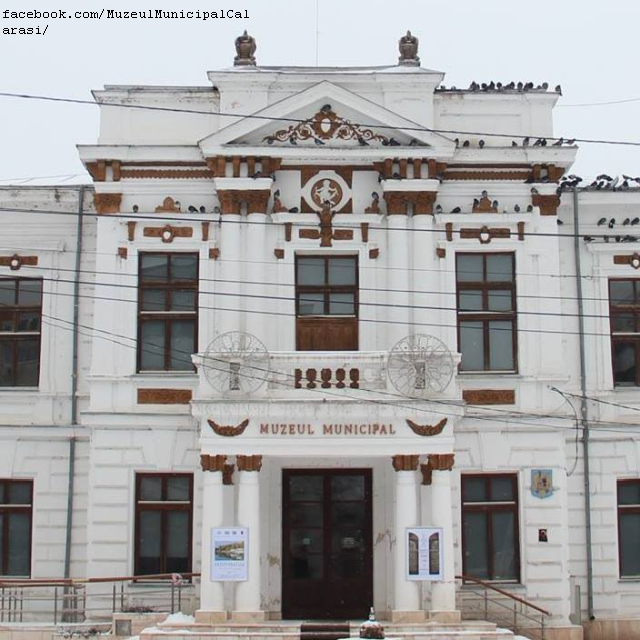
Development continued in the 20th century. The most important transformation was the demolitions of the 1980s, which led to the loss of the old center of town, with the exception of a single building, the old town hall, which now houses the Calarasi Municipal Museum. We talked about the demolitions with museographer Florin Radulescu:
“That was a complex phenomenon, it started with the Ribbentrop-Molotov pact. It was then that the persecution of Jewish people started in earnest. The central area of Calarasi was owned largely by that community. They had shops on the ground floor and homes on the second floor, some rented, some owned. This led to the first wave of emigration, the Jewish people left. In the Black Book of atrocities committed against the Jews, published in 1946, we can read about the nefarious contracts that the people in power signed with Jewish people, becoming co-owners, with an overwhelming ownership percentage. As the Jewish people left, the co-owners became full owners.”
After 1945, as politics changed, so did the situation on the ground. Here is Florin Radulescu:
“A change of regime came, the communists grabbed power. Houses were nationalized, at least in part. Others were just seized non-legally. The main institutions of the state took root in these central houses, where our museum is. I found in the US Library of Congress a phonebook from 1959, and on November 7 Street we find all the institutions. At some point, each institution built their headquarters, and these houses were left to rot. All these houses gradually became dilapidated.”
The historic center of Calarasi gradually degraded, against the growing poverty of an entire era. The solution of demolition was hastened by a natural phenomenon: the grand earthquake of March 4, 1977. Here is Florin Radulescu:
“Testimony from people who lived through those times say that many buildings had leaking roofs, had rats, were so insalubrious that they became unusable. In other words, it would have taken a lot of money to make them usable. Based on that, and on the wish of the regime to build new things, demolitions became feasible. Here, in the center of town, two blocks of flats were put up for English experts that came to help build two plants, one for making cellulose and paper, the other for making construction materials. For a very long time, in the area where the superstore was built, there was an old building known as the English Club, because it was frequented by the English. Then came the earthquake of 1977, which weakened all these buildings, and that is when the demolitions came. And this is how this building where our museum is came to be consolidated, and is still standing.”
The urban transformation of Calarasi had a few major moments, but the most impactful were in the 20th century.


























