RRI Live!

Listen to Radio Romania International Live

The new academic year

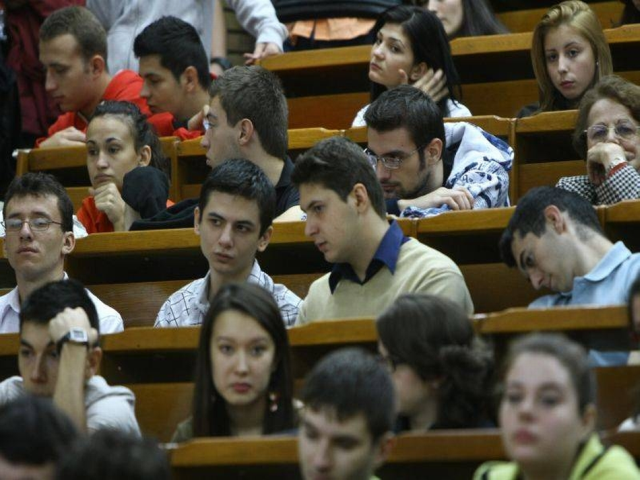
The new academic year begins in Romania on 1st of October.
The new academic year

, 01.10.2014, 12:40

October 1st, the day of the year when classes start in universities, is a time for novelty and a time for tallying up the past, especially since the University of Bucharest celebrates 150 years of existence. After 1989, higher education has also been provided by private institutions, in addition to the numerous state schools in the country. We spoke about higher education in Romania with Marian Staş, who teaches both at Harvard University and the University of Bucharest. We asked him if the level of quality in private and state-run universities is the same:


“The short answer is ‘no’, for at least two significant reasons. The University of Bucharest was founded 150 years ago, while private universities in Romania were only created 15 or 20 years ago. Secondly, there is a fear among the public that private schools are diploma-making factories, rather than schools where students learn. Also, there are reports that some students from private universities can actually pay to pass their exams and get their diplomas. On the other hand, this also happens in state universities. There are, however, good teachers and students in private schools, as well. If we look at figures, private education accounts for 3 to 5% of the entire education system in Romania, which is very low.”


As for the novelties introduced this year, the government issued an emergency executive order operating changes in the Law of Education. For example, if so far doctoral programmes implied full-time attendance, from now on they only require part-time attendance. Another change refers to the creation of tertiary colleges in universities. These provide courses for high school graduates who have failed their baccalaureate exams. This also allowing those who are university material to train for some other type of post-high school education. In recent year, only 40 to 50% of high school students passed their baccalaureate exam, which is a condition for going to university. Marian Stas explains:


“When in 2011 less than 50% of high school students passed the baccalaureate, that drastically reduced the pool of potential university students. Along the years, universities have prepared to take in more and more students, and suddenly there were too few. Another problem for universities is the quality of high school education. Young people who finish high school and pass the baccalaureate exam not always have the level of training required by universities.”


We asked Marian Stas if, in his opinion, these post-high school colleges will address the problem:


“It is definitely not a bad idea to have university teachers train these children. While it’s a good thing to have people who are willing to do this, this is not the purpose of a university. Universities should be focused on abstraction and intellectual constructs, not teaching practical skills, which should be taught by post-high school education. I’m curious to see the first generation of young people trained by these tertiary colleges and how they will cope with being at university. I am sounding the alarm here, because the framework methodology is insufficiently detailed and leaves room for arbitrary interpretation. Thus, young people who are not sufficiently trained may be facilitated access to universities.”


Young people wishing to enlist for these colleges may do so as of this year, as the government has asked universities to put together lists of degrees and curricula by October 20th. So far, several state and private universities have announced their availability for setting up such colleges. However, you will not find among them the most prestigious schools, such as the University of Bucharest, the University of Cluj, the University of Iasi and the Bucharest Technical University.
Who keeps culture alive?
Society Today Wednesday, 01 July 2026

Who keeps culture alive?

Despite insufficient resources, the Romanian artistic community continues to make itself known at the European level. For example, Banffy Castle in...

Who keeps culture alive?
photo: pixabay.com
Society Today Wednesday, 24 June 2026

The ROBOR index: an apple of discord

Although among the poorest citizens in the European Union, Romanians pay much higher interest rates for consumer loans or mortgages than other...

The ROBOR index: an apple of discord
Photo: Thomas Park / unsplash.com
Society Today Wednesday, 17 June 2026

Society Today

How much time does a child have left for themselves after school ends? That is the question behind a new survey conducted by Save the Children...

Society Today
Photo: Jon Tyson unsplash.com
Society Today Wednesday, 10 June 2026

Can poverty be eradicated?

One in five citizens in the European Union is experiencing poverty. That is why the European Commission proposed at the beginning of May a strategy...

Can poverty be eradicated?
Society Today Wednesday, 27 May 2026

A survey of poverty in Romania

More than a quarter of Romanians are at risk of poverty and social exclusion, making them, along with Bulgarians and Greeks, the most exposed in the...

A survey of poverty in Romania
Society Today Wednesday, 20 May 2026

The shifting labor market: balancing paychecks and personal life

The Romanian labor market is undergoing a period of swift transformation, driven by economic uncertainty, the rising costs of living and...

The shifting labor market: balancing paychecks and personal life
Society Today Wednesday, 13 May 2026

The “Seasonal Workers” campaign and the situation of Romanian farm workers in Austria

In Austria,  Romania ranks among the main countries of origin for immigrants there—second only to Germany and ahead of Bosnia and Herzegovina. For...

The “Seasonal Workers” campaign and the situation of Romanian farm workers in Austria
Society Today Wednesday, 06 May 2026

Important changes in the Romanian labour market

  Over the past 10 years, the number of foreign workers newly admitted into the Romanian labour market has soared from 5,500 in 2015 and 2016,...

Important changes in the Romanian labour market

Partners

Muzeul Național al Țăranului Român Muzeul Național al Țăranului Român
Liga Studentilor Romani din Strainatate - LSRS Liga Studentilor Romani din Strainatate - LSRS
Modernism | The Leading Romanian Art Magazine Online Modernism | The Leading Romanian Art Magazine Online
Institului European din România Institului European din România
Institutul Francez din România – Bucureşti Institutul Francez din România – Bucureşti
Muzeul Național de Artă al României Muzeul Național de Artă al României
Le petit Journal Le petit Journal
Radio Prague International Radio Prague International
Muzeul Național de Istorie a României Muzeul Național de Istorie a României
ARCUB ARCUB
Radio Canada International Radio Canada International
Muzeul Național al Satului „Dimitrie Gusti” Muzeul Național al Satului „Dimitrie Gusti”
SWI swissinfo.ch SWI swissinfo.ch
UBB Radio ONLINE UBB Radio ONLINE
Strona główna - English Section - polskieradio.pl Strona główna - English Section - polskieradio.pl
creart - Centrul de Creație Artă și Tradiție al Municipiului Bucuresti creart - Centrul de Creație Artă și Tradiție al Municipiului Bucuresti
italradio italradio
Institutul Confucius Institutul Confucius
BUCPRESS - știri din Cernăuți BUCPRESS - știri din Cernăuți

Affiliates

Euranet Plus Euranet Plus
AIB | the trade association for international broadcasters AIB | the trade association for international broadcasters
Digital Radio Mondiale Digital Radio Mondiale
News and current affairs from Germany and around the world News and current affairs from Germany and around the world
Comunità radiotelevisiva italofona Comunità radiotelevisiva italofona

Providers

RADIOCOM RADIOCOM
Zeno Media - The Everything Audio Company Zeno Media - The Everything Audio Company