Women’s Health and Domestic Violence
Bona Dea project promotes women's health and safety
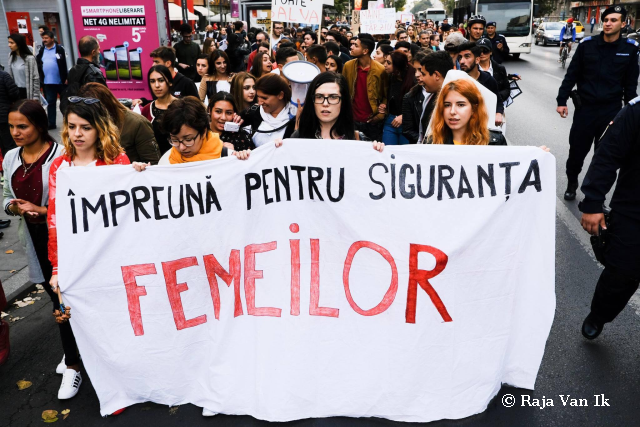
Christine Leșcu, 11.09.2019, 13:16
In Romania, information on womens health and measures against domestic violence have a hard time reaching the people directly interested in them. Statistics exist on the effects of the lack of information. For instance, one in five women have never been to the doctor for a check-up, and 20% of pregnant women never went to the doctor during their pregnancy. As many as 10% of mothers who give birth in the country are minors, while Romania ranks among the countries with the highest incidence of breast and cervical cancer. In order to address the situation, a feminist organization Filia Center has come up with a project called Bona Dea, promoting womens health and safety. Andreea Rusu, representing Filia Center, took part in the project, and told us about their aims and what they have achieved since last August:
Andreea Rusu: “With this project, we wanted to provide women with a safe space where they could talk about their issues, but also get useful information from experts. We went to 18 village clusters where we talked about maternal health and breastfeeding, about preventing breast and cervical cancer, and about preventing and combating violence against women. We also went to 6 cities, where we talked on the same topics, adding to these labour market discrimination against women and combating sexual harassment. In six months, we met with around 1,700 women, and travelled 11,000 km to get to 85 meetings. Unfortunately, we noticed that lack of information is rampant not only in rural, underdeveloped areas, but also in cities. For instance, Romania ranks very low in the EU in terms of prevention of breast and cervical cancer. We rank first in the number of deaths caused by this type of cancer. This also happens because women dont know how to identify the early signs for this disease.”
As part of the Bona Dea project, representatives of the Filia Center were able to confirm the statistics, and to understand the mentality and customs behind them.
Andreea Rusu: “In Romania, we still have this idea of not talking about sexuality, or contraception, or even sex education. That is taboo. This happens although, according to UNICEF, the average age people start their sex lives at is 15 and a half. However, many women lack access to information. For instance, many dont know what an ectopic pregnancy is. Best case scenario, they heard someone else had it and got scared. They dont understand why they have to go to the doctor during pregnancy. A lot of times, they see it as a luxury and dont understand that the health of the baby depends on medical check-ups. They hide behind some myths.”
This may be precisely why the first such contacts under the Bona Dea contract were more difficult, as recalled by another participant in the program, Elena Samoila:
Elena Samoila: “Women were very reluctant at first. This was my impression… everything seemed strange to them, they didnt know us… they didnt know what to expect, and why they would have to take time out of their day to come to our meetings. However, after the first meeting, the one on maternal health and breastfeeding, we saw that they were interested in getting informed. Which is why they came back, they asked questions, and were very active in our discussions.”
Andreea Rusu told us that they had a very different experience with local administrators and police:
Andreea Rusu: “Unfortunately, sometimes the authorities are either incompetent, or ill-willed. On the bright side, we met some extraordinary people too: social workers or health workers, who go out into the community every day, who know peoples problems, and know how to help them. We met some extraordinary women in the police, who were really getting involved. It is true that we have had some ugly interactions with the authorities, but they pale in comparison to the good experiences, learning experiences for us.”
Local police involvement is crucial in enforcing legislation against domestic violence. In Romania, one in four women is physically or sexually assaulted by their partner or former partner. Over 20,000 cases of battery or other kinds of violence among family members were filed with the police in 2017, and the situation improved in July 2018, when legislation on restraining orders came into effect, called provisional protection in Romania. 150 such orders were issued within 10 days of the law being introduced. Andreea Rusu told us that the first hurdle is the fact that the authorities themselves have to get used to this situation:
Andreea Rusu: “If among the authorities the mentality persists that a womans place is in the home, where she has to clean and raise the kids, then the information that they have to disseminate is distorted. If a police agent believes that a woman deserves a beating for failing to clean up the house, then it stands to reason that they would not issue a restraining order, and would not protect her rights.”
Elena Samoila picks up from there:
Elena Samoila: “Clearly a woman suffering domestic violence will not have the courage to complain to a police agent, to get the protection she is entitled to. This restraining order legislation was introduced so that a police agent can issue it on the spot, by filling in a form. With this order, the aggressor can be removed from the premises for up to five days. In this time, the victim has the possibility to initiate court proceedings and get an extension from the court.”
The Bona Dea project started in the summer of last year, and will be completed at the end of this month, when the representatives of Filia Center hope to register a drop in the lack of information.
(translated by: Calin Cotoiu)