Major discovery made by NASA
A discovery that could change the very foundations of research on outer space.
Corina Cristea, 18.08.2017, 13:23
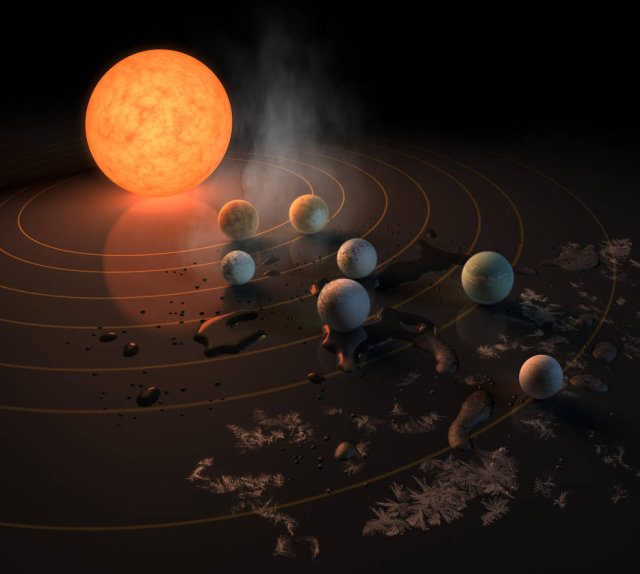
NASA has announced a major breakthrough: it discovered Earth-like habitable planets orbiting a remote star. The seven exoplanets make up a system which is at least one billion years old, which orbits an ultra-cool, low-density dwarf star, called TRAPPIST-1, located at 40 light years away in the Aquarius constellation. The star has 8% of the Suns diameter, and, according to researchers involved in the project, the proximity of the system and the considerable size of the seven exoplanets, as compared to the size of the dwarf star Trappist-1, have turned the new celestial formation into the favourite subject of future research. According to astronomer Nikole Lewis, from the Space Telescope Science Institute, TRAPPIST-1 gives us the unique chance to study the atmosphere of Earth-sized planets over the following years. Romanian science journalist Alexandru Mironov has more on the significance of this discovery:
“It is a long-awaited moment for the science world, as well as for the world of imagination-it is proof that the Universe is the same everywhere. That is… there are stars and planets orbiting the stars, planets of various sizes, revolving around stars of various sizes and that many of them are Earth-like, in terms of characteristics and chances to sustain life. So, it is a moment when we start asking ourselves whether or not our descendants will truly try to step out of the solar system. It is equally a moment which changes the mentality of human society, because if we start thinking beyond the limits of our solar system, we should really take a first step here, in the solar system. Just imagine that in a relatively short time span, of 15-20 years, people will have already set foot on Mars and will have started colonising the planet. It will mark the inception of travels to the Moon and of economic adventures looking for us there. The discovery does not produce an immediate economic effect, but, as weve said earlier, there will be a drastic change in mentality after that. From now on, nobody can believe the Earth is unique in the Universe. The Universe looks like the cosmos featured in the equations of mathematicians, astrophysicists and cosmology experts.
Given their density, the planets seem to have rocky compositions. Experts recall that water is the key life-sustaining element on Earth, which is why all research on Trappist focuses on water as a starting point. Researchers have labelled the discovery as an important puzzle piece when talking about life-sustaining environments, and are due to determine whether the planets are capable of supporting liquid water on their surface. For the time being, what is certain is that the exoplanets are far enough from the sun to have water, while three of them have the potential of supporting lifeforms. Here is Alexandru Mironov again.
“NASA hasnt gone public with this research, but its clear they have divided the sky in areas they study separately, astronomers working in Atacama, Chile, studying different promising areas. Well, 40 light-years away theres this star that has all these features, and its a big possibility that three of these seven planets could sustain life. The type of lifeforms it has, we do not yet know, but they are definitely carbon-based, this is my opinion.
The first exoplanet, 51 Pegasi B, was discovered in 1995 by Swiss astronomers. Since then, NASA has confirmed the existence of another 3,500 exoplanets in the Universe. Last year alone a planet similar to Earth was found in the Proxima Centauri galaxy, 4.24 light-years away. What makes TRAPPIST 1 so special then? It is the first time a large number of Earth-like planets are discovered orbiting around the same star. What can we expect from now on? Alexandru Mironov told us.
“We should expect a series of extraordinary events. Lets not forget that six months ago the world witnessed the re-discovery, so to say, of gravitational waves by the LIGO system in the US. That means we will soon have the capacity to build new telescopes using this new technology. And that, in turn, will provide us with a new way of looking at the universe, apart from light, infrared, X and gamma rays. We already know a great deal about the Universe, but theres a lot more we can learn. We now have equipment orbiting the Earth, on the Moon or on Mars or orbiting Mars. We are making new advancements every day. We are gradually turning from Homo sapiens into Homo cosmicus. Whatever its consequences, the discovery of life-sustaining planets brings us one step closer to answering the question on everyones lips: are we alone in the universe? (Translated by D. Vijeu and V. Palcu)