Tatiana Tibuleac Wins the EU Prize for Literature
Tatiana Tibuleac has been decorated by Romanian President Klaus Iohannis with the Cultural Merit in rank of Knight
Corina Sabău, 01.08.2020, 14:20
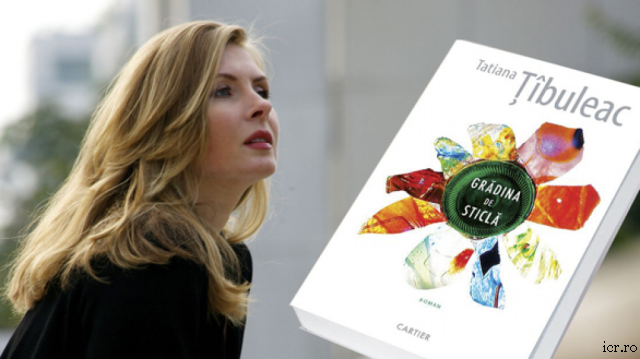
Tatiana Tibuleac has been decorated by Romanian President Klaus Iohannis with the Cultural Merit in rank of Knight, awarded to coincide with Romanias National Day. She was given the distinction in appreciation for her important activity in literary creation, and for the talent and professionalism she showed along her career, which gained her recognition at the European level. She is originally from the Republic of Moldova, and used to work as a journalist. In 2019, Tatiana Tibuleac was one of the 14 winners of the EU Prize for Literature, a prize given out in October 2019 in a ceremony at the Bozar Palace in Brussels. The Glass Garden, the novel that won Tatiana the award, is, according to critic Simona Sora, in several ways the novel of a whole generation of women, and of a storyteller that is as authentic as she is surprising. We met Tatiana at the conference The Power of Storytelling in October 2019, and talked to her about writing, about languages, about Chisinau, and about Paris, the city she calls home now. We also spoke to her about how the Romanian language has shaped her stories, about the ways in which her grandmother shaped her, and about resilience in the face of hardship. We also spoke about the controversies sparked by The Glass Garden, published in 2018, and about her native city of Chisinau, as well as about the award she got:
“The most emotional part regarding the EU prize for me was to read out loud in Romanian on the stage of Bozar Palace. This was really emotional for me, there were a lot of Romanians in the room, and I thought that the Romanian language, sounding loudly from that stage, was in fact the actual prize, for me personally. It seemed to me that everyone there, the writers who got prizes, gathered there to tell a story, and that Romanias voice sounded on an equal footing, and that was more emotional for me than the prize itself, and that was quite an unexpected surprise. I am trying to enjoy these awards, but I am getting back to work, which for me is writing.”
We started our discussion about languages with Tatiana Tibuleac starting from a fragment from The Glass Garden. She said her relationship with languages is tense, tight, unpredictable. Here is the fragment: There a street in Chisinau, the longest and most difficult street in the world. On that street, the buildings, trees, traffic lights, even the trash bins, even the holes in the road know Russian words.
Here is what she told us about this relationship:
“There are people who speak a single language very well, there are people who speak several languages poorly. I think I am part of that category of people who get by in more than one language. But when it comes to writing or using a language, it is the language that chooses them. At home I talk to my husband most of the time in English, and that is the language that allows me to talk about my daily life the best. Living in Paris, I hear a lot of French, my children prefer French to anything else, and it is a language I love mostly thanks to them, and I started to associate French with childhood and games. Russian, which I speak fairly well, means a lot to me, with it I connect to a literature that I like, and I also listen to music in Russian. At the same time, when I have to write something, Romanian is the language I choose, and which chooses me in turn. I realized that Romanian is the language with which I have a friendship relationship, and which I learn as I write it. For me, Romanian became even more dear to me after writing The Glass Garden. Because I revisited Chisinau, I revisited my childhood, the childhood backyard in which I spoke mostly Russian, I realized that in fact the Romanian language and I have known each other for a lot of years, and after this latest book, The Glass Garden, our friendship is even closer.”
Here is what Gabriela Adamesteanu wrote about the novel:
“Tatiana Tibuleac makes a powerful return, in another context and another level, to the theme of motherhood, of the loved/ unloved child, to the tragic consequences of unlove, of remorse, it is a book as wrenching as the novel The Summer When Mother Had Green Eyes. The orphan who discovers a multicultural Chisinau is adopted from a village orphanage by a single and ambitious woman, who wants to offer her a prosperous future. At the same time, it is possible that she buys herself workhands, exploiting her as mercilessly as they do in a Dickens novel. The questions haunt you after this riveting reading, this novel of becoming of a girl who grows up between two cultures and two languages, at a time of shifting frontiers and political systems.”
Here is what Tatiana Tibuleac said:
“I asked myself if the Glass Garden would be understood, if writers in Romania could connect to the realities of the Chisinau I describe, and fortunately they connected more than I could have hoped for. I was wondering why someone from France would read a story taking place in Chisinau, about a little girl who tries to learn Russian to the detriment of the Moldovan language, as it was called back then, which then turned to being called Romanian. Talking to the translator of the book, which comes out in France in March, I realized he found something very different in this book. He also told me that this fight for identity is not something too foreign, because many people find themselves in this struggle. I dont believe there is just one way of reading The Glass Garden.”