
RRI Live!

Listen to Radio Romania International Live

The “Nicolae Iorga” Museum Complex in Valenii de Munte

A historian, politician, writer, literary critic, journalist and last but not least a professor, Nicolae Iorgas name has remained instilled in the memory of Romanians for his tragic death.
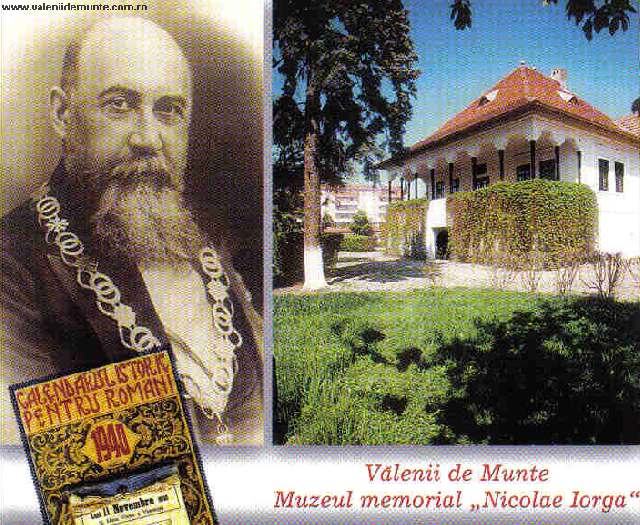
The “Nicolae Iorga” Museum Complex in Valenii de Munte

, 11.01.2014, 12:00

Of all the iconic personalities of Romanian culture, Nicolae Iorga holds pride of place. A historian, politician, writer, literary critic, journalist and last but not least a professor, Nicolae Iorga’s name has remained instilled in the memory of Romanians for his tragic death.


He died assassinated by legionnaires in November 1940. The execution took place close to one of his usual residences in Valenii de Munte, Southern Romania. The place henceforth has remained emblematic of Romanian culture. Built around 1833 by a local nobleman, the house was first seen by Iorga in 1907. He immediately took a liking for it and bought it. He moved there only three years later, after another two wings had been added to the original house.


Mihaela Voicea, a curator with the “Nicolae Iorga” Museum Complex in Valenii de Munte told us more about the offers of the museum. “The house has four main rooms. The first served as Nicolae Iorga’s studio, the place where he spent most of his time writing. The historian wrote over 1350 books and 25,000 articles. His studio also contains a plethora of personal objects: a Cordoba-leather portfolio, his inkpot and writing feather, a photo of Ecaterina Iorga in her old age. In front of the desk there is a collection of issues of “Neamul Romanesc”, the paper Iorga ran and edited in Valenii de Munte. There is also an elephant-shaped clock Iorga had received from Romanian students in America”.


Another room is the bedroom, fitted with red sycamore maple furniture with folk motifs from Campulung Moldovenesc, which is telling of Iorga’s propensity for peasant culture.


Curator Mihaela Voicea: ”18th century icons hung above the bed, while in front of the bed there is a beautiful ebony jewel case. Then there is the lavatory, with the mirrors and the perfume crystal phials, Carara marble, as well as a very beautiful photograph of Ecaterina Iorga when she was 18, in traditional outfit. Then we reach the little drawing room, where Ecaterina Iorga used to entertain her guests. A glass show case can be found in the drawing room where travel items are on display, as well as five photos of his children. Iorga had 11 children, 4 from his first wife, Maria Tasu, whom he divorced, and 7 from his second wife, Ecaterina. It is also here that we can find Ecaterina’ s portrait, painted by Sever Burada in 1925, as well as her writing desk. We now reach the last room, the grand hall, where the historian received his guests. Lots of paintings can be found here, two by Nicolae Grigorescu, which were offered to Iorga as a gift in 1904, namely, “In the Campinita River Valley” and “Apple Flowers”. There is also Iorga’ s portrait, painted by one of his nephews, Catul Bogdan. It is also here that we can find Iorga’ s favorite painting, featuring one of his ancestors, the Steward Iordache Draghici. “


In the hallway of the house in Valenii de Minte you can also admire two lithographs, depicting Ruling Prince Alexandru Ioan Cuza and his wife, Elena, as well as a portrait of Nicola Iorga, depicting him as he was granted the title of Doctor Honoris Causa of the University of Oxford in 1931. A most accomplished rhetorician as well as a politician who was extremely set in his ways, for less than a year, over 1931-1932 Iorga was Prime Minister. His articles and avowed political stance sparked off the conflict with the Iron Guard, whose members eventually assassinated him on November 27, 1940 in the forest near Strejnic, close by the city of Ploiesti, Southern Romania.



RRI Encyclopedia
RRI Encyclopaedia Sunday, 08 March 2026

The George Severeanu Museum

The George Severeanu Museum is located in Bucharest, in a house built at the beginning of the 20th century and forms part of the Bucharest...

The George Severeanu Museum
Sergiu Celibidache (1912-1996)
RRI Encyclopaedia Sunday, 01 March 2026

Diplomat Grigore Gafencu

Grigore Gafencu served his country without reservation and sought to promote its interests both in his official capacities and during his exile after...

Diplomat Grigore Gafencu
Lo scultore Frederic Storck
RRI Encyclopaedia Saturday, 21 February 2026

A Scholar of international repute – Traian Săvulescu

Traian Săvulescu used to be one of the leading figures of the Romanian science in the 20th century, a biologist, botanist, professor and president...

A Scholar of international repute – Traian Săvulescu
RRI Encyclopedia
RRI Encyclopaedia Sunday, 15 February 2026

General Henri Cihoski (1871-1950)

The history of the Romanians was also written by foreigners, just as Romanians are present in the history of other nations. Although a numerically...

General Henri Cihoski (1871-1950)
RRI Encyclopaedia Saturday, 07 February 2026

The ancient city of Callatis

Callatis was an active commercial, cultural and spiritual center for over a millennium, spanning the Greek, Roman and Roman-Byzantine periods....

The ancient city of Callatis
RRI Encyclopaedia Saturday, 31 January 2026

Romania’s Strongest Trade Bank before WWII

Marmorosh-Blank used to be one of Romania’s strongest banking institutions before 1945. It functioned under two generations of bankers, the first...

Romania’s Strongest Trade Bank before WWII
RRI Encyclopaedia Saturday, 24 January 2026

Archaeology in Glina, near Bucharest

Under the visible layer of today’s Bucharest and the capital’s surroundings lie much older traces of human habitation, which predate the...

Archaeology in Glina, near Bucharest
RRI Encyclopaedia Sunday, 18 January 2026

Monuments from Soviet-occupied Bucharest

On pedestals, in imposing poses, they have to convey inspiring messages across generations. War heroes and heroines, kings and queens, politicians,...

Monuments from Soviet-occupied Bucharest

Partners

Muzeul Național al Țăranului Român Muzeul Național al Țăranului Român
Liga Studentilor Romani din Strainatate - LSRS Liga Studentilor Romani din Strainatate - LSRS
Modernism | The Leading Romanian Art Magazine Online Modernism | The Leading Romanian Art Magazine Online
Institului European din România Institului European din România
Institutul Francez din România – Bucureşti Institutul Francez din România – Bucureşti
Muzeul Național de Artă al României Muzeul Național de Artă al României
Le petit Journal Le petit Journal
Radio Prague International Radio Prague International
Muzeul Național de Istorie a României Muzeul Național de Istorie a României
ARCUB ARCUB
Radio Canada International Radio Canada International
Muzeul Național al Satului „Dimitrie Gusti” Muzeul Național al Satului „Dimitrie Gusti”
SWI swissinfo.ch SWI swissinfo.ch
UBB Radio ONLINE UBB Radio ONLINE
Strona główna - English Section - polskieradio.pl Strona główna - English Section - polskieradio.pl
creart - Centrul de Creație Artă și Tradiție al Municipiului Bucuresti creart - Centrul de Creație Artă și Tradiție al Municipiului Bucuresti
italradio italradio
Institutul Confucius Institutul Confucius
BUCPRESS - știri din Cernăuți BUCPRESS - știri din Cernăuți

Affiliates

Euranet Plus Euranet Plus
AIB | the trade association for international broadcasters AIB | the trade association for international broadcasters
Digital Radio Mondiale Digital Radio Mondiale
News and current affairs from Germany and around the world News and current affairs from Germany and around the world
Comunità radiotelevisiva italofona Comunità radiotelevisiva italofona

Providers

RADIOCOM RADIOCOM
Zeno Media - The Everything Audio Company Zeno Media - The Everything Audio Company






















