Architect Ion Mincu
The founder of the “neo-Romanian style, Ion Mincu is one of Romanias most prominent architects.
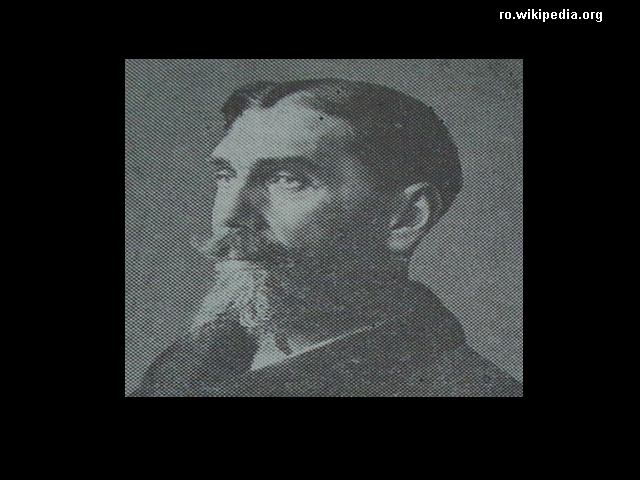
Christine Leșcu, 13.12.2014, 14:07
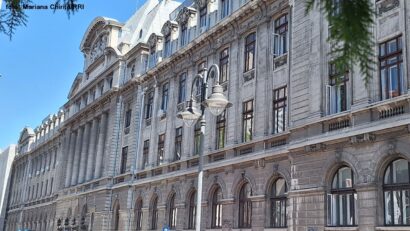
In early December this year, we commemorated 102 years since Ion Mincu’s death. Architect Ion Mincu was also the founder of Romania’s architecture higher education, Bucharest’s University of Architecture bearing his name. The architect’s fame and outstanding merits are obvious, yet little is known about his life, art historian Oana Marinache noted:
“The biography we have from his friend, art critic Nicolae Petrascu, published in 1928, provided most of the information, at the same time sparking a series of polemics. His year of birth is uncertain. Some even ventured to come up with specific data such as 1849, 1851 and 1852. What we know for sure is that the architect was born into a family of vine-growers. He was born in the eastern town of Focsani and completed his studies there. One of his daughters said he was born in 1851, but the officially accepted year is 1852. His professional trail is quite interesting. At that time, most of the architects pursued engineering, enrolling at the Roads and Bridges School in Bucharest. Mincu was employed by his native Focsani County’s roads service and it was only in the late 19th century that he had the opportunity to take up architecture. He felt his artistic side was insufficiently developed. So he attended the technical school, then the Fine Arts School in Paris, the Architecture Department. There he studied with famous professors, and in 1883 he got his degree. Then he was awarded a prize that, jointly with a scholarship offered by the Romanian state, enabled him to take a study trip across Europe. He came back home in 1884, having visited Italy, Spain, and having even reached Constantinople. That fact-finding trip provided him with lots of landmarks, especially with those related to enamelled ceramics. “
The first distinctive traits of the neo-Romanian architectural style were apparent during the restoration of a villa in Bucharest. Art historian Oana Marinache:
”His first commissioned work consisted of the change of General Ion Lahovary’s house in Bucharest, a house which can still be seen today on the premises of the Cantacuzino Hospital. There, Mincu had a major intervention in the initial aspect of the house adding the porch, an element he had borrowed from peasant architecture, a kind of architecture he will resort to whenever his commissioners allowed him to use it. Later on he would design general Lahovary’s funerary monument in the Bellu Cemetery in Bucharest. However, Mincu shot to fame thanks to his contribution to Romania’s Pavilion at the International Exhibition in Paris in 1889, a work which was entirely inspired from traditional architecture, actually a Romanian public house whose replica he would later on provide for the Promenade Restaurant in Bucharest in 1892.”
Apart from those notable achievements, Ion Mincu will also be remembered for the Girls’ Central School in Bucharest, the Robescu Villa in Sinaia mountain resort and the restoration of the Stavropoleos church, also in Bucharest. So peasant architecture as well as church architecture were the sources of inspiration for what would later on become the neo-Romanian style. Although Ion Mincu was the first one to create the style, it would be perfected by students and disciples the architect guided towards the rural world as a source of inspiration. Neither the “neo-Romanian” label was concocted by the maestro, or at least that’s what art historian Oana Marinache told us:
”I’d rather say the name ‘national style’ or ‘neo-Romanian style’ was given by historians in the 20th century, in a bid to pinpoint that moment in the history of Romanian architecture. We also need to understand the label against the background of the formation of the Romanian Kingdom, in 1881. In 1906, the Romanian school of architecture compelled recognition at the National Exhibition, most of the pavilions being in the national style. Later on, the Romanian state even initiated a project meant to encourage the building of villas and public institutions in that national style.”
Some of the Romanian architects who created in that style were Petre Antonescu, Nicolae Ghica-Budeşti, Grigore Cerchez, Toma T. Socolescu and Constantin Iotzu. Their supreme master, however, is architect Ion Mincu, who, without boasting an impressive number of works, gave Romanian architecture its specificity.