
RRI Live!

Listen to Radio Romania International Live

Ecaterina Teodoroiu

Ecaterina Teodoroiu is known in Romanian history books as one of the symbols of World War I.
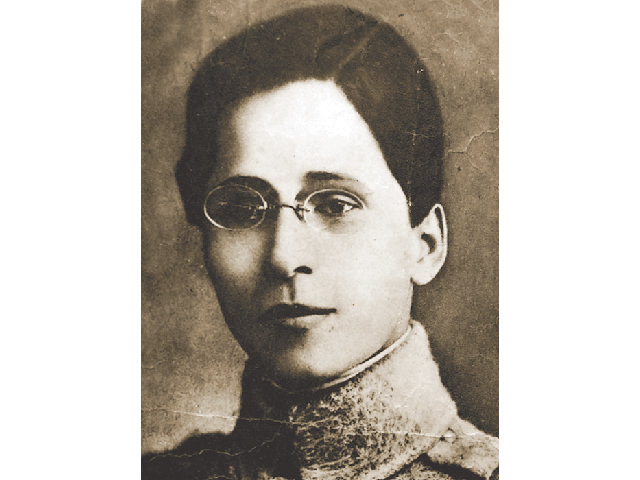
Ecaterina Teodoroiu
Ecaterina Teodoroiu

, 09.01.2016, 14:31

Ecaterina Teodoroiu is known in Romanian history books as one of the symbols of World War I. However, not many people in Romania today know that she was the first and only woman fighting in the Romanian Army in 1916 and 1917. We asked Valentin Patrascu, the curator of the Ecaterina Teodoroiu Memorial House, to tell us more about this woman born on January 14, 1894 near the town of Targu Jiu:


Valentin Patrascu: “Ecaterina Teodoroiu was born into a rather modest peasant family in Gorj County. She was the third of the eight children of Vasile and Elena Teodoroiu, who lived in the village of Vadeni, next to Targu Jiu, today a district in this town. According to her primary school teacher, as a teenager she was very interested in history, and she wanted to study and become a teacher herself. After finishing primary school in her home village, Ecaterina Teodoroiu went to school in Targu Jiu and later in Bucharest. She wanted very much to go to the Gheorghe Lazar High School, but we have no evidence that she actually studied there. We do know that she attended a nurse school in Bucharest, sometime between 1909 and 1916.


While in Bucharest, Ecaterina Teodoroiu joined a reconnaissance unit called The Shepherd Bucur under the command of Arethia Pitesteanu, the future wife of the politician Gheorghe Tatarescu. This was a special unit providing military training for young women. When Romania joined the war in August 1916, Ecaterina was in Targu Jiu, in a unit that provided supplies to the troops, as well as medical assistance and evacuation. She first saw action in October 1916, when she joined the civilians defending the bridge over the Jiu River against the German troops. Within a month, she decided to join the Romanian army as a volunteer.


Valentin Patrascu: “In November 1916, Ecaterina decided to join the Romanian troops as volunteer. She made the decision after her brother Nicolae had been killed in the battle for the Jiu Valley on November 1st. So it was at a time when the Romanian army was retreating that Ecaterina joined the very unit where her brother served. She fought alongside the Romanian troops while they were withdrawing towards Craiova, in the south of the country. She was wounded in the hip during the battle of Filiasi and had to recover in Bucharest and then in Iasi, after Bucharest had been occupied by the Central Powers in December 1916. In January 1917, Ecaterina Teodoroiu requested to join the troops again and fight with the Romanian troops in Moldavia.


The Romanian army commanders were reluctant from the very beginning to accept a woman among their ranks, and now that she was injured, they tried even harder to persuade her to stay behind the front line when she recovered. However, all their efforts were to no avail. Instead, she was promoted to the rank of non-commissioned officer and joined the troops fighting in the battle of Muncel.


Valentin Patrascu: “On August 22nd 1917 the Second Battalion, which she was part of, was deployed to the frontline. She anticipated a German attack against the unit she commanded and ordered her troops to get out of the trenches and launch a pre-emptive strike. It was during this action that she was hit in the chest by two bullets fired by the Germans. Thats how she died.


Shortly after her death, the newspapers of the time dubbed her “the hero on the Jiu and the authorities built the first statue to her memory in Targu Jiu in 1921. The myth that was born even survived the communist regime. Her surname was even changed from Toderoiu to Teodoroiu, which was considered more resounding and better fitting to her legendary status.

Sergiu Celibidache (1912-1996)
RRI Encyclopaedia Sunday, 01 March 2026

Diplomat Grigore Gafencu

Grigore Gafencu served his country without reservation and sought to promote its interests both in his official capacities and during his exile after...

Diplomat Grigore Gafencu
Lo scultore Frederic Storck
RRI Encyclopaedia Saturday, 21 February 2026

A Scholar of international repute – Traian Săvulescu

Traian Săvulescu used to be one of the leading figures of the Romanian science in the 20th century, a biologist, botanist, professor and president...

A Scholar of international repute – Traian Săvulescu
RRI Encyclopedia
RRI Encyclopaedia Sunday, 15 February 2026

General Henri Cihoski (1871-1950)

The history of the Romanians was also written by foreigners, just as Romanians are present in the history of other nations. Although a numerically...

General Henri Cihoski (1871-1950)
RRI Encyclopedia
RRI Encyclopaedia Saturday, 07 February 2026

The ancient city of Callatis

Callatis was an active commercial, cultural and spiritual center for over a millennium, spanning the Greek, Roman and Roman-Byzantine periods....

The ancient city of Callatis
RRI Encyclopaedia Saturday, 31 January 2026

Romania’s Strongest Trade Bank before WWII

Marmorosh-Blank used to be one of Romania’s strongest banking institutions before 1945. It functioned under two generations of bankers, the first...

Romania’s Strongest Trade Bank before WWII
RRI Encyclopaedia Saturday, 24 January 2026

Archaeology in Glina, near Bucharest

Under the visible layer of today’s Bucharest and the capital’s surroundings lie much older traces of human habitation, which predate the...

Archaeology in Glina, near Bucharest
RRI Encyclopaedia Sunday, 18 January 2026

Monuments from Soviet-occupied Bucharest

On pedestals, in imposing poses, they have to convey inspiring messages across generations. War heroes and heroines, kings and queens, politicians,...

Monuments from Soviet-occupied Bucharest
RRI Encyclopaedia Sunday, 11 January 2026

The Corneşti Iarcuri Citadel

Just a few kilometers from Timișoara (western Romania), in the town of Cornești in the Banat Area, there are traces of one of the most spectacular...

The Corneşti Iarcuri Citadel

Partners

Muzeul Național al Țăranului Român Muzeul Național al Țăranului Român
Liga Studentilor Romani din Strainatate - LSRS Liga Studentilor Romani din Strainatate - LSRS
Modernism | The Leading Romanian Art Magazine Online Modernism | The Leading Romanian Art Magazine Online
Institului European din România Institului European din România
Institutul Francez din România – Bucureşti Institutul Francez din România – Bucureşti
Muzeul Național de Artă al României Muzeul Național de Artă al României
Le petit Journal Le petit Journal
Radio Prague International Radio Prague International
Muzeul Național de Istorie a României Muzeul Național de Istorie a României
ARCUB ARCUB
Radio Canada International Radio Canada International
Muzeul Național al Satului „Dimitrie Gusti” Muzeul Național al Satului „Dimitrie Gusti”
SWI swissinfo.ch SWI swissinfo.ch
UBB Radio ONLINE UBB Radio ONLINE
Strona główna - English Section - polskieradio.pl Strona główna - English Section - polskieradio.pl
creart - Centrul de Creație Artă și Tradiție al Municipiului Bucuresti creart - Centrul de Creație Artă și Tradiție al Municipiului Bucuresti
italradio italradio
Institutul Confucius Institutul Confucius
BUCPRESS - știri din Cernăuți BUCPRESS - știri din Cernăuți

Affiliates

Euranet Plus Euranet Plus
AIB | the trade association for international broadcasters AIB | the trade association for international broadcasters
Digital Radio Mondiale Digital Radio Mondiale
News and current affairs from Germany and around the world News and current affairs from Germany and around the world
Comunità radiotelevisiva italofona Comunità radiotelevisiva italofona

Providers

RADIOCOM RADIOCOM
Zeno Media - The Everything Audio Company Zeno Media - The Everything Audio Company

























