The University Halls in Bucharest
A venue with a long tradition for the academic world.

România Internațional, 16.04.2016, 14:00
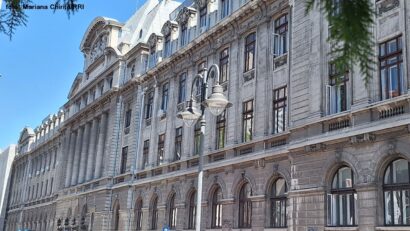
If you take a stroll along the streets of historical Bucharest, each and every corner has its own pleasant surprise lying in wait for you. For instance, on the streets behind the tall buildings lining the Magheru Boulevard, Bucharest’s main thoroughfare, among an assortment of neo-Romanian and modernist structures, you will come across a neo-Gothic building surrounded by a lush garden. The building is known as Casa Universitarilor (the University Halls). It was built in mid 19th-century by Cezar Librecht. Historian Dan Falcan tells us who Librecht was:
”Cezar Librecht had quite an adventurous life. He was part of the inner circle of ruler Alexandru Iona Cuza. It appears the two had met before Cuza became ruler in 1859, probably in 1856 or 1857. At the time, Cezar Librecht, who was of Belgian origin, was in Galati working for the Danube Commission’s Telegraphic Service, while Cuza was the prefect of county of Covurlui, which is present-day Galati County. It’s hard to say what brought the two together. Perhaps it was the passion they shared for horseracing and for gambling. What we do know is that Cezar Librecht remained a friend of Alexandru Ioan Cuza even after the latter was elected ruler of Moldavia on January 5th 1859 and also of Wallachia, a little later, on January 24th. He was one of Cuza’s most trusted men and was even appointed the head of the Postal and Telegraphic Services, while unofficially he was in fact running the ruler’s secret service, having direct access to letters and telegraphic dispatches which he could intercept and read. Taking advantage of the special status he had been granted by the ruler, as well as of the intelligence he got, Cezar Librecht became a thriving businessman. He was part of Cuza’s close circle of friends, a circle formed around Maria Obrenovici, the ruler’s mistress. Librecht made his fortune through acts of corruption and the privileged relationship he had with the ruler.”
While Librecht’s morality as a businessman was questionable, his tastes when it came to the arts and architecture were not, as demonstrated by the house he owned in Bucharest. Historian Dan Falcan tells us more about this building:
“This splendid house, now a listed building, was built by Cezar Librecht in 1865, one year before Cuza abdicated, and was designed by an architect of Dalmatian origin, Luigi Lipizer. The building is spectacular. Its eclectic architecture combines neo-Gothic, Byzantine and Islamic elements. With its crenellations and lavish decoration in the Neo-Gothic and Romantic styles typical of the 1850s and 60s, as well as its Byzantine and Arabic influences, this building is atypical of Bucharest’s architecture. Most of the stately buildings that are still left in the city date from around the same time as Librecht’s residence, or even to a later date, to around 1880 and 1890, but their style is predominantly French. However, the Librecht house stands out, also on account of the large gardens surrounding it, which make it all the more attractive.”
The building stood the test of time and became a symbol of Bucharest, even after its resident fell into disgrace. Here is historian Dan Falcan once again, telling us more about the life of Cezar Librecht:
”After his protector Cuza stepped down and left the country, Librecht was involved in a lawsuit. He was investigated, put on trial and convicted. He even spent time in prison for about a year or two, and afterwards left for France, although he was a Belgian. He was an adventurer all his life and that’s also how he died. In the late 1880s, he became involved in the Spanish civil wars and died there during the conflicts. So his ending was suited to the adventurous life he had lived. The people of Bucharest, however, are grateful for the fact that, despite his many dubious affairs, he at least left the city this architectural masterpiece. The building was confiscated by the Romanian state and later purchased by the Royal Palace Marshal Gheorghe Filipescu during the reign of King Carol I. This is why the building was known for a long time as the Librecht-Filipescu house, after the names of its two owners. In 1947, when the communists had already seized power in the country, they nationalised the building and, a year later, in 1948, turned it into the University Halls.“
Today, the Librecht-Filipescu House is the property of the University of Bucharest.
(Translated by E. Nasta)