The Universul newspaper
In 1829, when the Romanian Principalities started a process of modernisation and openly embraced western values, the first paper in the Romanian language, Curierul Românesc, was issued in Bucharest.

Christine Leșcu, 27.08.2016, 14:15
In 1829, when the Romanian Principalities started a process of modernisation and openly embraced western values, the first paper in the Romanian language, Curierul Românesc, was issued in Bucharest. The press made up for the lost time, in spite of a rather late debut, as compared with Western Europe, with the number of publications increasing at a fast pace, thanks to modernisation and socio-cultural emancipation. Towards the end of the century, on August 20, 1884, the first issue of the daily paper Universul was published and Universul became the Romanian newspaper with the widest circulation until the early 1950s. It was founded by Luigi Cazzavillan, an Italian journalist and former volunteer in Garibaldi’s Army who had settled in Bucharest, where he taught Italian and represented the Bianchi bicycle factory. Today, however, Cazzavillan is mainly praised for his essential contribution to developing popular press by issuing publications accessible to everyone and which disseminated cultural and scientific information, without any trace of triviality.
Ilie Rad, a professor at the Babeş-Bolyai University in Cluj-Napoca told us more about Luigi Cazzavillan and about the type of content carried by Universul: “Luigi Cazzavillan, a journalist by profession, had been the correspondent of an Italian publication in Romania during the 1877-1878 War of Independence. Initially, he tried his luck with two other publications. In 1880, he brought out Frăţia româno-italiană (‘The Romanian-Italian Brotherhood’ in Romanian) and Tezaurul familiei (‘The Family Treasure’ in Romanian) and acquired the necessary experience to set up, in 1884, the daily Universul, which he probably named after an Italian paper of the same name. The paper was neutral from a political point of view. It was a magazine-type newspaper with many pieces of news and information on everything from car accidents to murders. It was a gazette for everyone, but not exactly what we call today a tabloid, because reporting was kept at a certain level of decency, unlike today’s yellow press. Impartiality and objectivity mattered a lot to the editors. Due to technology and its wide circulation, Universul cost only 5 bani. Romanian society had already undergone a process of modernisation and the number of book readers was on the increase. In 1828, when the first Romanian newspapers were published, the number of copies did not exceed 300, whereas in the late 19th century, the newspapers sold up to 40,000 copies a day.”
In time, Universul started publishing a number of supplements for children, literature, travel and popular science. These supplements, their price, number of issues and accessibility of information turned Universul into the most popular newspaper before World War I and also in the inter-war period.
Ilie Rad has more about the story of this paper: “I believe it had even more readers than the leftist competition, namely Adevarul, because of its low price, but also because of the accuracy of the information and the type of news it carried. Universul is the first publication in the history of the Romanian press that had agents and correspondents abroad. For instance, the famous Dreyfuss case in France was widely covered by the paper, because Luigi Cazzavillan could afford to pay a correspondent abroad to send back fresh news on international events. Moreover, the paper managed to attract important writers. For example, the great prose-writer and playwright Ion Luca Caragiale published many of his short stories and sketches in this paper.”
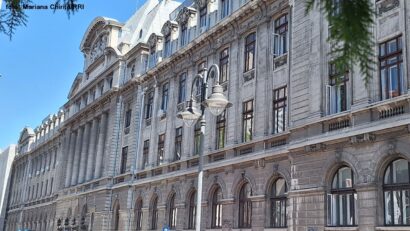
Unfortunately, Luigi Cazzvillan died when he was only 52, in 1904. During World War I in Romania, between 1916 and 1918, Universul was no longer published. It was issued again with new owners, the best known of whom is the journalist and politician Stelian Popescu. He ran Universul during most of the inter-war period, up until 1943, and unfortunately contaminated it with his centre-right political beliefs. Although Universul did not manage to stay politically neutral, it still remained the most widely read newspaper and managed to survive briefly even during the Communist period, until 1953. Its offices were located in the centre of Bucharest, on Brezoianu Street, near the University, in an imposing building also built by Cazzavillan based on designs by an Italian architect.
Here is Ilie Rad once more: “Cazzavillan built this palace. Later, changes were made to the building. It also hosted the printing press and the offices. For instance, one of the later owners, Stelian Popescu, had a huge, sumptuous office, where top-level politicians and business people were received and treated like VIPs, right in the centre of Bucharest. There is a street now in Bucharest named after Cazzavillan, and it’s good that he has not been forgotten.”
Having hosted the editorial offices of many important papers, the building on Brezoianu Street has managed to survive up to this day and has been recently refurbished.