Mihail Kogalniceanu
The modernisation of the Romanian principalities that began in the 19th century
Ștefan Baciu, 29.09.2017, 15:12
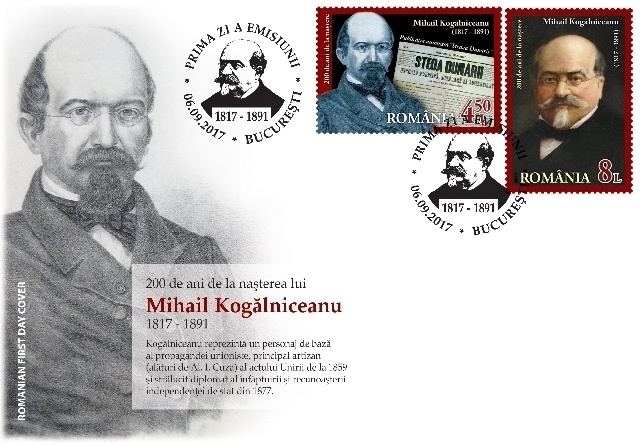
The modernisation of the Romanian principalities that began in the 19th century and the creation of the Romanian state were the result of the efforts of a special generation of Romanian intellectuals whose work as politicians helped rejuvenate the state’s institutions and paved new ways in the world of culture. Mihail Kogalniceanu was one of the architects of modern Romania. A politician, minister, lawyer, historian and pioneer of Romanian journalism and novel-writing, Mihail Kogalniceanu was born 200 years ago, in September 1817 in Iasi. Descending from an old Moldovan boyar family, he completed his primary studies in Moldavia and furthered his education in Luneville, France, and then in Berlin, Germany, with the help of his patron, ruler Mihail Sturdza.
He developed an early interest in history and literature, as Mihaela Tudose, a curator of the Mihail Kogalniceanu Memorial Museum in Iasi, explains: “Ever since he was in his early twenties, Mihail Kogalniceanu wrote a number of studies, such as The Romanian or Wallachian Language and Literature and A Study on the History, Customs and Language of Bohemian Gypsies in France in 1937. Back home from his studies in 1838, his father Ilie put him in touch with Gheorghe Asachi, Moldavia’s most illustrious scholar, who steered the country’s education at the time. From the very beginning, Asachi entrusted the young Kogalniceanu with the printing of the supplement Alauta romaneasca. In 1845, Kogalniceanu published an almanac of education and entertainment, followed by a number of major magazines, such as Dacia Literara, where he published a study or a programme aimed at laying the foundations of Romania’s national literature. In the period surrounding the unification of the Romanian Principalities, Kogalniceanu wrote and led the unionist propaganda via another important periodical, Steaua Dunarii”.
In light of his research on the Roma, Kogalniceanu would be able to contribute to the drafting of the legislation on the emancipation of the Roma slaves, in mid 19th century. In 1948, at 30 years of age, he drafted a revolutionary programme militating for the union of Moldavia and Wallachia without which the entire modernisation of the Romanian territories would not have been possible. His project would be realised in 1859 with the ascension to the throne of Alexandru Ioan Cuza, who later even appointed Kogalniceanu his prime minister in 1863.
Mihaela Tudose explains: “There is a tendency to associate Kogalniceanu with Alexanxru Ioan Cuza in particular because during this short reign he was the artisan of a number of reforms that modernised the young Romanian state created in mid 19th century. It’s also true that towards the end of this reign, after a visit made by Kogalniceanu to Craiova and southern Oltenia in 1865, immediately after the agricultural reform, he was received with a lot of enthusiasm. The fact that Kogalniceanu was received warmly there was misrepresented by the camarilla around Cuza so as to downplay Kogalniceanu’s work. Consequently, the relations between them grew distant and Kogalniceanu eventually resigned. Shortly after that, Cuza himself was forced to abdicate, in February 1866.”
In spite of his resignation, Mihail Kogalniceanu continued to play a key role after the new king, Carol I, took the throne. Kogalniceanu became his foreign minister, and made use of his diplomatic experience and skills after the country won its independence from the Ottoman Empire in the 1877-1878 war.
Mihaela Tudose: “Thanks to his efforts and to the appreciation he enjoyed in European capitals, Kogalniceanu was appointed a member of the Romanian delegation that took part in the Peace Congress in Berlin. Together with Ion Brătianu and thanks to their joint diplomatic efforts, they managed to bring Dobrogea back within the national borders of Romania. It was Mihail Kogalniceanu who wrote the first regulation on the administrative and legal administration of Dobrogea, in 1880. And in 1881, after the Kingdom of Romania was proclaimed, Kogalniceanu became the first Ambassador of Romania to Paris.”
Towards the end of his life, after withdrawing from public activity, Mihail Kogalniceanu was also the President of the Romanian Academy, between 1887 and 1889. He died in July 1891 in Paris.