The architectural style of Greater Romania
Developments of early 20th-century architecture in Romania
Christine Leșcu, 16.12.2017, 13:17
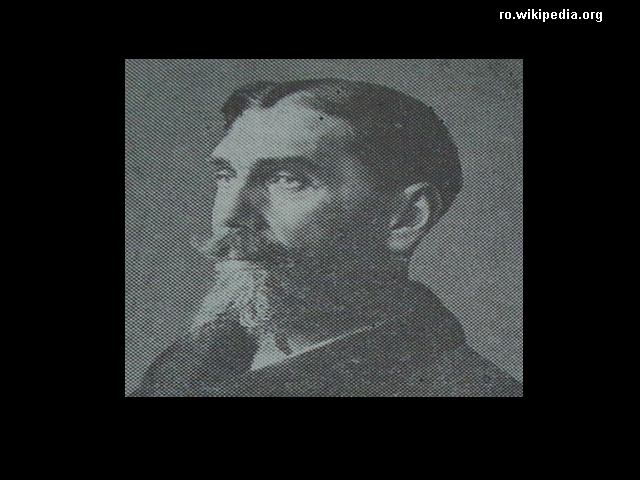
The union of all Romanian provinces in one state, on December 1, 1918, triggered a cultural effervescence focused on finding and highlighting the elements specific to the Romanian civilization. In architecture, this approach led to the emergence of a new style – the neo-Romanian style. This style became part of a trend that started taking shape in the second half of the 19th century at the same time with the emergence of modern European states. In these newly formed nations certain historical architecture elements were promoted, in an attempt to single out specificities of their architectural tradition. In Romania, it was architect Ion Mincu who gave the first impetus for the creation of a domestic neo-style. Ion Mincu was born around 1851 and studied at the Belle Artes University in Paris. The first characteristics of the neo-Romanian style were visible during Ion Mincus restoration works on a private villa in Bucharest. Architect Ruxandra Nemteanu tells us more about it:
“He had the idea to give an already built house, that is the Bucharest home of doctor Lahovary, the aspect of a rural house specific to the sub-Carpathian traditional area. Ion Mincu, after having finished his studies in Paris, had a travel scholarship to Italy, France and Spain. One of the houses that he created, which in my opinion is his greatest work, is the Robescu House in Galati. It is in fact a mixture between the architecture that was being promoted as specific to the traditional area of Wallachia, and foreign elements. Robescu House now hosts the Childrens Palace in Galati. Both Lahovary House, which can be found within the precincts of the Cantacuzino Hospital in Bucharest, and Robescu House feature majolica decorations, without any traditional Romanian elements. Both buildings testify to the experiments carried out at the time and the attempts to forge a new style.
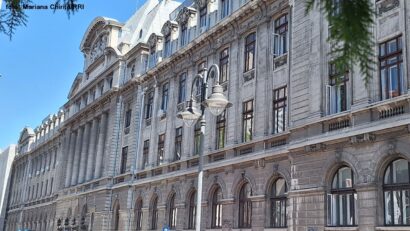
Another source of inspiration can be traced in these early experiments, besides western majolica and Wallachian rural and church architecture, namely the Brancoveanu palaces in Bucharest and in the countryside. This element dominated the new style and was taken further by the young architects that followed in Ion Mincus steps. This period of experimentation lasted for a while and in 1906 during a Great Exhibition held in Bucharest celebrating the anniversary of the 40th year of King Carol Is reign, the exhibition pavilions already featured a new style containing many decorative elements in the Brancovenesc style. While Ion Mincu was the first to give an impetus to the new national style, Petre Antonescu was the architect who perfected this style. Born in 1873, he changed the appearance of the Triumphal Arch in Bucharest into what we see today and designed the building housing the Law Faculty in Bucharest.
“I believe that he was very talented, and thanks to his skills, he managed to create an architectural style that was taken over by several younger architects who took him as an example. He is the one who created the current headquarters of the City Hall, the former office of the Public Works Ministry, with those loggias taken over from the Brancovenesc-style architecture or inspired from the architecture of the Vacaresti Monastery. Whats interesting about this style is that, when applied to small scale projects, for instance to houses or smaller buildings, as compared to multi-storey buildings, the results were more spectacular and the buildings were more proportionate. This is normal, because taking over elements conceived or used for smaller-scale buildings such as the Brancovenesc-style ones, and transposing them on larger buildings, would no longer give the impression of an organic, well-structured work.
Little by little, the neo-Romanian style gained recognition and more and more private and public buildings were constructed in this style across the country. Nicolae Ghica-Budeşti, Grigore Cerchez, Toma T. Socolescu and Paul Smărăndescu were some of the Romanian architects who adopted this style. (Translated by E. Enache & L. Simion)