Railway Stations of Bucharest
Rail transportation proved to be the first modern way to ease the exchange of goods, improve the workers mobility, at the same time contributing to state centralization
Steliu Lambru, 25.09.2020, 12:01
After the Union of 1959 and the making of Greater
Romania in 1918, railway played an essential role in the formation and cohesion
of this state. Romania had adopted the French cultural model and saw a significant
development of its railway network with the capital city Bucharest as the
country’s most important railway hub.
Romania’s first king, Carol I is responsible for the
country’s first major railways, all of which met in Bucharest.
Romania’s capital had several railway stations but
along the years, the modernization of the country’s railway network led to the
disappearance of some and the emergence of others.
If we look at a Bucharest map,
we’ll see that all the city’s railway stations are located in the main compass
points adding to the capital’s international importance. We recall that many international
trains arrived in Bucharest’s North Station, such as the famous Orient Express,
which from here was bound for southern and eastern destinations. In the
following minutes historian Dorin Stanescu is going to refer to the
contribution of this famous train to the modernization of Romania’s rail
infrastructure.
Dorin Stanescu: In 1883 the
Orient Express used to enter Romania through Varciorova in the west, then went on
to Turnu Severin, Craiova, Slatina, Pitesti and Bucharest. It was bound for
Giurgiu, in the country’s south and then to the port of Smardan. It crossed the
Danube to Varna from where a ferryboat took it to Constantinople. However, this
train route also prompted the then authorities to step up the construction of
the country’s railway infrastructure. Many components of this railway network
were added in that period, such as the famous Cernavoda bridge designed by
Anghel Saligny, which played an essential role in the Orient Express route. The
train was now bound for the port of Constanta, in southern Romania, from where
the ships of the Romanian Maritime Service took its travelers to
Constantinople.
The history of the Bucharest
railway stations starts with the Filaret station in 1869, opened with the
inauguration of the first railway linking Bucharest and Giurgiu, in the
country’s south. The U-shaped two-storey building had three rails in front of
it that could accommodate three trains. The premises have served as a bus
terminal since 1960 and its building was declared a historical monument. Between
the Filaret Station and the future North Station there was another station
called Dealul Spirii, which no longer exists. Its former location was replaced
by a crossroad in the city’s western region.
Another station, which no longer
exists today was the Cotroceni Station, close to the palace, which nowadays
houses the Romanian presidency and was used by the royal trains. It was
dismantled back in 1960, just like Filaret and its building serves as an
entrance gate to the Cotroceni Park.
A second station with the same
name was operational at nearly 1.5 kilometers from the first, in the city’s
western area. It is still operational but has an extremely reduced traffic, two
freight trains that are bringing supplies to the two malls in the region.
Herastrau used to be another
station, close to the present King Mihai park in northern Bucharest.
In 1872, King, Carol 1st
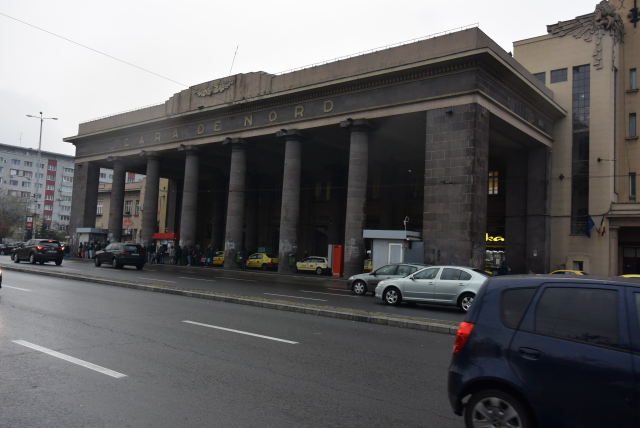
inaugurated the country’s most important railway station, Gara de Nord, the
North Station, which presently has 14 rail lines. Its premises have also
increased during the years. Its first name was the Targoviste Station after the
name of a city north-west of Bucharest. The facility, which got its present
name in 1888, has the same U-shaped main building as Filaret. It reached the
largest number of travelers between 1950 and 1990 and its premises have also
been declared a monument.
One of Bucharest’s prettiest
stations is Obor or the East Station, which covers the eastern regions
connecting Bucharest to the city of Constanta, on the Black Sea coast. It is
still operational and has also been declared historical monument.
Baneasa is one of Bucharest’s most
discrete railway stations and it was built in 1936 according to blueprints by
the famous architect Duiliu Marcu. The station was used by the royal family to
welcome its guests. It served the same purpose back in the communist regime and
it is still operational nowadays, with limited traffic though. The newest
railway stations in Bucharest are Basarab, Progresu and Titan, built after
1945. Only Basarab is still operational for trains bound for the country’s
south-western regions.
(bill)