Representative buildings of the 1930s in Bucharest
The modern history of the capital of Romania starts with the second half of the 19th century, around 1850

Steliu Lambru, 03.07.2021, 14:00
The
modern history of the capital of Romania starts with the second half
of the 19th century, around 1850, when it turns from an
Oriental into a European city. Looking at a map or a drawing
depicting the city over 150 years ago, one would hardly be able to
recognize it. This is because the Old City, former commercial
quarters, with a few medieval churches, only vaguely sketch the old
capital of Wallachia.
The
history of Bucharest crosses three periods of great transformation.
The first is during the reign of King Carol I, between 1866 and 1914.
The second was during the reign of King Carol II, in the 1930s, while
the third was during the rule of communist ruler Nicolae Ceausescu,
in the 1980s.
King
Carol II was the most controversial sovereign of the four that
Romania had. With a strong personality, intelligent, but also full of
flaws and weaknesses, Carol II managed to transform Bucharest in
conformity with the needs of the capital, and the architecture trends
of the time. Carol II’s reign, between 1930 and 1940, was one of
grand projects, recalling those of his forebear, Carol I. His father
Ferdinand I’s reign, between 1914 and 1927, covered WWI and the
consolidation of the newly formed country, Greater Romania, by
uniting, in 1918, most of territories inhabited by Romanians. The
1920s were years of integration and recovery after the war. Only in
the 1930s did Romania manage to resume grand development projects,
one of them being Bucharest itself. During the reign of Carol II,
building roads across the country and state and culture institution
buildings were a priority.
Construction
engineer, professor, and academician Nicolae Noica is the director of
the Romanian Academy Library. He reviewed for us a few notable
buildings that Bucharest owes to controversial ruler Carol II. The
list has to begin with the royal residence itself:
The
first building would be the Royal Palace. On the night of December
7th to the 8th, a conflagration consumed the
entire central part of the palace. Consolidation of the foundations,
and the resistance structure, was made by engineer Pragher. After
1932, building works were done for the central section, which ended
with a reception report for the Royal Palace. I found that report.
Then, in 1938, building started for the wing that faces the Atheneum,
which went on until 1940. It is remarkable that the 1940 earthquake
did not damage the building.
The
projects continued at an alert pace. Institutions for a state that
doubled in size in 1918 needed bigger buildings. Here is Nicolae
Noica:
Another
important building was the headquarters of the Foreign Ministry, now
the seat of government. This building was designed by Duiliu Marcu,
while the reinforced concrete buildings were done by engineer
Gheorghiu between 1937 and 1938. That was the old foreign ministry
building. The new National Bank palace was done at a time when an
urban design study was being run, when the Higher Technical Council
analyzed all the changes in alignment in the area. The public utility
decree issued by King Carol II expropriated those areas.
King
Carol II lives in history as a great supporter of culture. The
Academy was no exception to the list of institutions he encouraged.
Noica mentioned the very building of the institution he leads:
Another
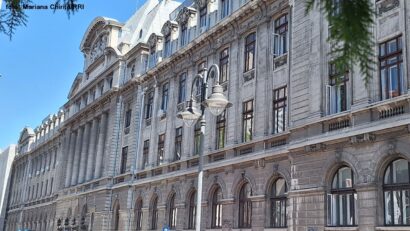
impressive building is the building of the Romanian Academy Library.
For the first time, after in 1931 Professor Duiliu March had
submitted to the Academy the project for one of the sections of the
library building, between 1935 and 1937 they built this remarkable
edifice, with work led by engineer Ioanovici. The inauguration, on 5
June 1937, was attended by the king himself, who insisted to be
present at the Academy session when they made Lucian Blaga a member.
On
one of the big boulevards of Bucharest we find another grand building
erected during the reign of Carol II, the headquarters of the
National Archives. To the west, close to Cotroceni Palace, the
presidency building, we find the Military Academy, a monument in the
Bauhaus style. Here is Nicolae Noica:
Another
representative building is the Patrimony of the Official Registry,
today the National Archives, across from Cismigiu Park. The Higher
School of War, today the Military Academy, was built between 1937 and
1939. The main body of the Higher School of War was built on a
length of 120 meters, and has 3,650 sqm. The entire building was
erected in just two years. The work was led by engineer Emil Pragher,
a great personality.
We
may also put on the short list the Institute of Agricultural
Research, the Village Museum, the Triumphal Arch of Bucharest, the
royal residence in Scrovistea, the Fire Tower Castle in Sinaia, and
the Orthodox cathedrals of Cluj, Medias, and Timisoara.