The Building of the Central School for Girls in Bucharest
Among the old high schools in Bucharest, the Central School for Girls has a special place

Christine Leșcu, 22.11.2022, 00:40
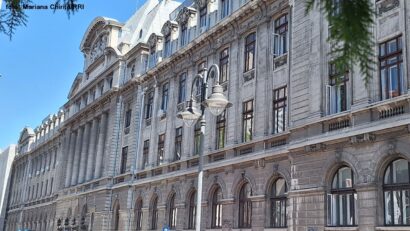
Among the old high schools in Bucharest, the Central School for Girls has a special place, not only due to a tradition of high performance, but also due to the building housing it, which is representative for the architecture style known as national, or Neo-Romanian. It was designed in its general lines by architect Ion Mincu, causing other architects to take up that style, which peaked between the world wars, and became the prevalent manner of designing public, but also private, buildings in Greater Romania. However, irrespective of changes over time, its beginnings lie in the very special style of the Central School for Girls in Bucharest. The institution was set up in 1852, during the reign of Prince of Wallachia Barbu Stirbey, but its buildings were inappropriate for the school in the years following the creation of the Kingdom of Romania, in 1881. in fact, right after the kingdom was set up, Parliament passed an ample program of building public venues, among them schools, allotting major funding for this program. We spoke about this with Nicolae Noica, who authored a volume called The History of the the Central School for Girls in Bucharest:
“A bill was introduced for schools and cultural education institutions, allocating a major portion of funding, which at the time was about 10% of the countrys budget, even up to 12%. The first step was made in 1885. Architect Ion Mincu was contracted to submit a project for the Central School for Girls. The building project specified all the functions that the venue had to tend to. Classrooms had to have a height and surface so that each student had 7 cubic meters of air available indoors. In the library, where the students spent a lot of time, there had to be 9 cubic meters. Architect Ion Mincu made it happen. He designed the school as a rectangle, with a basement, a ground floor, and one upper floor. The school at the time also had dormitories. The girls could live in the dorms, and also have all meals there, because it also had a cafeteria.”
After a change in the initial schedule proposed by the Ministry of Education, the bid for the construction contract was signed with the company of engineer Sicard, which started work in 1888. Two years later, in 1890, the school moved its venue from its initial one, near Coltea Hospital, and set up headquarters in the new building near Gradina Icoanei, where it still is. Architect Ion Mincu adapted his artistic vision to the idea of providing every comfort for study to the students there. Here is Nicolae Noica once again:
“The general rectangle shape consisted of a courtyard, which is still beautiful, after 100 years. He designed the yard to be the recreation space for the students. They could spend their breaks here. What is interested is that the corridor that servers as access way for the courtyard was closed, and had columns like those in monasteries. At some point, he wanted to have the corridor as an open space. However, the constraints of the weather forced his to close it, and, as opposed to monasteries, here they have some very sturdy windows, which still work today. I would just like to add that they were a first in a new style of architecture.”
The new style combined the vernacular architecture and the Brancovenesc style, as well as domestic church architecture, also borrowing from Mediterranean elements in ornamentation. This is best reflected by colored tile ornaments beneath the roof. Also, up there there are, in large letters, the names of the most prestigious wives of princes and rulers who were major sponsors of culture. While studying the archives to uncover the original plans drew by Mincu, author Nicolae Noica uncovered some more documents that show the interest in education during that time of deep reform in the country:
“We found the payrolls for the teachers who worked here back in the day. A teacher of geography, of history, or Romanian, was paid 270 gold lei. You could buy a gram of gold with 3 lei, so 270 divided by 3 equals 90 grams of gold. Today, a gram of gold is around 200 lei. 90 multiplied by 200 is 18,000 lei, which today even the president or his ministers dont get. The claim that there was scarcity back then is not sustainable. Professionals were respected, teachers were respected. The results could be seen along the years.”
Today, after 170 years since the creation of the Central School for Girls in Bucharest, and 132 years after it moved into its present complex, the building designed by Ion Mincu can still be admired in its original form.