The cesspits of Bucharest
The study of history has evolved from ancient times to the present time, from the simple series of Egyptian pharaohs to total history.
Steliu Lambru, 27.11.2023, 13:39
The study of history has evolved from ancient times to the present time, from the simple series of Egyptian pharaohs to “total history”, as the great French historian Lucien Febvre had called the ambition to write everything about the man of the past. “Everything” meant any investigation related to the human being, from the highest taboos to the most hidden parts of everyday life. So, it’s not surprising that historians and archaeologists have come to also study places that we regard with repulsion, such as toilets, pits, collecting canals generically called “haznale”- cesspits in the 19th century Romanian language.
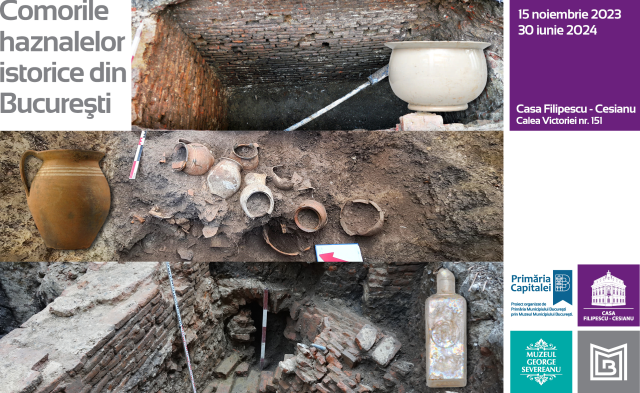
Bucharest’s cesspits are being researched by the historians and archaeologists from the Bucharest Municipality Museum on the occasion of excavations in the central area, aimed at the rehabilitation of some heritage buildings. From the archeological research in the Bucharest cesspits, from the stories of each object found there, one can notice how the Romanian society of the 19th century was transforming from an oriental to a western society.
Theodor Ignat, an archaeologist at the Bucharest Municipality Museum, worked on the construction sites and was our guide through the repulsive underground cesspits of Bucharest. We asked him to explain the new meaning that the Turkish word “hazna” has received in Romanian: “Hazna comes from Turkish and means treasure, treasury. We dont know exactly how it turned into a pejorative word today. It is supposed that the places sheltering valuable objects were hidden in the ground, and since these pits are dug into the ground I think this could be the connection. Probably, in the past, cesspits were also used to hide things because no one would have thought to look in the garbage.”
We asked Theodor Ignat what the purpose of the cesspit was: a toilet, a collecting canal or a pit: “I think all three, not necessarily at the same time. The objects that we find there are generally whole pieces, which means that there was an environment in which there was water or a liquid of some kind. But it’s possible for the cesspits to have also been used as toilets. Human waste decomposes, we havent found anything like that. Instead, we found organic matter, but it can mean anything. People didnt just throw excrement in the cesspits. They also threw away leftovers that, if thrown elsewhere, would have spoiled and smelled. So, it was more practical to throw them into a hole in the ground. The practice of throwing smelly food scraps into the ground has been recorded since the Neolithic. The cesspit could also be a landfill, it has multiple roles. A colleague came up with a new explanation that we need to check, namely that these places were used as ice houses.”
The objects recovered from the Bucharest dumps were displayed in the Museum of Urban Anthropology within the Bucharest City Museum in an original exhibition. Objects were collected from a number of Bucharest cesspits, such as the one in the yard of Sfântu Dumitru church in the old center, the one of the Mavrogheni church near the current Romanian government offices, the cesspit of a drug store in the former Jewish quarter and the sewer network under the building of the former Marmorosch –Blank Bank, also in the old city centre. On display are beautifully painted porcelain vessels, most of them imported, flower pots, pharmaceutical and, cosmetic containers, a very expensive perfume bottle with the monogram of the Roger & Gallet perfumery in Paris but also tubes of toothpaste.
Theodor Ignat tell sus what people used to throw in the cesspits: “All sorts of objects. Many of them could not be found because they were made of perishable materials such as wood, vegetable fibers or leather. And then, we find objects that passed the test of time under the ground. In general, we find a lot of pottery of all categories and types. There is no specific category of pottery thrown into the cesspits. Imported vessels that, once broken, were no longer needed, were thrown away. On the other hand, we also find whole pots and we ask ourselves why would anyone throw away a whole pot? “
The cesspits were built at a distance of 10 to15 meters from the church or theinhabited area. Although they were not at a long distance, they were built so as not to smell or be a source of infection. Theodor Ignat says that a cesspit was a complex work: “It was an elaborate work, at least the brick part, and they were built specifically for this purpose, they were not reused rooms. They were covered somehow, the walls are very well sealed, and a sand and lime mortar was poured on the bottom of them which prevents the forming of mud. They were made in such a way that I think they were emptied periodically.”
From the cesspits of Bucharest, archaeologists brought to the surface objects of the material civilization of the past, that people no longer needed. But today they are a fascinating story, part of a life that is also ours. (LS/EE)