The Eurasian griffon vulture returns to Romania
The Făgăraș Mountains are preparing to host an emblematic species that disappeared from Romania during the communist era: the griffon vulture.
Daniel Onea, 30.01.2026, 14:00
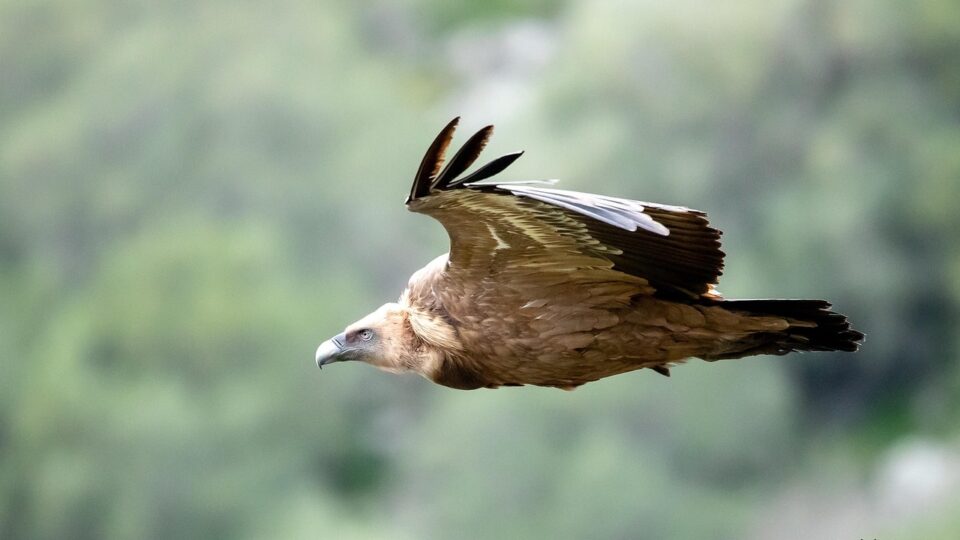
The Făgăraș Mountains are preparing to host an emblematic species that disappeared from Romania during the communist era: the griffon vulture (Gyps fulvus). The Conservation Carpathia Foundation, together with international partners and with the support of local communities in Arges County, has launched a large-scale program to reintroduce this species vital to the ecosystem. Robert Zeitz, an ornithologist and expert directly involved in the program, says that in Romania there used to be large populations of vultures. Currently, they are considered extinct, and their reintroduction is a natural step towards restoring the ecological balance.
Robert Zeitz: “It is essential to bring these birds back into our fauna, because they play an important sanitary role. The griffon vulture is strictly a scavenger. It feeds only on dead animals. Through its presence, the ecosystem becomes healthier. The most important causes of their disappearance were shooting, the theft of eggs from nests and systematic, direct persecution. Apart from these there were poisoning campaigns directed against fur-bearing predators, such as foxes, wolves or bears. After Romania’s accession to the European Union, the legislation changed positively, and all these activities became illegal. Therefore, the most important factors that led to the disappearance of vultures no longer exist. Although certain limiting factors of lesser importance are still present, specialists believe that the time has come for the griffon vulture to repopulate all the historical areas it occupied in the past.”
Risks exist in any reintroduction program, but they are reduced when the local communities and health authorities get actively involved. Robert Zeitz emphasizes that modern technology and human involvement are the keys to success: “Monitoring with GPS transmitters makes it possible to reduce risks: possible poisoning outbreaks can be identified very easily and quickly, and the culprits can be held accountable. We have modern methods for locating released birds, we can track their movements and, if a problem arises, we can intervene quickly. In the vast majority of cases, communities are delighted. There are numerous positive examples in countries such as Greece, Italy, France or Spain, where the presence of vultures attracts a significant number of visitors. Therefore, we can develop local tourism, which is beneficial for communities. The sociological aspect is also important. Vultures attract tourists and create jobs. We will build an information center, “Casa Vulturilor” – House of Vultures in Valea Mare Pravăț commune, following the model of those already existing for bison or beavers. Locals also benefit from an economic point of view. Since these birds consume dead bodies, we could take over dead animals from households for free, saving farmers the costs of cremation.”
The birds are brought from Spain because this country has one of the most stable populations of griffon vultures in Europe. The partners of the Conservation Carpathia Foundation have experience in relocation and know where to extract the specimens, Robert Zeitz explains: “The vultures that will arrive here come from rehabilitation centers. They are birds that have had minor health problems or have been weakened, but have recovered and are fit to be released into the wild. Instead of being released to Spain, they will be brought to Romania. An acclimatization aviary is currently being built near the town of Rucăr. Once in the country, the vultures stay in this space for approximately six months, during which they become familiar with the area and the landscape of the Făgăraș Mountains. The release will be done using the “soft release” method. The aviary is opened, and the birds can fly out whenever they want, with the possibility of returning. This method, already established in other countries, reduces stress, and the birds tend not to leave the area. All specimens will be equipped with satellite transmitters. We are talking about young birds, which will spend their maturation period in our area. They reach sexual maturity at 4-5 years, at which point they will start nesting here. It is vital to eliminate major risks, such as poisoning or electrocution. If this project is successful, we could continue with the reintroduction of the black vulture and the bearded vulture.”
The griffon vulture weighs between 6 and 11 kilograms, has a body length between 93 and 122 centimeters, and a wingspan of 2.4–2.8 meters. The female lays a single egg per year, and both parents care for the chick until it becomes independent. The time horizon for population recovery is a long one, requiring patience.
Robert Zeitz: “Our plan is to bring, for 5-6 years, between 18 and 22 specimens annually. We hope that the first pairs will form in 3-4 years, and that the first egg laying will take place in 4-5 years. We estimate that we will have a stable, self-sufficient population of griffon vultures in Romania in approximately 8-10 years. It is a slow process, because these birds have a long life, living for several decades, and their biological rhythm requires patience to see concrete results.”
Through this project, Romania aligns itself with European efforts to restore vulture populations and follows the example of countries that have succeeded in either reintroducing or consolidating existing populations, from the griffon vulture in Spain, France and Bulgaria, to the bearded vulture in Switzerland, Austria or Germany. The return of the griffon vulture, after 70 years, represents more than the repair of a historical mistake, it is a sign that nature conservation in Romania has evolved, a process in which man and nature are learning to coexist again. (LS)