Rethinking space
A local scientific discovery has created the perfect opportunity for a new artistic approach.
Ana-Maria Cononovici, 03.02.2026, 14:00
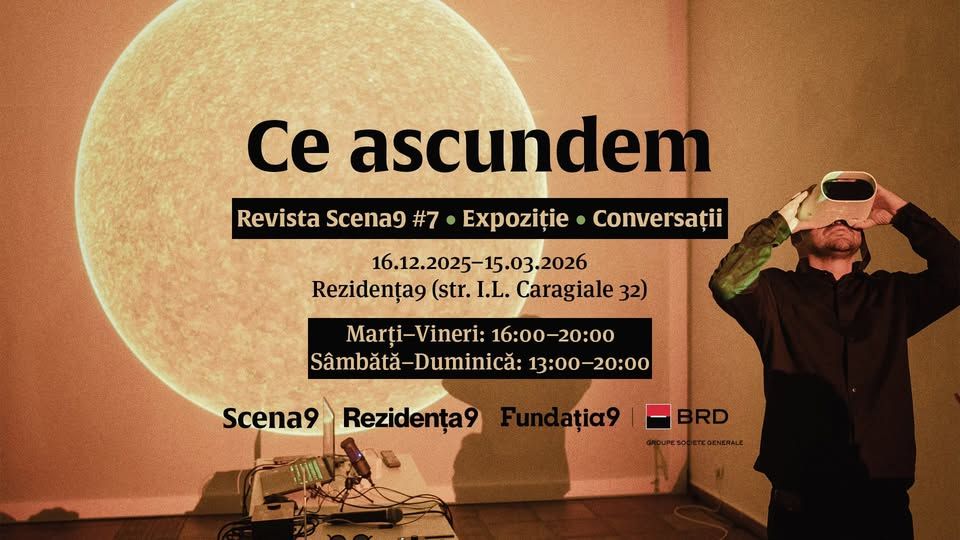
A cluster of stars bears the name Bârlad. A phenomenon first seen by the human eye at the Astronomical Observatory in Bârlad. A poetic experience, yet one grounded in rigorous science. In Bucharest, at Rezidența9, visitors are invited to a series of related events and to the collective exhibition “What We Hide”, developed from issue no. 7 of Scena9 magazine. The exhibition continues a unique cultural project in Romania, where journalism is transformed into installation, and stories step out of print to be lived as a shared experience, at Rezidența9. Andra Matzal, coordinating editor of Scena9, spoke to us about the project.
“The exhibition ‘What We Hide’, which is on at Scena9 in Bucharest until March 15 this year, is built around the newest printed issue of Scena9. The magazine appears once a year and always has a central theme. This time, the theme is precisely ‘what we hide’, because I realized that we are extremely good at hiding, both as individuals and as a species. So, we explore this theme from many angles: personal, social, family, and then we expand the spectrum all the way into science. And we reach the idea that even the environment we live in, the space around us, has many things to hide, if we do not know how to look at them.”
Andra Matzal also told us that one of the chosen perspectives for relating to others was a scientific one—indeed, a cosmic one.
“We started from the observations and discoveries made, quite unexpectedly, at the Astronomical Observatory in Bârlad, where an astronomer named Ciprian Vîntdevară has made some of the most important astronomical discoveries in Romania: a giant star, larger than the Sun and far brighter, whose light reaches us from 21 million years ago; and many variable stars, which he named after the city of Bârlad. Around this work, my colleague Ionuț Sociu wrote a report for the magazine, and from that story we built, together with the Augmented Space Agency, two interactive installations for the exhibition ‘What We Hide’.”
The Astrobinocular in the exhibition is a portable virtual planetarium, accessed through a VR binocular device. It allows visitors to explore cosmic structures, constellations, and the discoveries made at the Bârlad Observatory, in an immersive and interactive way. The same translation of science into experience is found in SOL, an audiovisual installation built from solar scientific data provided by a global network of observatories. Under the light of a virtual sun, two of the researchers behind these discoveries were also present at the exhibition: Ciprian Vîntdevară, astronomer and museographer at the “Vasile Pârvan” Museum in Bârlad, and Florentina Pîslan, who has worked since 2021 at the Institute of Space Science, in the Laboratory of Astrophysics, Cosmology and Theoretical Physics. She studies gravitational waves produced by binary black hole systems, within the context of the LISA space mission (Laser Interferometer Space Antenna). She is a PhD candidate at the Faculty of Physics at the University of Bucharest and is actively involved in science communication and outreach, serving as a trainer with Games of Science since 2024. Andra Matzal gave us more details.
“At the Astronomical Observatory in Bârlad, more precisely at the ‘Vasile Pârvan’ Museum, there is an entire community of passionate astronomers gathered around the work of Ciprian Vîntdevară. As we know, in Romania both culture and research are underfunded, and yet the motivation and dedication of certain people have made all this possible. From this point on, it is no longer just research activity. What I find absolutely essential is that this research comes alive in the city itself. There are many young people and people of all ages who gather around the Observatory, who publish a specialist magazine, who set off on observation camps. It seemed to me a subject that could give us a little hope in an increasingly dark and pessimistic world. That is why we chose to focus some of our attention on how astronomical and space research is done in Romania, and on the fact that even under unfavourable conditions, there are people doing work that truly matters.”
Andra Matzal also told us what else visitors can discover in the exhibition.
“Within the exhibition ‘What We Hide’ we have several types of events, which we organise together with our colleagues at Rezidența9 until March, starting from each room of the exhibition. Each room covers a certain type of space, with its own hidden layers. We will talk about migration. We will talk about personal stories. About what happens when personal space intersects with political space. About what women’s rights mean, and what violence against women means, and how, socially, we are skilled at hiding such things. About what it means to hide our illnesses from those close to us. At the same time, we will also host workshops with artists, to help all of us—whether or not we are artists, young or old, children or adults—come closer not only to art, but also to the complex subjects addressed in Scena9, which are, in fact, part of all our lives.”
At Rezidența9, until March 15, the focus will change every week. There will be invited guests and events, offering audiences the chance to meet some of today’s most relevant artists and thinkers. (VP)