Romanian winter traditions
“A Journey through Winter Traditions” and “Christmas and New Year Customs and Traditions Festival, the White Flowers” are two of the events that the “Dimitrie Gusti” National Village Museum in Bucharest regularly organizes around the holidays.
Ana-Maria Cononovici, 30.12.2025, 14:00
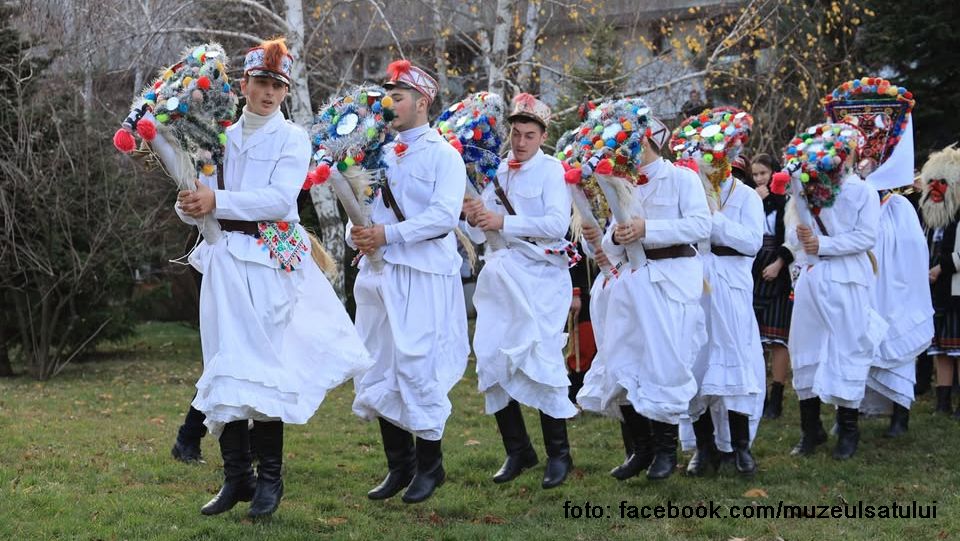
The Goat, the Bear, the Masks, the Moşoaiele, a masked celebration on Christmas Eve, which takes place in the commune of Luncavița in Tulcea county as well as the Star and the Little Plough are traditions that, in the past, prepared the atmosphere of the winter holidays, also having the role of chasing the evil spirits from the households. Elements of this traditional folk theater are still preserved on the streets of today’s cities, and the cultural institutions are making efforts to pass them on to the younger generations.
“A Journey through Winter Traditions” and “Christmas and New Year Customs and Traditions Festival, the White Flowers” are two of the events that the “Dimitrie Gusti” National Village Museum in Bucharest regularly organizes around the holidays. Iuliana Mariana Balaci, director of communication and museum education at the “Dimitrie Gusti” National Village Museum in Bucharest, first spoke to us about the event “ A Journey through winter traditions”: “The “Dimitrie Gusti” National Village Museum has been organizing the program “A Journey through traditions” for five years, which includes four major projects: “Journey through spring traditions”, “Journey through summer traditions”, through autumn and winter traditions. We thought how to better capitalize on traditions, once we have identified the traditions of each season, especially those related to the agro-pastoral calendar, the traditional calendar, than through a series of creative workshops, which also involve story telling. And here we are, ending with the program “A Journey through Winter Traditions”, a very beautiful cycle; we have reached the end of the year, the season of winter holidays that begin with Saint Andrew and end in January, with the Epiphany, which is why the museum marks them with a series of workshops dedicated to children, and also to parents. During these workshops, children are invited to discover winter traditions, by making a caroling bag, decorations to put on the tree or that can be given to the loved ones for the holidays, the December 1 belt, the three-color belt, then the Star, the New Year’s blessing stick or Sorcova in Romanian and folk masks.”
There are also candle-making and book illustration workshops, which, beyond the folk art workshops, complete the winter holiday atmosphere. And since parents sit by their children’s side, these workshops mean quality time spent with the family, on Saturdays or Sundays, Iuliana Mariana Balaci, director of communication and museum education at the “Dimitrie Gusti” National Village Museum, told us, and she also added: “It is good that these traditions are known by children, and children can only learn them if they are shown and told by adults. The program ‘A Journey through Winter Traditions’ always has the most participants, because, firstly, it is cold outside and people are looking for solutions to spend quality time as a family, with their children, and secondly, there are children between 4-12 years old, who want to make something else than what they do in kindergarten or school. Adults are delighted to be able to offer them part of what they experienced in their childhood, in the village of yore. Generally, there are at least 10 participants in the workshop, there are always more than ten, we even reach 15 children, which challenges us to look for larger spaces inside the museum. And, always, those who come to these workshops also visit the village museum and somehow mark the rediscovery of the heritage.”
Beyond activities for children, the National Village Museum “Dimitrie Gusti” also organizes popular events targeting adults. Iuliana Mariana Balaci, director of communication and museum education at the National Village Museum “Dimitrie Gusti”, gives us details: “In December, one of the most important events, which is addressed to the general public, is the “Festival of Christmas and New Year Customs and Traditions, the White Flowers”, an event that is part of the “Seasons at the Village Museum” program and marks the very moment of carols. In general, at the Village Museum, on the first day of the festival we highlight the carols from all areas of the country and on the second day of the festival we have a parade of folk customs and especially the groups of masked people and carolers, from several areas of Romania, focusing on the areas where they exist spontaneously. I am referring to the areas of Maramureş and Bukovina, all those groups representing various characters such as Horses, Boyar Bears, the Goat, the Deer and the Bear. In the eastern part of the country we also have the skulls from Luncaviţa, in the southern part we have the Brezaiele. We have the Goats from the Bistriţa-Năsăud area and the carolers from the western part, from Transylvania, the men’s carol. All these groups of carolers gather at the Village Museum to be part of a big festival and show the traditions of the villages they come from, being the representatives of the ethnographic areas and even of the historical provinces.”
Groups come from far away to present genuine events whose authenticity can be confirmed by researchers at the village museum. In villages, these events take place between Christmas and the New Year, and even after, in some cases. (LS)