The Duck Billed Dinosaur from Hateg Country
The Hațeg Basin is one of the most important places in Europe for the study of dinosaurs
Călin Coțoiu and Ana-Maria Cononovici, 31.03.2026, 14:00
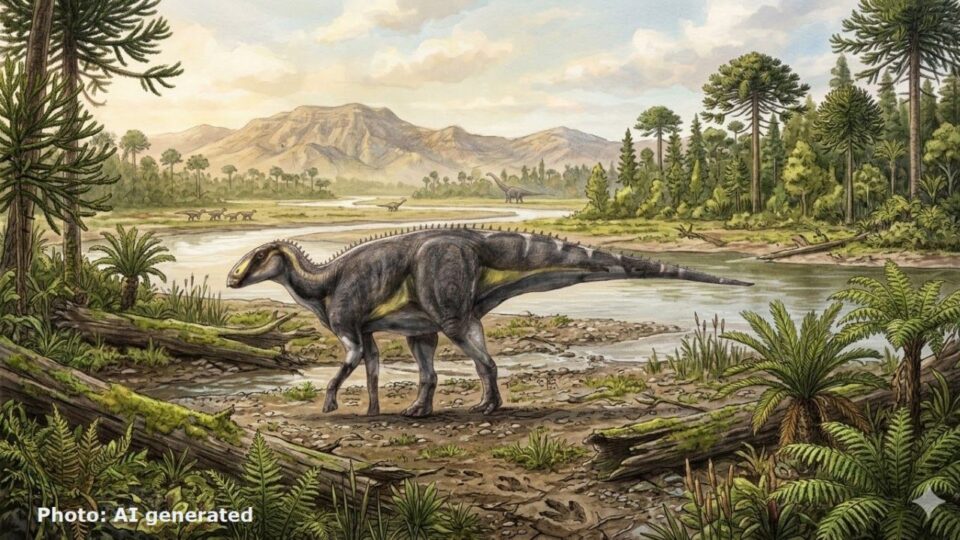
The Hațeg Basin is one of the most important places in Europe for the study of dinosaurs from the Late Cretaceous. Paleontologists from the University of Bucharest and the Eötvös Loránd University of Budapest recently discovered a new species of dinosaur in the territory of the Țara Hațegului UNESCO International Geopark.
Zoltan Csiki-Sava, Associate Professor and researcher at the Faculty of Geology and Geophysics of the University of Bucharest, spoke to us about this new discovery:
“It is about identifying a new genus, or a new species of dinosaur, from the group we call duck-billed dinosaur. Interestingly, the first dinosaur that was identified in Romania, in the Haţeg area, more than a hundred years ago, was also a duck-billed dinosaur. And when we discovered this skeleton, obviously, we compared it with this first species. And, to our surprise, we realized that it is something different, and that it also comes from a different area of the Haţeg basin and, apparently, according to all our estimates, from rocks that are somewhat older. So it is about a new species of dinosaur, with a duck beak, which is different from the so-called Telmatosaurus Transylvanicus, identified by Franz Nopcsa over a hundred years ago.”
And this proves that the dinosaur fauna of Haţeg Island, 70 million years ago, was more diverse than previously thought, our interlocutor also told us, mentioning that in recent years we have been in a fortunate period of discoveries in the area, and added:
“This series of discoveries began about eight years ago, with the identification of a new species, a new genus of mammal, which lived at the same time as dinosaurs, after which a small Crocodilian that lived in this area was identified, a turtle and, starting in 2022, 5 new species of dinosaurs have been identified so far, from the Haţeg area actually. All the dinosaurs that have been identified recently are herbivorous dinosaurs, so basically what we have done is we have increased quite a lot the diversity of herbivores that populated this island and that we can show that they lived in different periods, were part of different associations. So basically these new discoveries show us that the evolution of this island existed, the dinosaur faunas, the vertebrate faunas, over millions of years, changed, new species appeared, which replaced those that existed previously. It is a period in which we managed to add quite a lot of important information, related to the composition of this island fauna. Perhaps the most interesting news that emerged is the one that was published at the beginning of this year, in which not only did we manage to add new species of dinosaurs, related to those previously known, but we managed to show that some dinosaurs that we had already known for some time, in fact, are not what we considered them until now, they are not part of the group that we considered them to be part of until now, but represent a group of completely new dinosaurs, the so-called horned dinosaurs, or Ceratopsians, and which have not been found in the European archipelago until now.”
And because, in the Geopark, information must be brought to the attention of the public in an attractive way, we invited Zoltan Csiki-Sava, Associate Professor and researcher at the Faculty of Geology and Geophysics at the University of Bucharest, to tell us the story of the “Duck-billed Dinosaur”:
“The most interesting story, perhaps, is not related to the Haţeg area, but to the broader significance of this animal. Because we have talked so far about the Haţeg area, which 70 million years ago was an island area. But it was not the only island area, practically all of today’s Europe was a huge archipelago, made up of islands of different sizes and separated by sea canals, which practically ended up isolating these animals on different islands, and made each island have a separate species of dinosaur. That is why, for example, in Haţeg, we have many names that indicate exactly this. Dinosaurs called Transylvanicus, or Zamolxes, or Transylvanosaurus, and so on, showing that we are dealing with animals that are only known from here. And the newly discovered dinosaur, which was named Kryptohadros, which means the hidden duck-billed dinosaur, because for over a hundred years it was not discovered, it remained hidden from researchers, this dinosaur showed us that its closest relative was actually on another island in an area that today represents the northern part of Italy. Basically, the newly discovered dinosaur indicates kinship relations between the dinosaurs from the Haţeg area and the dinosaurs from this area of Italy, and probably also a dinosaur that was recently discovered in Bulgaria. And the interesting thing is that practically at the same time, a little later, duck-billed dinosaurs also appear in the western part of Europe, in Spain, in France, in another island area, but they seem to be totally different. And this tells us the following thing: that practically the European archipelago was colonized by different waves of duck-billed dinosaurs, who came from Asia, and some of them, reached southeastern Europe, colonized this area, and remained on these islands, while others somehow bypassed that region, probably through northern Europe, and reached western Europe and populated those islands, and from there they even reached northern Africa.”
Our interlocutor also launched a comparison over time, emphasizing that this whole story with different waves of migrations from Asia, which ended up colonizing different parts of Europe, could find a very interesting historical correspondence with the waves of migratory peoples, who at the beginning of the Middle Ages, the end of Antiquity, also came from Asia and ended up colonizing different regions, including some, the Vandals, reaching North Africa, in the same area where the dinosaurs from Europe arrived 70 million years earlier.