
RRI Live!

Listen to Radio Romania International Live

Architect Duiliu Marcu

Used to think of Bucharest as the Little Paris, with its 19th century and La Belle Époque buildings, we forget that the Romanian capitals architecture started to be modernized as early as the interwar period, more precisely in the 1930s; and it was moder
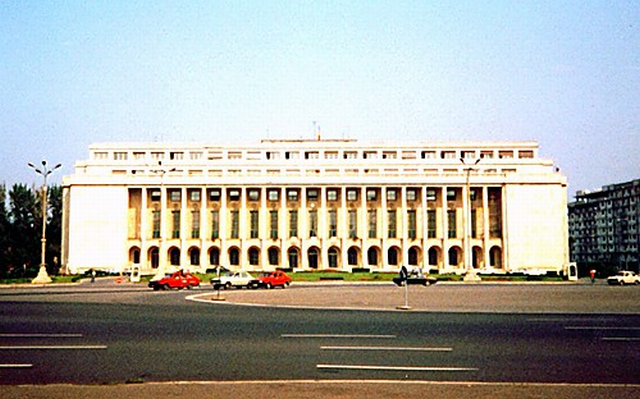
Architect Duiliu Marcu

, 16.08.2014, 14:14


Used to think of Bucharest as the Little Paris, with its 19th century and La Belle Époque buildings, we forget that the Romanian capital’s architecture started to be modernized as early as the interwar period, more precisely in the 1930s; and it was modernized according to the latest and most avant-garde trends of the time, visible today in the architecture of emblematic buildings such as Victoria Palace, which is currently hosting Romanian Government’s offices, or “Carol 1st” National Defense University. Those buildings, and others, were designed by Romanian architect Duiliu Marcu.


Art historian Oana Marinache will next tell us a few things about him and his work: “ He was born in Calafat, Southern Romania, in March 1885, into a rather poor family. Thanks to his own efforts and resilience, he managed to get as far as the School of Fine Arts in Paris, and studied architecture. The training there was academic, and that can be seen in many of his works in Bucharest and the provinces. From a stylistic point of view they can be described as belonging to historicism, an adaptation of 19th century elements in an eclectic combination of French tradition. He also authored some works that belong to the neo-Romanian style. In the 1930-1940 period, when Romanian architects started adjusting to the international modernist style, Duiliu Marcu too embraced the style and adapted it according to his own personal vision, creating what we can call today ‘the Duiliu Marcu style’. His best known works belonging to that style are Victoria Palace, the extension of the Romanian Academy Library, as well as town planning works commissioned probably by King Carol 2nd.”


Of the buildings designed by Duiliu Marcu and erected in the 1930s and 1940s, worth mentioning are the ones that originally hosted the Autonomous Agency of State Monopolies and the Romanian Railways Palace, currently the head offices of the Economy Ministry and the Transport Ministry, respectively. The building of the old Athenee Palace hotel, next to the Romanian Athenaeum, was also designed by Duiliu Marcu. But what defines his style?


Art historian Oana Marinache tells us: “He tried to adjust the international style to the Romanian landscape, in general, and to Bucharest in particular. In theory, they should have been buildings free from any decorations, standing out thanks to their geometrical aspect and their bulkiness, as well as to their large windows. Emphasis was laid on that kind of surfaces that allowed good lighting in the rooms and on comfort. On the other hand, we do see some decorative elements, such as the red brick. Naturally, Duiliu Marcu worked with various contractors, and most of the craftsmen and stonemasons at the time came from Italy. And they, too, brought a new air to those buildings.”


Although he was an advocate of the modern style, in his early years, Duiliu Marcu also designed some more classical-style buildings. Jointly with architect Nicolae Ghika-Budesti, he worked on a new wing of the Bucharest University building. After the communists had come to power, Duiliu Marcu adapted to the new regime, and even became a member of the Romanian Academy in 1955 and president of the Romanian Architects’ Society between 1953 and 1963. He died in 1966, and details about his adjustment to the communist system and his own tribulations after the war can be found in the excerpts from his diary, published by Georgeta Filitti in Romanian cultural periodicals.

Tags:
Sergiu Celibidache (1912-1996)
RRI Encyclopaedia Sunday, 01 March 2026

Diplomat Grigore Gafencu

Grigore Gafencu served his country without reservation and sought to promote its interests both in his official capacities and during his exile after...

Diplomat Grigore Gafencu
Lo scultore Frederic Storck
RRI Encyclopaedia Saturday, 21 February 2026

A Scholar of international repute – Traian Săvulescu

Traian Săvulescu used to be one of the leading figures of the Romanian science in the 20th century, a biologist, botanist, professor and president...

A Scholar of international repute – Traian Săvulescu
RRI Encyclopedia
RRI Encyclopaedia Sunday, 15 February 2026

General Henri Cihoski (1871-1950)

The history of the Romanians was also written by foreigners, just as Romanians are present in the history of other nations. Although a numerically...

General Henri Cihoski (1871-1950)
RRI Encyclopedia
RRI Encyclopaedia Saturday, 07 February 2026

The ancient city of Callatis

Callatis was an active commercial, cultural and spiritual center for over a millennium, spanning the Greek, Roman and Roman-Byzantine periods....

The ancient city of Callatis
RRI Encyclopaedia Saturday, 31 January 2026

Romania’s Strongest Trade Bank before WWII

Marmorosh-Blank used to be one of Romania’s strongest banking institutions before 1945. It functioned under two generations of bankers, the first...

Romania’s Strongest Trade Bank before WWII
RRI Encyclopaedia Saturday, 24 January 2026

Archaeology in Glina, near Bucharest

Under the visible layer of today’s Bucharest and the capital’s surroundings lie much older traces of human habitation, which predate the...

Archaeology in Glina, near Bucharest
RRI Encyclopaedia Sunday, 18 January 2026

Monuments from Soviet-occupied Bucharest

On pedestals, in imposing poses, they have to convey inspiring messages across generations. War heroes and heroines, kings and queens, politicians,...

Monuments from Soviet-occupied Bucharest
RRI Encyclopaedia Sunday, 11 January 2026

The Corneşti Iarcuri Citadel

Just a few kilometers from Timișoara (western Romania), in the town of Cornești in the Banat Area, there are traces of one of the most spectacular...

The Corneşti Iarcuri Citadel

Partners

Muzeul Național al Țăranului Român Muzeul Național al Țăranului Român
Liga Studentilor Romani din Strainatate - LSRS Liga Studentilor Romani din Strainatate - LSRS
Modernism | The Leading Romanian Art Magazine Online Modernism | The Leading Romanian Art Magazine Online
Institului European din România Institului European din România
Institutul Francez din România – Bucureşti Institutul Francez din România – Bucureşti
Muzeul Național de Artă al României Muzeul Național de Artă al României
Le petit Journal Le petit Journal
Radio Prague International Radio Prague International
Muzeul Național de Istorie a României Muzeul Național de Istorie a României
ARCUB ARCUB
Radio Canada International Radio Canada International
Muzeul Național al Satului „Dimitrie Gusti” Muzeul Național al Satului „Dimitrie Gusti”
SWI swissinfo.ch SWI swissinfo.ch
UBB Radio ONLINE UBB Radio ONLINE
Strona główna - English Section - polskieradio.pl Strona główna - English Section - polskieradio.pl
creart - Centrul de Creație Artă și Tradiție al Municipiului Bucuresti creart - Centrul de Creație Artă și Tradiție al Municipiului Bucuresti
italradio italradio
Institutul Confucius Institutul Confucius
BUCPRESS - știri din Cernăuți BUCPRESS - știri din Cernăuți

Affiliates

Euranet Plus Euranet Plus
AIB | the trade association for international broadcasters AIB | the trade association for international broadcasters
Digital Radio Mondiale Digital Radio Mondiale
News and current affairs from Germany and around the world News and current affairs from Germany and around the world
Comunità radiotelevisiva italofona Comunità radiotelevisiva italofona

Providers

RADIOCOM RADIOCOM
Zeno Media - The Everything Audio Company Zeno Media - The Everything Audio Company
























