The University Museum in Bucharest
The museum of the University of Bucharest was opened in 1967
Steliu Lambru, 29.08.2026, 14:00
The University of Bucharest was established and has operated under this name since 1864, following the founding of Romania through the union of the Principalities of Moldavia and Wallachia in 1859. However, it did not emerge out of nowhere; previously, there had been institutions of higher education in Wallachia, such as the Royal Academy, founded by Prince Constantin Brâncoveanu in 1694, where instruction was conducted in Ancient Greek. Thus, the University of Bucharest had a history and a heritage that, in 1967, allowed it to open a museum.
In 1964, the institution celebrated its centennial. On that occasion, cultural and educational events were organized to mark the milestone reached by Romania’s most important university. However, the University Museum would have to wait another three years before opening. Valentin Maier is a researcher at the University Museum and confirmed that the idea to commemorate the University was tied to the centennial, although it was put into practice a little later.
V. Maier: “It was connected to the centennial in ’64. About a year earlier, all the necessary preparations for this event had begun. We were living under a communist regime; our rector was Gheorghe Mihoc, a mathematician and an important scientist for Romania. Adrian Corbu was involved in all the work required to build the museum’s collection. In fact, the decision to establish a museum came after the centennial. The rector at the time was convinced that the University of Bucharest deserved to have a museum to preserve its history and showcase it to the general public, because Romania did not have many institutions in the country that were over 100 years old at that time.”
Every institution has a driving force, and the University of Bucharest Museum had Adrian Corbu. He was the one who initiated the sustained effort to gather a collection worthy of public display, to reconstruct moments in the University’s history, and to bring back into the spotlight the names of professors and alumni who have had a profound impact on Romanian history.
V. Maier: “Adrian Corbu began collecting various objects. This included works of art, decorative items, written documents, of course, photographs, and so on. He gathered everything he could to best illustrate the history of the University of Bucharest and beyond. And this is still evident today, namely the history of higher education itself. He managed to build this collection gradually; later, however, naturally, the collection had to be expanded—it wasn’t sufficient. The University of Bucharest allocated funds toward this end, to expand the collection. Several announcements were published in the press at the time, calling on those who wished to contribute to make donations. It was even announced that those who wished to contribute would also be able to receive money. Work was carried out in archives and libraries to identify useful documents.”
A museum houses many types of valuable artefacts that pique the interest of anyone curious enough to step inside. Valentin Maier:
V. Maier: “The exhibits consist mainly of documents—written documents. There are also photographs, as well as a few objects that belonged to professors over the years or that have become part of the institution’s collection: medals, plaques, a few flags, a model of the University Palace, student ID cards, stamps, and many other items. Of course, there are books and all kinds of other written documents, as well as diplomas and other records, either originals or copies.”
Among the exhibits at the University Museum is a unique model. We asked Valentin Maier about its history.
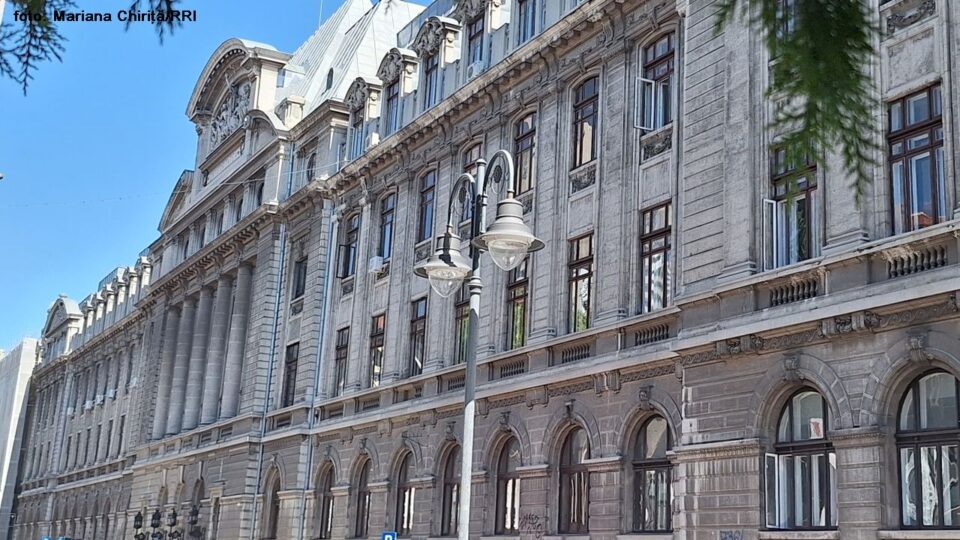
V. Maier: “It’s the University Palace in Bucharest, depicted in its original form—that is, the design created by architect Alexandru Orăscu, a professor of geometry at the Faculty of Sciences of the University of Bucharest. He managed to oversee all the necessary work to build the University Palace over a fairly long period. That was between 1857 and 1869. We have to remember that in 1857, after all, Romania wasn’t even a country yet. He worked, however, as best he could given the circumstances of those years. The Palace was completed later, during the reign of Carol I; it was a palace for a small number of professors and a small number of students. The University Palace housed not only the University of Bucharest but also other representative institutions of the state. This means it also housed the Romanian Senate, the National Museum of Antiquities—which today we might identify as the National Museum of Romanian History—the Art Gallery, and the School of Fine Arts.”
The University of Bucharest Museum is also unique because it can be visited online; it features a website rich in content and an interactive Facebook page. Whether accessing the site via a computer, laptop, phone, tablet, or other electronic device, visitors are transported into a diverse world. Temporary exhibitions and reproductions of historical documents are thus brought closer to the virtual visitor. (MI)