
RRI Live!

Listen to Radio Romania International Live

Block of Flats in Romania

Most people in Romania live in blocks of flats, the most prominent feature of 20th century urban civilization.
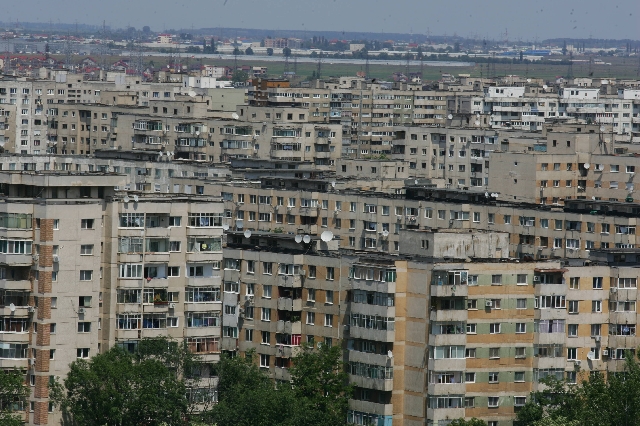
Block of Flats in Romania

, 15.02.2014, 14:00

They were mainly built during the communist regime, between 1950 and 1989. Besides a job and a car, an apartment in a block of flats was the sign of social ascent and escape from the narrow rural environment. Romania’s urban development and planning were tightly linked with the process of industrialization, during which entire neighborhoods of blocks of flats were built near plants and factories.


Blocks of flats, however, are an invention of western civilization, based on the principle of strict order and regulations, inspired by the classical utopia of the perfect society, the organization of monasteries and military barracks. The socialist phalanstery imagined by Charles Fourier in the first half of the 19th century was not far from the reality of the blocks built later. The Socialist thinking associated blocks of flats to progress and the working class, as having a house with a yard was seen as a sign of bourgeoisie. The sobriety, minimalism and functionality of blocks of flats prevailed in the shaping of a new trend in architecture.


The block as a trend in Romania emerged in early 1920s, after the creation of Greater Romania, and gained momentum in the 1930s, when Americanism started to become popular. Young people from rich families would no longer want to live in their parents’ big houses and would claim their independence by buying for themselves an apartment in downtown Bucharest or other city. It was also then that the modernist architecture of Romanian towns started to gain shape, incorporating multi-storey block of flats, made of concrete.


Young Romanian architects educated abroad, especially in Paris, brought to Romania the latest trends in the Euro-American urbanism. Architect, painter and essayist Marcel Iancu and architect Horia Creanga, writer Ion Creanga’s grandson, were two of the most representative promoters of modernist and cubist architecture. Thanks to them, the Magheru and Calea Victoriei boulevards became home to the most ambitious and futurist blocks built in Romania. One of the best known such building was the 14-storied Carlton, which collapsed though during the earthquake of November 10th, 1940. Other famous blocks in interwar Bucharest were Wilson, Aro and Nestor.


After 1950, the enlargement of the capital city and of other towns was done according to a systematic policy of building blocks for the working class. Bringing people from villages to towns and cities increased the demand for such blocks. Their configuration was very much to the liking of the political police, as people were much easier to control. The standard blocks had 4 and 10 storeys. Tower blocks started to be built in the 1980s. Statistics show that in 1989, some 75% of Bucharest’s inhabitants lived in a block of flats. One of the most representative buildings of the communist period was the Intercontinental Hotel, built between 1968-1970.


After 1989, tower blocks made of glass and steel started to emerge in Romania, as office buildings for multi-nationals and later, after 2000 as apartment buildings. The modern trends led to the incorporation of glass forms in historical buildings, such as the Novotel Hotel in Bucharest, whose façade recalls the building of the National Theater, destroyed by bombardiers in August 1944.


RRI Encyclopaedia Sunday, 11 January 2026

The Corneşti Iarcuri Citadel

Just a few kilometers from Timișoara (western Romania), in the town of Cornești in the Banat Area, there are traces of one of the most spectacular...

The Corneşti Iarcuri Citadel
RRI Encyclopedia
RRI Encyclopaedia Sunday, 04 January 2026

Ion Monoran

The Romanian Revolution of December 1989 created modern heroes—the heroes of the anti-communist civic movements whose goal was for human beings to...

Ion Monoran
Muzeul Fluierelor Lumii
RRI Encyclopaedia Saturday, 27 December 2025

The Museum of Flutes from around the World

Ion Puican The Museum of Flutes from around the World is a cultural project initiated by the ISVOR Cultural Association, dedicated to the...

The Museum of Flutes from around the World
RRI Encyclopedia
RRI Encyclopaedia Saturday, 20 December 2025

The Bucharest of Yesterday in Postcards

The transformations we see in today’s Bucharest are effects of the communist regime, of the bulldozers and cranes that tried to legitimize an...

The Bucharest of Yesterday in Postcards
RRI Encyclopaedia Sunday, 14 December 2025

The “Prof. Nicolae Minovici” Museum in Bucharest

  The building that houses the “Prof. Nicolae Minovici, Ph.D.” Folk Art Museum, affiliated to the Bucharest City Museum (MMB), is known to...

The “Prof. Nicolae Minovici” Museum in Bucharest
RRI Encyclopaedia Saturday, 29 November 2025

The Last Prince of Moldavia, Grigore Alexandru Ghica

The earthly remains of the last prince of Moldavia before the Union of the Romanian Principalities in 1859, Grigore Alexandru Ghica (1804-1857), have...

The Last Prince of Moldavia, Grigore Alexandru Ghica
RRI Encyclopaedia Saturday, 15 November 2025

The Art House of Sibiu

The ASTRA Museum in Sibiu is one of the largest and most complex open-air museums in Europe, dedicated to the promotion of Romania’s material...

The Art House of Sibiu
RRI Encyclopaedia Sunday, 09 November 2025

Sergiu Celibidache (1912-1996)

  The conductor Sergiu Celibidache was one of the major personalities of European and international classical music in the second half of the...

Sergiu Celibidache (1912-1996)

Partners

Muzeul Național al Țăranului Român Muzeul Național al Țăranului Român
Liga Studentilor Romani din Strainatate - LSRS Liga Studentilor Romani din Strainatate - LSRS
Modernism | The Leading Romanian Art Magazine Online Modernism | The Leading Romanian Art Magazine Online
Institului European din România Institului European din România
Institutul Francez din România – Bucureşti Institutul Francez din România – Bucureşti
Muzeul Național de Artă al României Muzeul Național de Artă al României
Le petit Journal Le petit Journal
Radio Prague International Radio Prague International
Muzeul Național de Istorie a României Muzeul Național de Istorie a României
ARCUB ARCUB
Radio Canada International Radio Canada International
Muzeul Național al Satului „Dimitrie Gusti” Muzeul Național al Satului „Dimitrie Gusti”
SWI swissinfo.ch SWI swissinfo.ch
UBB Radio ONLINE UBB Radio ONLINE
Strona główna - English Section - polskieradio.pl Strona główna - English Section - polskieradio.pl
creart - Centrul de Creație Artă și Tradiție al Municipiului Bucuresti creart - Centrul de Creație Artă și Tradiție al Municipiului Bucuresti
italradio italradio
Institutul Confucius Institutul Confucius
BUCPRESS - știri din Cernăuți BUCPRESS - știri din Cernăuți

Affiliates

Euranet Plus Euranet Plus
AIB | the trade association for international broadcasters AIB | the trade association for international broadcasters
Digital Radio Mondiale Digital Radio Mondiale
News and current affairs from Germany and around the world News and current affairs from Germany and around the world
Comunità radiotelevisiva italofona Comunità radiotelevisiva italofona

Providers

RADIOCOM RADIOCOM
Zeno Media - The Everything Audio Company Zeno Media - The Everything Audio Company























