Historian Gheorghe Brătianu
Among the leading figures in 20th-century Romanian historiography, Gheorghe I. Brătianu holds an important place.
Steliu Lambru, 13.09.2026, 14:00
Among the leading figures in 20th-century Romanian historiography, Gheorghe I. Brătianu holds an important place. Gathered around the ‘Revista Istorică Română’ (Romanian Historical Magazine) in the 1920s, the young scholars of that time, Constantin C. Giurescu, Petre P. Panaitescu, Gheorghe I. Brătianu, and others, proposed new principles of historical methodology to move away from the positivist thinking that had prevailed until then and founded the New School. In that spirit, Brătianu excelled through his writings and was considered by many to be the leader of his generation.
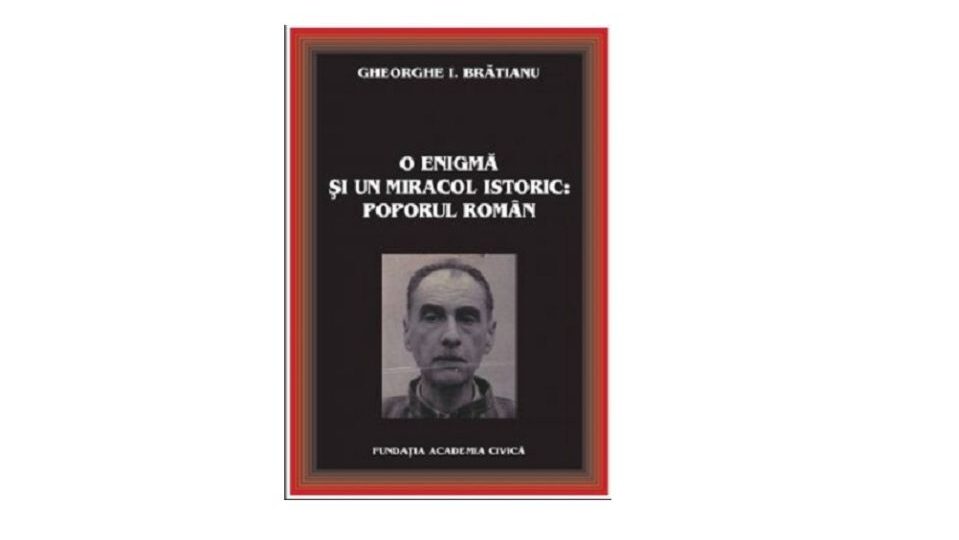
Born on January 28, 1898, in Ruginoasa, Iași County, Gheorghe I. Brătianu was the son of the Liberal politician Ion I. C. Brătianu and his first wife, Princess Maria Moruzi-Cuza. Although he held a law degree, Brătianu was deeply drawn to history, which he studied at the Sorbonne. There, in 1929, he earned his doctorate with a dissertation on Genoese trade in the Black Sea region during the 13th century. As a product of the French educational system, Gheorghe Brătianu was influenced by the French Annales School of historiography. He was a university professor and a member of the Romanian Academy. Among his extensive historical works, the volumes ‘An Enigma and a Historical Miracle: The Romanian People’, ‘The Historical Tradition Concerning the Founding of the Romanian States’, and ‘The Black Sea’ are the best known and most highly regarded.
Like other young people of his generation, Brătianu fought on the front lines of World War I and was involved in politics. Furthermore, Brătianu also took part in the fighting in Crimea during World War II until 1942. He was married to Princess Elena Sturdza, with whom he had three children, and died in detention at the Sighet prison at the age of 55. He is considered one of the symbols of Romanian patriotism. When he was offered the chance to leave for France to avoid arrest, he reportedly said, ‘A Brătianu never leaves his country.’
As a politician, Brătianu led a faction of the National Liberal Party that was close to the authoritarian regime of King Carol II. Although a Francophile, during World War II Brătianu advocated for an alliance with Nazi Germany. After the communist regime took power in 1945, Brătianu was arrested and imprisoned in Sighetul Marmației, like most Romanian democratic politicians.
In a 1996 interview with the Oral History Center of Romanian Radio Broadcasting Corporation, another prominent Romanian historian, Petre Ș. Năsturel, recalled the circumstances leading up to the arrest of Gheorghe I. Brătianu in 1950: “I knew Professor Brătianu, but I hadn’t majored in history, I’d majored in Greek, Latin, and Byzantine philology. But the professor cared about me and even wanted to hire me at Iorga’s Institute of History, which he headed. But one day, a grim day, Professor Gheorghe Brătianu, along with other internationally renowned researchers and scholars, was forced to stay at home. The question arose of how to get the publications to them so they could continue working from home and how to get their papers published. And so an entire network was organized, involving Mrs. Elena Brătianu, the professor’s wife, Professor Mihai Berza, myself, and a French Catholic priest, Father Emil Jean, who had remained at what had been the French Institute of Byzantine Studies on Christian Tell Street.’
It was the excellent relations between Romania and France that saved Brătianu’s work. In those days, when the terror of Stalinism reigned, everything seemed hopeless. Petre Ș. Năsturel gave further details: “This French priest, through the French Embassy, sent Brătianu’s unpublished works, books and articles, to Paris to a great friend and scholar, Father Vitalien Laurent. And so, everything that escaped destruction is due to this chain of goodwill and Romanian dignity, with France’s help. Later, the works appeared in Paris, Munich, and elsewhere, but they were preserved as part of Romania’s cultural heritage. And after a number of years, Brătianu’s works, printed in France and Germany, were translated into Romanian so that they would be accessible to our fellow Romanians back home.”
Today, when we look back, everything seems easier, simpler, and some even allow themselves the luxury of nostalgia. But back then, everything was a matter of life and death. Petre Ș. Năsturel is back at the microphone with details: “It was very dangerous, most dangerous of all for Brătianu, who ultimately met his end in the torments of Sighet Prison. It was also very dangerous for Mihai Berza, who at the time had two young children. It was also dangerous for me, who at the time had neither a wife nor children, but I had my parents living with me, whom I supported financially. But we all did our duty, and that is something that must be known. In the West, I realized that people imagine that Romanians remained passive under the insidious Soviet-Romanian communist occupation. There were people among us who knew how to fight; some fell, some died in prison, and others escaped. I am among those who escaped.”
Gheorghe Brătianu was one of Romania’s great historians of the 20th century. Long blacklisted for political reasons, he was restored to the Romanian public consciousness in the name of freedom after 1989. (LS)