Eugeniu Iordachescu
Starting in 1977, after the big earthquake that killed as many as 1,500 people, Bucharest saw deep changes during the Communist regime led by Nicolae Ceausescu. After 1989 many books and photo albums were issued that render the image of what Bucharest once was and which compare the old urban physiognomy with the current one. In downtown Bucharest, the town planning process, as they officially named the demolition policy, revolved around the megalomania of the Peoples House, the current headquarters of the Parliament Palace, and the Socialism Victory boulevard, which is today the Unirii boulevard.
Steliu Lambru, 26.01.2019, 15:01
Starting in 1977, after the big earthquake that killed as many as 1,500 people, Bucharest saw deep changes during the Communist regime led by Nicolae Ceausescu. After 1989 many books and photo albums were issued that render the image of what Bucharest once was and which compare the old urban physiognomy with the current one. In downtown Bucharest, the town planning process, as they officially named the demolition policy, revolved around the megalomania of the Peoples House, the current headquarters of the Parliament Palace, and the Socialism Victory boulevard, which is today the Unirii boulevard.
The ambition to change the city of Bucharest at such an unprecedented rhythm in the history of Romania entailed the loss of important lay and religious monuments, besides the exceptionally beautiful private residences. 20 churches were put down, the most important ones being the Vacaresti monastery, Cotroceni monastery, Sfanta Vineri church and Ienei Church. Another 12 churches were relocated to escape the destruction of bulldozers or were hidden behind blocks of flats.
The solution that saved lots of monuments from Bucharest was the process of relocation. The respective structures were moved to another location to leave room for the newly-designed boulevards and squares. The relocation process was coordinated by a team of engineers headed by Eugeniu Iordachescu, a technical director with the Bucharest Design Institute. Thus, the Nuns Hermitage, Olari church, Mihai Voda church, Domnita Balasa church, the synod palace of Antim Monastery and several others are still standing today thanks to the efforts of Eugeniu Iordachescu and his team.
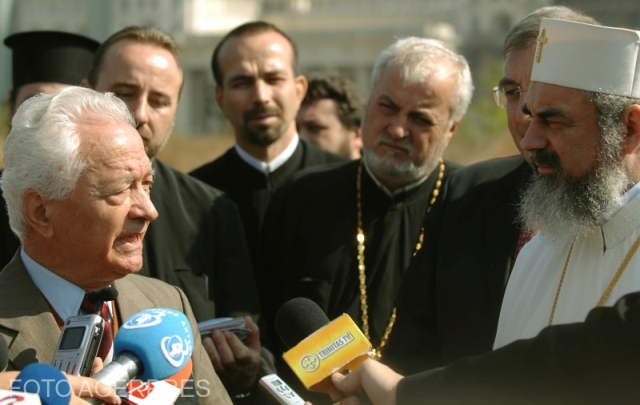
On January 5, 2019 Eugeniu Iordachescu died at the age of 89. He was born in Braila (southeast) in 1929 and studied to become a civil engineer. In the 1980s, together with his colleagues, he applied the relocation method that had been successfully used in the countries with more than 100 years of experience in the field. The process consisted in underpinning the foundation of the building, which was standing on reinforced pillars located here and there, and then a concrete slab was poured under the foundation. Also pulleys were mounted under the building. Then the building was put on tracks and could be easily transported anywhere. The method proved very successful and it was also applied in the case of another 28 buildings. Three of the moved buildings were blocks of flats on Stefan cel Mare Road. Their relocation was aired on TV in 1983, with the inhabitants continuing to stay in their homes and with the gas, water and electricity supply being still functional. In 2004 Eugeniu Iordachescu gave an interview to the Oral History Center of the Romanian Radio Broadcasting Corporation in which he recollected the relocation process of 1983.
Eugeniu Iordachescu: “Three blocks of flats on Stephen the Great Boulevard had their location changed. They had to be either demolished or relocated. As the technology used for building relocation had been proved successful, I was allowed to use it in the case of the three blocks of flats. The underground tunnel was supposed to be constructed in the area, so the three buildings had to be relocated. Among those who were invited to watch the relocation process there was Suzana Gadea, president of the Council of Socialist Culture and Education. After the relocation process had begun, comrade Gidea asked me: ‘can we visit an apartment? I told her, ‘yes and we entered the elevator of the moving building. The elevator was fully functional and Suzana Gadea turned to me in amazement and said: ‘youre such a crazy man! We went right up to the sixth floor, entered an apartment and she sat down to make sure the moving wasnt felt. She didnt feel anything in the elevator either. She asked for a glass of water and the housewife brought in a couple of glasses. She wasnt thirsty but wanted to see if the water in the glass was moving during the relocation operation. It wasnt.
However, the creativity of engineer Iordachescu and his team wasnt to the liking of Nicolae Ceausescu and his wife. Although this solution had been successfully implemented, the dictator issued orders for several churches to be demolished. So, the Vacaresti Monastery and the famous St. Friday Church in downtown Bucharest were razed to the ground. Iordachescu explained the method he employed for the relocation of some churches.
Eugeniu Iordachescu: “With most of the churches we had to build a framework as we needed to support the buildings heaviest weight, which is represented by the thick walls in the case of churches. The Synod Palace of the Antim Monastery for instance, was a special, uncommon construction weighing 9 tons. It was moved in three stages. The first step was to rotate it, then we moved it 20 meters but before breathing a sigh of relief, Ceausescu didnt approve the location and we needed to bring it 13 meters farther. Then we faced another problem. After having completed the works required by the laborious process of moving one of the compounds towers about 40 meters, the dictators wife ordered us to demolish that building and we had to obey orders and bring hat building down.
Engineer Iordachescu and his team tried, with very little success though, to diminish the impact of Ceausescus megalomaniac urban planning on Bucharest.