Romania’s Philatelic Collection at the National Museum of History
An overview of the collection from its own curator.
Ion Puican, 18.04.2026, 14:00
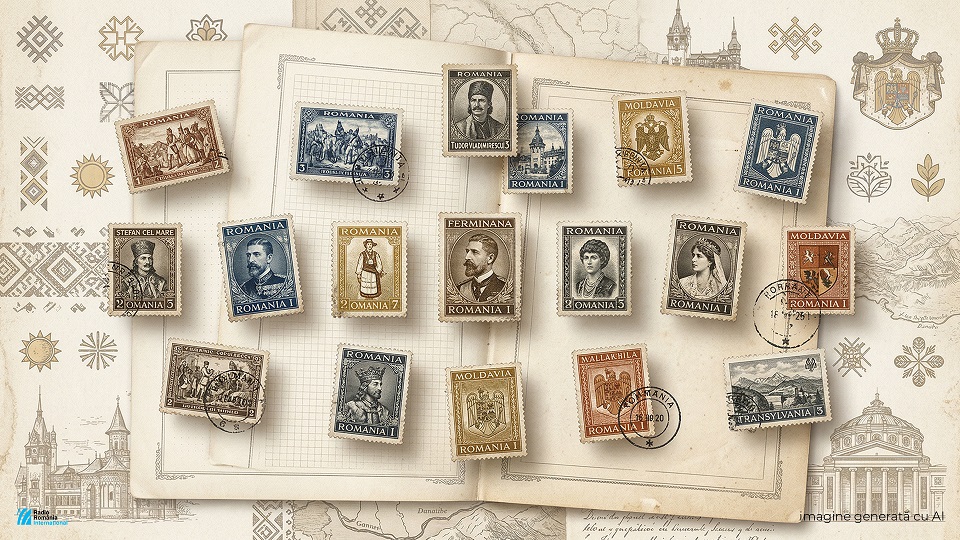
Romania’s Philatelic Collection, preserved at the country’s National Museum of History (MNIR), includes some of the most valuable Romanian stamps, such as the ones that mark the beginnings of modern postal service. Among them is the famous Bull’s Head (“Cap de bour”) stamps. These pieces show how Romania has been represented, in time, through images, symbols and important events.
Cristina Antonie, the collection’s curator, gave us details about the Romanian Philatelic Collection at the MNIR:
“Romania’s Philatelic Collection is very vast. It has millions of stamps, both Romanian and foreign. In addition to these, we also have dies and postal stationery. These are in fact stages in stamp manufacturing. There were many people who worked to make a small piece of paper, which initially had a postal value and now has an inestimable value. It is important, for the National Museum of History, to house such collections, because stamps tell us something, they tell us about very interesting topics. Each stamp has a story, something to say about a personality or about the person who manufactured the stamp, about the designer.”
What did the work of making a stamp entail? What were the work stages and how many people worked to make a small piece of paper? Cristina Antonie:
“As I said, it’s a very laborious job, which has evolved in time. If at the beginning they were manufactured manually, in the 20th century stamps were made mechanically, with the help of printing plates or dies. But to make them, one had to start from an idea, from a drawing. A model was made, then a basic dice, which turned the drawing into mechanical or chemical engraving, embossed or debossed, depending on preferences, or the two techniques were mixed. The engraver made a number of tests, to see if adjustments were needed. Then followed the color tests. Basically, the stamp was printed in several color versions. Once the pattern maker set, a transfer roller had to be made, to allow making hundreds of stamps. The hardened transfer roll was rocked under pressure against the flat plate, transferring the stamp design multiple times to create the final printing plate. Moreover, given that there were multicolored stamps or stamps with different nominal values, transfer rolls had to be made for each color separately and for each nominal value. Of course, mistakes were made, so this laborious process had to be resumed. Can you imagine how much work they had to do? It is easier now, everything is digitalized and, with the help of a computer, this whole process has been simplified.”
Cristina Antonie also told us about the rare stamps in the collection:
“The famous Bull’s Head stamps are the oldest stamps issued in our country. We have all the original dies. There were two Bull’s Head issues. We also have an unissued dice, which is practically unique, like all the others. These were applied by hand. So a Bull’s Head stamp is very valuable. In addition to being very old, it is also the printing method itself that makes it valuable. Then we have the United Principalities stamp. (…) We have its original dies, which is important, because they were made using a different technique at the time – galvanoplasty. With these dies, mechanized printing began. We also have two lithographic stones. These are work stages in stamp making, using the lithographic method.”
Where can the collection be seen by those passionate about philately?
“Unfortunately, we do not have a permanent exhibition, due to the lack of space and the fact that we are still inventorying the stamps. It takes time, there are millions of them. We managed to finish the inventory of the dies, which is precisely why I set about publishing them, to make them as well known to the public as possible. The catalog can be purchased both online and at our souvenir shop within the Museum.”
Beyond their postal role, stamps are today miniature historical documents. They talk about personalities, important moments and changes in society, and together they tell a discreet, but very clear part of the Romanian history. (EE &VP)