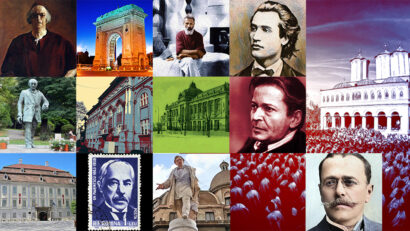
Petre Antonescu
Architect Petre Antonescu left a lasting mark on Bucharest.
Christine Leșcu, 11.04.2015, 13:08
A city of contrasts, of imposing palaces erected next to small houses with gardens in front of them, Bucharest is also a city of mixed architectural styles. There are great Romanian architects who designed eclectic projects and also some in a modernist and Romanian style. One of them is Petre Antonescu, the master who left his lasting mark on Bucharest. The Triumphal Arch, The Palace of Bucharest City Hall, the building that houses the Law Faculty, all of which are iconic buildings for the capital city, were designed by him, all in different styles. In April we commemorate 50 years since Petre Antonescu’s death and we find out who he was from architect Sidonia Teodorescu.
Sidonia Teodorescu: “He lived a long life. He was born in 1873 in Ramnicu-Sarat. He was one of the main representatives of Romanian architecture in the first half of the 20th century. At 20 years old he abandoned the Law School he had attended in Bucharest to go and study at the School of Fine Arts in Paris, which he finished in 1899. He came back to Romania and started to do works in different major styles and his works were appreciated. He had started to be appreciated back in Paris, where he had won several contests. In Romania, he was also a teacher and this was in fact the most defining part of his work. He taught for 38 years — between 1900 and 1938 – and between 1900 and 1938 he was the Rector of the School of Architecture. He was even a member of the Commission of Historical Monuments, monuments that he tried to save. He promoted the Neo- Romanian style first used by Ion Mincu.”
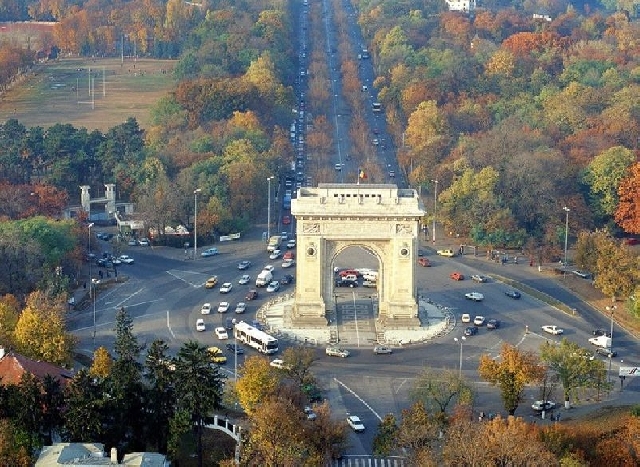
In fact, as Petre Antonescu himself confessed, the Neo-Romanian style was his favorite style. Bucharest’s Town Hall was designed in this style and so was the prefecture of Dolj county in Craiova and the Marmorosch-Blank bank in Bucharest, which has some elements specific to the Neo-Romanian style. The style, initiated by Ion Mincu, combines elements of folk architecture with elements of the Brancovenesc style. On the other hand, for the Triumphal Arch, Petre Antonescu sourced his inspiration from Roman architecture. A first triumphal arch was built for the first time in Bucharest in 1878 to celebrate victory during the independence war, but it was made from materials such as wood and stucco and then it was dismantled. The second Triumphal Arch, located where the current one is, on Kiseleff Road, was designed by Petre Antonescu. Here is architect Sidonia Teodorescu again:
Sidonia Teodorescu: “He was inspired by Roman architecture not only for the Triumphal Arch, but also for other works such as the AGIR Palace (hosting the General Association of Romanian Engineers). The arches there are inspired by Roman aqueducts. This is a classical triumphal arch. Many people say it resembles the one in Paris, but on a much smaller scale. The second Triumphal Arch was built in 1922 and marked the coronation of King Ferdinand and Queen Marie, as well as the making of Greater Romania. This second Arch, also designed by Petre Antonescu, was built using less resistant materials, and it even had to be refurbished sometime in the 1930s. It was restored in the shape we now see, on a reinforced concrete frame, with brick, marble and stone masonry.“
Other impressive buildings in Bucharest, designed by Petre Antonescu, are the former Malaxa villa — today’s headquarters of the Romanian Cultural Institute, as well as the building of the Law School, on the banks of Dambovita River. Speaking again is architect Sidonia Teodorescu, this time about the Romanian Cultural Institute building.
Sidonia Teodorescu: ”It is an edifice built in 1930, for industry tycoon Malaxa, having all the technical facilities of that time: elevator, air conditioning, central heating, radiators, a sliding roof in the main hall. An impressive sliding door, made of massive bronze, separates the tycoon’ s study from the rest of the house. All rooms were built around the main hall, which is very large, and was tailored to host events and welcome guests. Living areas and bedrooms face the garden. The Law School is a very beautiful building, actually a mix of several architectural styles. It is monumental, through its emplacement, plane geometry and layout. It was meant as a classical building, yet it also has Art Deco style elements. It should have been the central piece of the new university citadel, a complex project, which was also designed by Petre Antonescu, of which only the Students’ Culture House was completed, and for which he worked jointly with engineer Emil Prager. “
Emil Prager was born in 1888 and died in 1985. He is the civil engineer who after the war reconditioned the Romanian Athenaeum’s dome.