Romanian writer Augustin Buzura and the communist censorship
Censorship was extremely vigilant in Romania during the communist regime
Christine Leșcu, 06.10.2018, 12:22
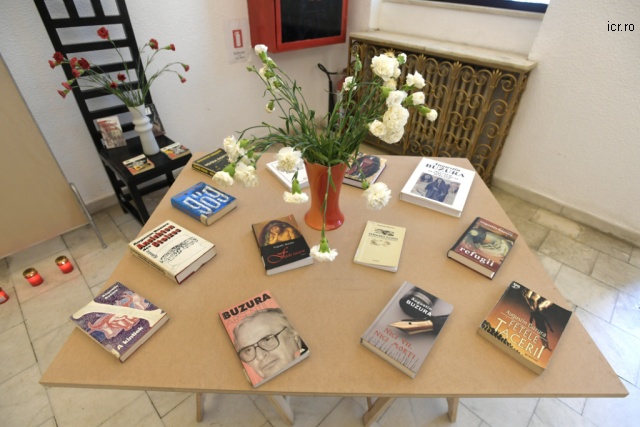
Censorship was extremely vigilant in Romania during the communist regime, just like in any other totalitarian regime. The communist censorship mainly targeted intellectual works, and many writers came under fire, having no choice but to alter their own texts, or give up publishing their books altogether. Augustin Buzura was one of the writers who stood up to the communist censorship and whose works were banned by the communist regime.
Born on September 22nd 1938, Augustin Buzura died on July 10, 2017. Buzura studied medicine and when he was very young he actually considered becoming a psychiatrist. However, during his student years Buzura was a columnist for prominent cultural magazines and went on to make a final decision for writing literature, since pursuing both careers would have been too demanding. In a 2008 interview to Radio Romanias Culture Channel, Augustin Buzura recalled the time of his debut as a prose writer. Here is the late Augustin Buzuras voice, stored in Radio Romanias Archives.
Augustin Buzura: “My debut volume was brought out when I was a 3rd year student. I had written a couple of prose works. I used to work at night, when reading rooms in our campus were less crowded. It was during the night that I managed to write the volume of short stories entitled “The Cape of good hope, which people really liked. Part of the short stories included in that volume had been published in Tribuna magazine, but some of the others were published in other cultural magazines as well. As for the volume, it was included in the Luceafarul collection of the State Publishers for Literature and Arts. So this was my literature debut, a little jammed by medicine, so to say.
Augustin Buzuras editorial debut with his short stories volume “Cape of good hope took place in 1963. A few years later, the communist regime became somewhat more relaxed and slightly more liberal, ideology-wise, so at that time literature was no longer constrained by the ideology of socialist realism, and writers were able to express themselves more freely. However, the relaxation period was short-lived. In 1971 Nicolae Ceausescu launched the so-called “mini-cultural revolution designed after a Maoist model. Here is prose writer Augustin Buzura once again, with details on that.
Augustin Buzura: “Censorship had not been as bad as it became after the cultural revolution of the early 1970s. There had been certain rules you were not supposed to break, but I wasnt keen on doing that, at that time: you were not supposed to write “German, but only “East-German or “West-German, names of factories or products were not supposed to be stated, well, everything that was part of that basic secrecy area. But otherwise, you could write just about anything that was not a direct attack against the regime. You could describe it, instead, which to me seemed more harmful than an attack. I opted for describing it and writing about man in general, against the backdrop of a brutal history. I wrote the novel “The Absentees, I wrote it rather easily and, to my astonishment, with the advent of the mini-cultural revolution I was suddenly banned. Then, by some weird kind of logic, the novel was banned once again in 1988, although not a single copy of it could be found in bookshops and libraries.
In spite of his renewed attempts, Augustin Buzura failed to find out the reason why his novel, “The Absentees, was banned. After a long time, he was given a vague explanation, according to which he had described the regime in gloomy colours. In spite of the ban, Augustin Buzura did not change his style at all, so his later novels shared the same fate: they had to go through the many filters of the communist censorship.
Augustin Buzura: “It was of paramount importance to me to speak to a censor. Writing a book took less time than fighting to get it published. Ive known censors of all types… Some of them were quite erudite, they were not at all amateur. For instance, my most criticized book, ‘Egos, went from one censors office to another, until it reached the Securitate, where they asked me how I knew about political inmates wearing tin glasses, about torture methods or working conditions at the Canal. This was the general tone the conversation had, and you had to nerve yourself for it. Conversely, other books, such as ‘Shelters, wouldnt have made it to the market if it hadnt been for the censor. He understood the kind of book it was. You could sometimes negotiate with censors who were older.
With the fall of communism in December 1989, Augustin Buzura continued to take an active stance in culture, edited specialized magazines, led the Romanian Cultural Foundation and helped turn it into the present-day Romanian Cultural Institute.
(translated by: Eugen Nasta, Vlad Palcu)