
RRI Live!

Listen to Radio Romania International Live

The fortified church and the peasant stronghold of Saschiz

Saschiz, in central Romania, distinguished itself through two features typical of Saxon settlements in Transylvania: the fortified church and the peasant stronghold.
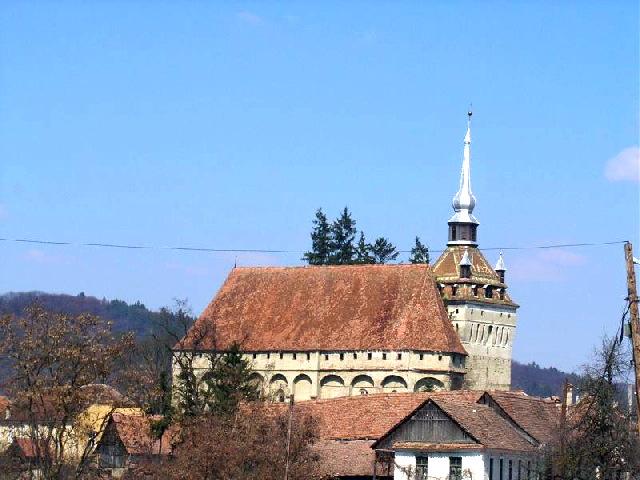
The fortified church and the peasant stronghold of Saschiz

, 13.09.2014, 12:37

Saschiz, located in the centre of Romania, was inhabited at first by Szeklers and then by Saxons. It distinguished itself through 2 features typical of Saxon settlements in Transylvania: the fortified church and the peasant stronghold. The church, located in the city centre is one of the biggest and most impressive Saxon places of worship. Today, it can be admired in its original state, being almost unaltered. Saint Stephen is the patron saint, and the church has 22 buttresses and, as expected, it took a long time to build. Alin Pora, historian and co-author of “A monograph of Saschiz ”, tells us more.


“The construction works began in 1945 and ended in 1525. In order to build this edifice the intervention of the Saxon Community in Sibiu was required and the documents showing how the money was sent from Sibiu were kept. From an architectural standpoint, the church is built in a late Gothic style with a starred arch. A unique element in this church’s construction is the creation of a place, above the arch, from where archers would defend the community in case of an attack. Initially, the fortified church had another fortified wall that was destroyed with time and was never rebuilt. The reason for this was that, shortly after the church was built, so was the peasant stronghold in Saschiz, which served both as a residence and as a storage space for provisions in times of peace. In times of war, the villagers would take cover in the stronghold.”


Recent archaeological findings show that, despite previous suspicions, St. Stephen’s Church was not built on top of an older basilica. As a consequence, its size and facets are the same today as when the church was originally built. In 1677, the main tower was expanded, having as model the clock tower from Sighisoara, a rival town for Saschiz in the Middle Ages. Therefore, the tower is large and big and it has a clock at its top, as well as a statue commonly known as Bogdan, which rings a warning sound every 15 minutes. The warnings referred to attacks from the Tatars, which was the main reason why the stronghold was built. Alin Pora tells us more:


“The peasant stronghold was built for defence purposes. The legend says that villagers from 7 villages took part in the construction and you could not pass through Saschiz unless you put some effort into the construction. For instance, merchants who would pass with their carts had to unload their merchandise at the end of the village, fill their carts with rocks and go up to the stronghold, and only after that could they pass through Saschiz. The stronghold dates from around the same time as the church. It had seven towers, one of them being the school tower, built as a token of the Saxons’ respect for education. The stronghold is on a hill, north of the church and tower.”


Apart from the school tower, the peasant stronghold of Saschiz had other towers, such as the gate tower, the princes’ tower on the north side, the priests’ tower and the ammunition tower. However, none of these can be seen today because the stronghold was never rehabilitated and it was abandoned during the communist period. If it is to be renovated, the City Hall must first get European funds. If rehabilitated, the stronghold of Saschiz would definitely attract as many tourists as the ones in Rupea or Rasnov.




RRI Encyclopedia
RRI Encyclopaedia Saturday, 31 January 2026

Romania’s Strongest Trade Bank before WWII

Marmorosh-Blank used to be one of Romania’s strongest banking institutions before 1945. It functioned under two generations of bankers, the first...

Romania’s Strongest Trade Bank before WWII
Sergiu Celibidache (1912-1996)
RRI Encyclopaedia Saturday, 24 January 2026

Archaeology in Glina, near Bucharest

Under the visible layer of today’s Bucharest and the capital’s surroundings lie much older traces of human habitation, which predate the...

Archaeology in Glina, near Bucharest
RRI Encyclopedia
RRI Encyclopaedia Sunday, 18 January 2026

Monuments from Soviet-occupied Bucharest

On pedestals, in imposing poses, they have to convey inspiring messages across generations. War heroes and heroines, kings and queens, politicians,...

Monuments from Soviet-occupied Bucharest
RRI Encyclopedia
RRI Encyclopaedia Sunday, 11 January 2026

The Corneşti Iarcuri Citadel

Just a few kilometers from Timișoara (western Romania), in the town of Cornești in the Banat Area, there are traces of one of the most spectacular...

The Corneşti Iarcuri Citadel
RRI Encyclopaedia Sunday, 04 January 2026

Ion Monoran

The Romanian Revolution of December 1989 created modern heroes—the heroes of the anti-communist civic movements whose goal was for human beings to...

Ion Monoran
RRI Encyclopaedia Saturday, 27 December 2025

The Museum of Flutes from around the World

Ion Puican The Museum of Flutes from around the World is a cultural project initiated by the ISVOR Cultural Association, dedicated to the...

The Museum of Flutes from around the World
RRI Encyclopaedia Saturday, 20 December 2025

The Bucharest of Yesterday in Postcards

The transformations we see in today’s Bucharest are effects of the communist regime, of the bulldozers and cranes that tried to legitimize an...

The Bucharest of Yesterday in Postcards
RRI Encyclopaedia Sunday, 14 December 2025

The “Prof. Nicolae Minovici” Museum in Bucharest

  The building that houses the “Prof. Nicolae Minovici, Ph.D.” Folk Art Museum, affiliated to the Bucharest City Museum (MMB), is known to...

The “Prof. Nicolae Minovici” Museum in Bucharest

Partners

Muzeul Național al Țăranului Român Muzeul Național al Țăranului Român
Liga Studentilor Romani din Strainatate - LSRS Liga Studentilor Romani din Strainatate - LSRS
Modernism | The Leading Romanian Art Magazine Online Modernism | The Leading Romanian Art Magazine Online
Institului European din România Institului European din România
Institutul Francez din România – Bucureşti Institutul Francez din România – Bucureşti
Muzeul Național de Artă al României Muzeul Național de Artă al României
Le petit Journal Le petit Journal
Radio Prague International Radio Prague International
Muzeul Național de Istorie a României Muzeul Național de Istorie a României
ARCUB ARCUB
Radio Canada International Radio Canada International
Muzeul Național al Satului „Dimitrie Gusti” Muzeul Național al Satului „Dimitrie Gusti”
SWI swissinfo.ch SWI swissinfo.ch
UBB Radio ONLINE UBB Radio ONLINE
Strona główna - English Section - polskieradio.pl Strona główna - English Section - polskieradio.pl
creart - Centrul de Creație Artă și Tradiție al Municipiului Bucuresti creart - Centrul de Creație Artă și Tradiție al Municipiului Bucuresti
italradio italradio
Institutul Confucius Institutul Confucius
BUCPRESS - știri din Cernăuți BUCPRESS - știri din Cernăuți

Affiliates

Euranet Plus Euranet Plus
AIB | the trade association for international broadcasters AIB | the trade association for international broadcasters
Digital Radio Mondiale Digital Radio Mondiale
News and current affairs from Germany and around the world News and current affairs from Germany and around the world
Comunità radiotelevisiva italofona Comunità radiotelevisiva italofona

Providers

RADIOCOM RADIOCOM
Zeno Media - The Everything Audio Company Zeno Media - The Everything Audio Company






















