The Pogroms in Iasi and Bucharest
In 2025 it will be 84 years since the Bucharest Pogrom of January 21-23, 1941
Ion Puican and Eugen Cojocariu, 22.02.2025, 13:25
In 2025, at the beginning of the year, it will be 84 years since the Bucharest Pogrom of January 21-23, 1941, and 80 years since the liberation of the largest Nazi extermination camp at Auschwitz (Poland), on January 27, 1945. Two sad commemorations for the modern history of the world and Romania. The Bucharest Pogrom was a series of violent manifestations and crimes against Jews, which took place during the Legionary Rebellion of January 1941. It is considered the largest and most violent pogrom against Jews in Wallachia (a southern region of Romania). The same year, 1941, in the Moldavian region, between June 27-30, another pogrom took place, perhaps the most violent in the history of Jews in Romania. In those days of June 1941, 13,266 Jewish citizens of Iași were killed.
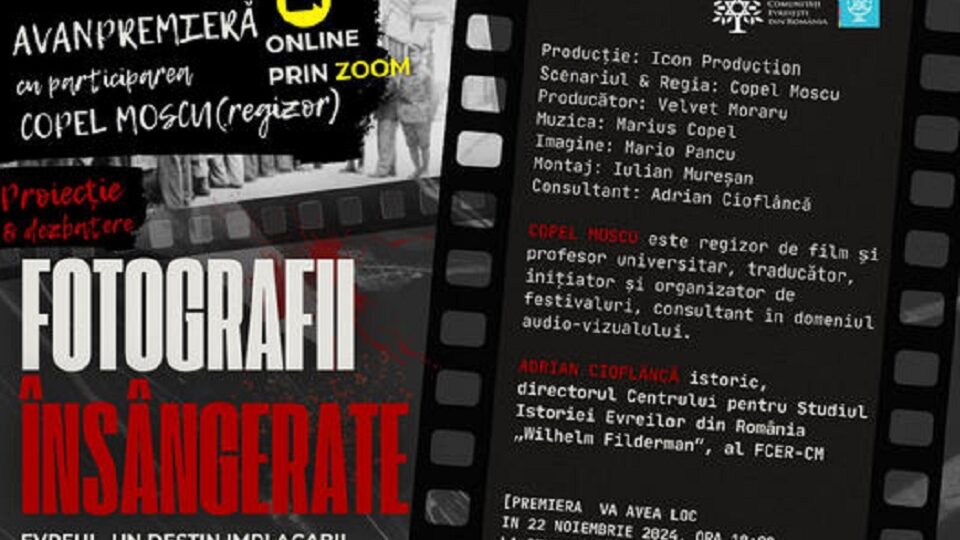
Film director Copel Moscu is of Jewish origin. He has made over 50 short and feature films, as a director and screenwriter, with multiple national and international awards. At the end of 2024, the premiere of his film “Bloody Photographs” took place, a documentary that evokes the earth-shattering events during the Iași Pogrom. We talked to the director about his origins and how these events were viewed during his childhood and youth, before the fall of communism in 1989:
“First of all, you know very well that I come from a family of Jewish origin. The interesting part is that during my childhood and youth I did not hear any stories about this pogrom. This terrible event, indeed, a black stain in modern history. But my parents wanted to stop me from judging those times, through ignorance. And I was very interested in what happened to our relatives, because we also had victims, relatives and friends who were victims of the Holocaust. This obscuring of real history was very fashionable at that time. The communist authorities actually discussed very little, almost nothing, about this event. It was not forbidden, but it was not good to talk. … It was an extreme derailing of history. I hope that it will be unique in history, that when some people who knew each other very well became enemies and some suppressed others without a very clear explanation, just out of hatred… ”
How the director Copel Moscu worked on this documentary, he himself tells us:
“There are photographs of these events kept at CNSAS. There are still a lot of classified documents and images, I don’t know for what reason, but which will someday be declassified and offered to the general public. It’s very interesting that, here, there are still secret things in our history, and probably we will continue to get great surprises, because the documents and photographs and images and accounts of those times are beginning to become clear, and each of us will interpret them in our modern way of thinking. We must understand that a certain era has a certain vision of history, and it is difficult to understand if we do not go into the depth of these details.”
The documentary “Bloody Photographs” presents images that illustrate the preparation and implementation of the pogrom, from the marking of houses where Jews lived, to the columns of Jews made to dig the pits into which their fellow citizens were to be thrown. Copel Moscu talks to us about the effect of these photographs on the audience, and the way in which they were inserted into the documentary film:
“It’s called the parallax effect in which you can somehow turn a two-dimensional photograph into a three-dimensional somehow, to give the viewer the opportunity to experience that image more intensely… The images that are negatives. Those are exactly the moments when death is being talked about… I mean, people can see the X-rays of their own existences at certain moments. …”
Can this documentary film become a study material within educational institutions for the new generations, to understand those moments in Romanian history?
“I say that this film should be shown in schools, especially since it is an almost mandatory subject. Let’s say, it’s optional, but it’s in the school curriculum. The Holocaust is studied. … Seeing this film, they might form an opinion about that era, about the relationships between people, about how a crisis situation can be thought of.”
This documentary brings back into the collective consciousness those moments of dramatic history. At that time, Romanian legislation from the last year of the reign of Carol II elevated to the rank of law racial discrimination against Jews, considered an “inferior race”. The National Legionary State tightened and restricted the civil liberties and rights of Jews. During the Legionary Rebellion, thousands of Jews from Bucharest were arrested, investigated and tortured. Temples and synagogues were desecrated and looted. A series of murders took place in the Jilava forest near the capital. According to statistics from those tragic moments, there were over 120 Jews killed in the Bucharest Pogrom, 1274 shops, apartments, and workshops devastated, and hundreds of truckloads of looted items were taken. These events in Bucharest were denied or omitted from recent history along with the suppression of the Legionary Rebellion. Theories have been put forward about alleged conspiracies by Jews and communists in connection with the Bucharest Pogrom and the veracity of those facts.