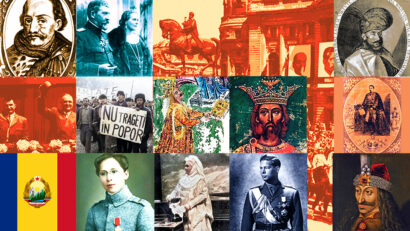
80 years since the installation of Petru Groza’s pro-communist government
The Petru Groza government, considered by historians to be one of the most harmful in Romanian modern history, is responsible for the Sovietization of Romania.

Steliu Lambru, 17.03.2025, 14:00
March 6, 1945, is one of the dates with a deeply negative significance in the history of contemporary Romania. On that day, following pressure from the Soviet emissary Andrey Vyshinsky, a government was installed that was formed by the National Democratic Front, an alliance led by the Romanian Communist Party, a government chaired by the lawyer Petru Groza. His government, considered by historians as being one of the most harmful, is responsible for the Sovietization of Romania and its economic, political, social and cultural transformation from a free and democratic country into a repressive and totalitarian one. Through the measures taken, the Groza government nationalised the means of production, various facilities and private homes, amended the legislation regulating the organisation of economic facilities, abolished political parties and made it easier for the courts to send hundreds of thousands of innocent people to prison.
In February 1945, groups of communists began protest actions against the government led by General Nicolae Rădescu with the aim of destabilising it and creating an artificial crisis. The deterioration of the political climate at that time was described in 1976 by Constantin Vişoianu, Minister of Foreign Affairs in that government, in an interview to Radio Free Europe. Vişoianu recalled how Andrey Vyshinsky forced King Michael I to sack Rădescu:
“It was in that atmosphere and amid that turmoil that Vyshinsky arrived in Bucharest on February 26, 1945. The Soviet embassy informed me, as I was at that time the Minister of Foreign Affairs of Romania, that Mr. Vyshinsky wished to be received by the King the next day. Although it was an improper request, I advised the King to accept it. The next day Vyshinsky had his first audience with the King, which I also attended. Vyshinsky began to explain what he thought the situation in Romania at that moment meant, saying all sorts of untrue things: that the government was not democratic enough, that it could not keep the masses under control, that it was not making enough efforts to calm the tensions. It was simply not true, but his idea was that the government was not democratic enough and that it had to be changed. He asked the King to replace the Radescu government as soon as possible. This first audience was conducted in a civilised tone.”
The king tried to delay Radescu’s replacement to gain time. But Vyshinsky was not willing to wait. A second and less cordial visit followed, as Constantin Vişoianu recalls:
“On February 27, Vyshinsky again asked to be received by the king. I was present at this audience as well. Vyshinsky’s tone became more brutal and he declared on behalf of his government that the present situation could no longer continue. ‘Your Majesty must intervene urgently and put an end to this intolerable state of affairs by instating a more democratic government’. He even demanded that the king immediately demand Radescu’s resignation and install a more democratic government. The king explained to him that the government was the most democratic possible, since representatives of the most important parties were there, including the communists, and that it was supported by the entire Romanian nation. Vyshinsky insisted that the Rădescu government was not democratic, without providing any justification. I intervened and explained to Vyshinsky Romania’s political and constitutional system, telling him that our king could not appoint the members of government, a task that belonged to the political parties. He insisted, demanding that a people’s government be formed immediately. And with that he left.”
Vyshinsky’s third audience with the king was the beginning of the end for Romanian democracy. Constantin Vişoianu:
“The next day, February 28, Vyshinsky requested a new audience with the king at 3:30 p.m. I was also present at the meeting again. This time, Vyshinsky’s tone was extremely violent. He said: ‘I have come to find out Your Majesty’s decision’. The king replied that he had informed the government of the Soviet representative’s wishes and that negotiations were currently taking place with the party representatives. Vyshinsky said: ‘That is not enough, I consider the Radescu government to be a fascist government and that it must be got rid of.’ He began to threaten, saying that the situation was very serious and that the new government must be installed by 6:00 p.m., that is, in two hours. He stood up, banged his fist on the table, and left, slamming the door so hard that the plaster around it cracked. And that’s how the third audience ended, at which I tried to explain to Vyshinsky that the king could not dismiss the government without consulting the leaders of the parties that formed it. Vyshinsky replied with false politeness that he had not come to talk to the foreign minister but to the king. I also informed the English and the American representatives of the attitude of the Soviet representative, since Vyshinsky was speaking on behalf of the Allied Control Commission of which the Allied powers were members. Unfortunately, the policy pursued at that time by the Americans and the British was not of much help to us.”
The appointment of Petru Groza to a government approved by the communists was the price that had to be paid to avoid bloodshed. But, on March 9, 1945, it also marked the return under Romanian control of Northern Transylvania, a territory ceded to Hungary in 1940 following the Vienna Diktat.