Ceausescu seen from up close
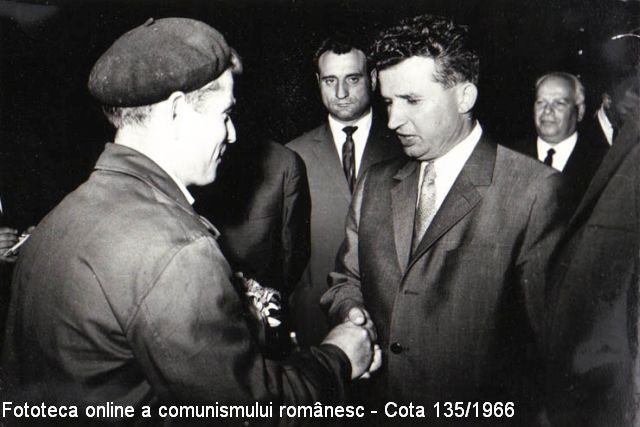
Working for Radio Free Europe, Sorin Cunea had the oportunity to witness many of Ceaușescu foreign visits.
Steliu Lambru, 02.10.2023, 14:00
The
openness, transparency and popularity of a dictator are some of the
strongest signals a propaganda machine can transmit. But since in a
dictatorship these signals must be interpreted as being the opposite,
so in the communist regime Nicolae Ceaușescu’s figure was the
opposite to
that
promoted by the propaganda. Not many Romanians can boast seeing him
from up close and ever fewer of shaking his hand. Suspicious and
increasingly paranoid, Ceaușescu would not let many people get too
close to him.
One
of the few occasions when he would make an exception was when he
travelled abroad and attended press conferences. Sorin Cunea worked
for Radio Free Europe in the second half of the 1960s and is the
Romanian journalist abroad who saw Ceaușescu from up close most
often. Interviewed by Radio Romania’s Oral History Centre in 1998,
he said he would find out about Ceaușescu’s foreign visits from
the Romanian press. He witnessed a
total of 12
visits by the Romanian communist leader:
We
were at the Bayer company, because his wife, who was a chemist,
wanted to
or
the German hosts had arranged for her to visit the consortium in
Leverkusen. As Ceaușescu
had
official talks I didn’t have access to, Noel Bernard decided we
should also go Leverkusen. After visiting a few departments, the
group of officials entered a conference room and that’s where she
was given explanations and answers to the questions she asked. I then
saw,
I think for the first time, Adrian Păunescu, who was part of the
press delegation accompanying the two. Bernard and I were standing in
the back and didn’t pay much attention to her questions. But I was
watching how Păunescu was sitting opposite her at the table and
noting
down every word she said, conspicuously, so that everyone would
see
how interested he was in what she was saying.
Ceaușescu had his people follow Sorin Cunea, just as he did most other journalists working for Radio Free Europe. He recalls being mistreated by the Romanian communist delegation in Ankara. When they let the media know they could enter the room that was going to host the cocktail party, I slung my recorder over my shoulder and headed for the door. Everyone else walked in, but I was stopped by an individual who addressed me in Romanian and his tone was typical of Securitate officers. He knew exactly who I was. Don’t put your recorder too close to the comrade. Keep a lower profile, can’t you see you’re bothering him? I didn’t answer back, so I just walked into the room. When it was Ceaușescu’s time to speak, I placed the microphone as close to him as possible, so I could get his discourse on tape and be able to broadcast parts of it later. I have to say that, as he talked, he would take small sips from a glass with a yellowish liquid, which I think was chamomile tea. Maybe he was allowed to do that, or maybe the doctors who accompanied him knew better. Sorin Cunea was also asked if he ever got to speak directly to Ceaușescu during press briefings. I addressed him a question once, in Bonn. I have to say I would always sit on the front rows at press briefings, because I really wanted my face to be in the news on the television. He answered my question
though. And during a news conference in Vienna, I was also in the front row, very
carefully observing the two. Whenever he was answering one journalist or
another, while the answer was being translated, Ceausescu looked intently at
his wife, Elena, for approval. And I saw her nodding most of the time, as if
she wanted to say ‘yeah, you answered pretty well to that one’.
Ceausescu’s capricious
and aggressive personality however often made him to take it out on the
others. Sorin Cunea recalls such an episode
Sorin Cunea: Also
in Bonn, while answering a question regarding the Conference for Security and
Cooperation, the translator, who was a guy from Bucharest translated and
completed the answer by specifically mentioning the ‘Conference for Cooperation
and Security in Europe’. Ceausescu swiftly turned to the translator and
retorted I didn’t say anything about Europe, you know. And the man had done nothing
wrong but only mentioned the complete title of that international conference. Furthermore,
Ceausescu was always carrying a comb with him, which it used to adjust his
haircut right before joining a conference or public event. He was always very
concerned about his physical appearance.
Seen
from up close, dictator Nicolae Ceausescu was nothing but a common,
simple man very different from the image the Romanian Television was striving to promote. But somehow, history has succeeded in overemphasizing the image of this
tiny, little man.
(CM/VP/bill)