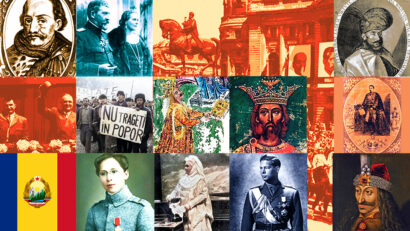
Romanian art in the 1940s and 1950s
Creativity, in totalitarian regimes, is almost annihilated, while art and artists become part of the propaganda.
Steliu Lambru, 30.05.2022, 14:34
During highly repressive regimes such as fascism and communism, art and artists usually comply with the requests of that particular ideology. Creativity, in totalitarian regimes, is almost annihilated, while art and artists become part of the propaganda. For this reason, being familiar with the type of political regime during which an art work was created, helps the viewer better understand that particular work. Whether we talk about painting, sculpture, theatre, film or an architecture, the political and social circumstances of totalitarianism leave their mark on the mind and work of artists.
In 1938, Romania started to slip towards totalitarianism. It was the year when King Carol II installed his authoritarian regime, a predecessor of fascism. Political parties and the free press were banned and replaced by a single party and subservient press. Things continued in the same manner from 1940 to 1944, when Romania was headed by Marshall Antonescu. After 1944-1945, at the end of WW2, the communist regime continued to make use of the previous criminal practices.As expected, artists adjusted their works to the rigors of that time. In the years of the fascist regime, the cult of the nation was the ideology that dominated the art world. After 1945, during the communist regime, proletarianism was the ideology that set the trend in art.
Art critic and historian Radu Bogdan was born in 1920 and died in 2011, at the age of 91. He lived throughout the totalitarian period. He had communist sympathies ever since his youth and worked in the pro-communist press. Bogdan had the reputation of a good professional. In 1995 he was interviewed by Radio Romania s and one of the questions was about the condition of the artist during the communist period. Bogdan gave his own example and that of his colleagues with the Institute of Art History: “If we say that the communist period was the period of a sick regime, are we telling the truth? All sort of sick things were happening. Although we cannot say the institute was made up of incompetent people, it was largely made up of cases. Each of us was a case. None of us, including myself, was a perfectly balanced character.”
Together with art historian George Oprescu, Bogdan was the one who picked the members of the commission that made the inventory of the royal property after the communists forced King Mihai I to abdicate, on December 30, 1947, and leave Romania: ”My recommendation was Edgar Papu. He was an assistant professor and I was a student, so I knew him from the faculty. I invited him to be part of the commission. Zambaccian, who was a party member, was also in the commission, alongside art trader Levi, who was not a party member and had a Turkish passport. The latter was proposed by Oprescu. There was also Nestor, a former legionnaire, a distinguished archeologist and scientist. Ion Jalea was also included to evaluate sculptures. The wife of Mac Constantinescu was part of the commission s secretariat. There was also historian Emil Condurachi, an expert in medals and antiquities. I was the expert in books and documents.”
The regime applied the thesis of Marx and Lenin aiming to adjust both artistic taste and public art to the soviet model. In this respect, the Romanian Athenaeum was the first target: ”There had been, at a certain moment, an order from the upper party lines that the fresco of the Athenaeum, painted by Costin Petrescu, should be covered by paintings of revolutionary heroes or accepted rulers such as Alexandru Ioan Cuza. Consequently, Iosif Iser, Camil Ressu and Stefan Constantinescu, seen as the best painters of that time, were commissioned with the new paintings. The project was eventually scrapped, because the paintings were too large. The original fresco was 3 m high, but it had unity. It did not have any particular artistic value, but, as I said, it had unity. This is what the new painting lacked as each of the three artists had its own particular style. Others were purely decorative, had no particular value. This whole project was eventually suspended.”
It is said that the artist, his work and the viewer always share a special bond. Unfortunately, this one was built on sufferance, a type of sufferance generated by the lack of freedom. Art in totalitarian Romania suffered as much as people did. (EE)