The 100th anniversary of Romania’s entry into WWI
On the 27th of August 1916, Romania entered WWI on the side of the Entente, after two years of neutrality.
Steliu Lambru, 19.09.2016, 14:16
Romania joined the war following pressure from its traditional ally, France, and as a result of the situation on the front, the battle of Verdun and the offensive of the Russian army. Romania agreed to enter the war after obtaining the promise that when the peace would be established, the territories inhabited by ethnic Romanians in Austria-Hungary would become united with the Kingdom of Romania. Romania’s delayed entrance into the war had two reasons.
Firstly, it was the wish of King Carol I that Romania should fight alongside Germany, something the political class was opposed to. The second reason was the distrust of the Romanian army in an alliance with Russia after the unfortunate experience of the 1877-1878 war. In two years’ fighting in WWI, Romania lost 535,700 soldiers, including the dead, the wounded and those reported missing, which accounted for 71% of the number of troops it had when it first entered the war. It thus ranked fourth in this regard, after Austria-Hungary, who lost 90% of its troops, Russia, who lost 76% of the troops, and France, who lost 73% of the troops. Romania also had 300,000 civilian casualties, including 250 doctors and 1,000 orderlies who died from typhoid fever. At the end of the war, however, Romania received more territories, with Greater Romania being created at an immense human cost.
The official narrative of WWI changed over time and so did public perception. In the aftermath of the war, the focus was on the victims and their families, the invalid and the survivors. Historical accounts were not triumphalist, with the scars left by the loss of human lives still fresh. As time passed, history became more militant, and political ideology gradually overshadowed the human element to the detriment of patriotism and national interest. The tragedies of WWI started to be seen not as tragedies of humanity but as sacrifices in the interest of the nation. Romania was no exception, its official history going through the stage of militant history and culminating with the communist regime that gravely distorted the significance of the events 100 years ago.
In the opinion of historian Razvan Paraianu from the Petru Maior University in Targu Mures, Romania’s entry into the Great War must be viewed as a restitution of the original meanings and feelings of the people who lived at the time: “We cannot glance innocently at the past. Semantics, the meanings and significance of the simplest of words are different. Many people will say this is relativism. It’s not relativism, it’s comprehending the fact that we understand the idea of nation and people differently from our parents and grandparents. The French sociologist Bernard Paqueteau, who came to Romania in the 1990s, wrote an article about the freezer of false ideas. It was the time when Robert Kaplan had written about the ghosts of the Balkans. Paqueteau’s article was a reaction to the idea that the communist regime had put the phantoms of the past into a freezer, and after 1989 something plugged off the freezer, setting the phantoms free to haunt societies. Paqueteau says it very clearly that the phantoms are not the same and that there was no freezer. The communist regime radically altered not only the meanings of words but also society itself, the one that understands significances.”
They say words attract reality, which means that their significance is so strong that it becomes decisive in forming opinions.
Razvan Paraianu believes that historians must formulate credible interpretations of WWI, without letting themselves being influenced by ideologies: “There is no way we could look innocently at WWI. Between 1916 and 2016 there is a huge gap that alters the meaning of words and facts. Reinhard Koselleck’s conceptual history shows that semantics is in close relations with the changes occurring in society, with the changes brought up by political events. It’s not an immediate change. Meanings have their own delays and we must pay attention to changes. The Dutch historian Frank Ankersmit says that the narrative language is not an object-language. What Ankersmit means is that an archaeologist finds ancient objects, unearths them, but the object remains an object. We do not work only with objects, we work with meanings, with the role that these objects played in their time. If we imagine that in the 3rd millennium an archaeologist dug and found a bottle, he would think we used to drink wine from that bottle. But maybe that bottle was a lamp. Or maybe that bottle was used as a Molotov cocktail. How awkward would it be for a lamp to be mistaken for a Molotov cocktail just because the form is the same, but their roles are completely different?”
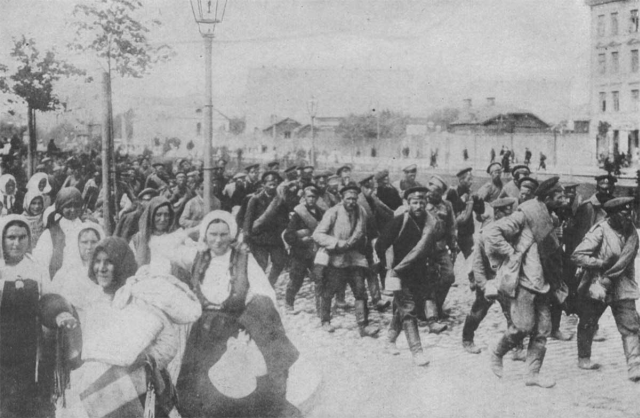
Reading the press, journals, letters and personal notes from WWI reveals a spirit that accompanied the departure of hundreds of thousands of Romanians along a different route, different from the one that we are used to. To many of them, the road was one without return. At the end of the war, the Greater Romania was the reward for their sacrifice, one that may have seemed too big for their loved ones.