
The Dacian Kosons
Dacians have left us gold coins made in imitation of Roman ones
Steliu Lambru, 18.12.2023, 14:00
Historical sources give us little information about the population of Dacians and Getae or Daco-Getae. Kosons, or Dacian gold coins, are one of the many enigmas floating around the civilization of those who lived on the territory of present-day Romania more than 2500 years ago. To the north and east of the Danube, towards Eastern Europe and Asia, lived, according to Greek and Roman written sources, barbarians, populations outside the area of the ancient Mediterranean civilization. The Romans called this space Barbaricum, where there was a veritable conglomerate of Germans, Thracians, and Iranians. In the first centuries of the Christian era, Asian and Slavic migrants also appeared in the region. In that conglomerate also lived the Daco-Getae, north of the Danube and in the intra-Carpathian space.
In the Greco-Roman world, the economy was monetized, money being the equivalent of all values. Barbarian populations imitated Greek and Roman coins to facilitate exchange. The first coins imitated by the Daco-Getae were the tetradrachms of Macedonian king Philip II in the 4th century BC. Other types of Greek coins were also imitated, such as those from the time of Alexander the Great and Philip III, of the same century. With the passage of time, until the arrival of the Romans in the Balkans in the second century before the Christian era, the Daco-Getae came to imitate imitations of Greco-Macedonian coins, their quality decreasing considerably in the representations on them, and in their quality. With the consolidation of the Roman state along the Danube in the west and south, the Daco-Getae imitated the Roman denarii. Thus koson coins appeared.
Historian and numismatist Mihai Dima researched Dacian coins of the Koson type, and is the author of some texts about them. He gave us a short introduction to the long history of the Kosons, whose name comes from a leader of the Dacians, who participated in the conspiracy against King Burebista in 44 BC, whom he succeeded.
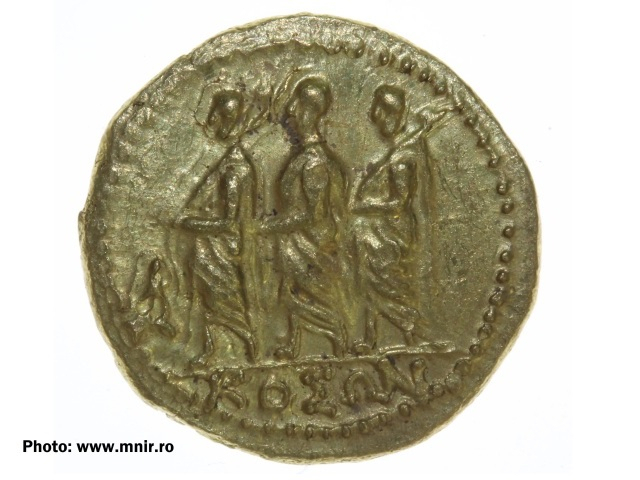
What is actually meant by Koson? On the one hand, a proper name that was attributed to a dynasty from Dacia, Thrace, or Scythia or, on the other hand, a gold coin. Later, silver coins with the inscription Koson also appeared. This is what is meant by Koson: a gold coin weighing about 8.5 grams, diameter between 18 and 22 millimeters. It depicts, on one side, an eagle sitting on a scepter to the left, holding a wreath in its right claw. On the other side are three figures, a consul between two lictors. A monogram usually appears on the front, and on the reverse the inscription Koson, in Greek.
Objects from antiquity that have reached us often also followed a medieval trajectory. This is also the case of the Dacian koson, which we learn about from a text by a great representative of the European Renaissance. Here is Mihai Dima.
Koson type coins were first mentioned in the 16th century by Erasmus of Rotterdam in a letter addressed to the bishop of Breslau. Since the letter dates from 1520, the piece described by Erasmus could not come from the famous hoard discovered in the bed of the river Strei, found in 1543. Also before 1543, a liturgical vessel was mentioned for the first time, with some ancient gold coins encrusted on it, among which a koson was also found. It was kept in Alba Iulia until 1557, after which it arrived in Slovakia, in Nitra. It has been suggested that the coin on the Nitra chalice may have come from a hoard discovered in 1491. It is possible that this is the oldest Koson-type coin that has survived to this day.
The kosons came to light following the discovery oftreasures, most of them accidental discoveries. Many koson finds are uncertain, in the sense that they are mentioned in sources, but have not physically reached the present day. But the experts have some certainty about some of them, as Mihai Dima also said:
The first hoard that we know for sure was made of Koson type gold coins was discovered at the beginning of the 19th century, in 1803, on Mount Godeanu, in the area of the Șureanu Mountains and the Orăștiei Mountains. Some residents of the village of Vâlcelele Bune discovered 400 coins that were identified as being of 3 types, with monograms, but of different sizes, the last type not having a monogram. Shortly before this discovery, in 1802, another hoard of gold coins of the Lysimachus type appeared in the same area, which led many residents of the area to try their luck. It seems that many got lucky, as the trade in gold coins attracted the attention of the Austrian authorities who began to inquire into their origin.
Since then, the koson finds have been stored in museums in Romania, but they also exist on the world antiquities market. Dacian kosons are evidence of the mimicry of a peripheral society, such as the Dacians, towards a dominant cultural model, such as the Greco-Latin one. But it is also a testimony of the relationship that has always existed between the center and the periphery.


























