The Greek Bucharest
Greeks are the oldest people to make it to Wallachia and leave a mark on the territories of today Romania.
Steliu Lambru, 17.03.2014, 12:30
Greeks are the oldest people to make it to these regions and leave their prints on the territories that are currently Romanian soil. Some of the first settlements they established on the Black Sea coast were Hystria, Tomis and Callatis, a couple of centuries before Christ. Dobrogea, a Romanian province between the Danube Delta and the Black Sea was the cradle of many Greek communities whose presence has been preserved up to these days in the local toponymy. A town in northern Dobrogea as well as the highest peak of Dobrogea Mountains are called Greci, which is the Romanian for Greeks. Not far from Dobrogea Mountains there lies the Enisala fortress, founded by Byzantine Greeks and Genovese merchants back in the 13th century.
The Greeks started to focus their attention on northern Danube in mid-15th century, after the biggest tragedy of the Christian-Orthodox world, the 1453 fall of Constantinople before the Ottoman armies led by Mehmed the Conqueror. According to historian Georgeta Penelea-Filiti, a world that died in Byzantium was to come back to life again on the Romanian territories.
After the fall of Byzantium, the Greeks started looking at the Romanian territories as a potential haven. Shortly after that Bucharest was first documented. As a coincidence, the first historical record of this small market town dates from 1459, 6 years after the fall of Byzantium, in 1453. The fall of Byzantium put an end to a whole world characterized by extraordinary vivacity and urban, political, legal and institutional development. The conquest of this Greek world by the Turks, who came from a different environment and culture, led to an inevitable clash. Many Greeks were thus forced to leave Byzantium. The Cantacuzinos were one of the most prominent Greek families. Of imperial descent, very wealthy and industrious, they eventually arrived in the Romanian territories after first moving to Bulgaria. They came here in the 17th century at a time when the country was torn by political infighting and ended playing a major role in Romanian history, becoming a champion of national sentiment. This assimilation of the Greeks had thus become a reality.”
After 1453, many Greeks moved north of the Danube. Their settling in Wallachia, in particular Bucharest, must be viewed as a continual, non-linear process generated by economic, political and, in some cases, personal reasons. Georgeta Penelea Filiti explains:
“The Greeks did not come to the area of present-day Bucharest only as princes, although there was one about whom they said was a maker of rulers, because he had managed to turn into subjects all the competitors to Wallachia’s princely seat. Those who came to Wallachia were attracted by lots of possibilities, potential gains and an easy living, so they were from many social categories and various walks of life. By reading the documents of the time I came to a conclusion. Most of the Greeks were into either trade and finances, or culture. And here we talk about something that would characterize Romania’s history for hundreds of years after 1453. Romanians were benevolent, tolerant, gentile, but passive. Therefore, that dynamic element came as something good for them. The Greeks came with their good and bad. Obviously, people surrounding rulers were also driven by that wave. A tax collector is never somebody that people like, but along with tax collectors also came professors, doctors, legal advisors. They all helped coagulate our urban society, rendering it more dynamic and more cultural.”
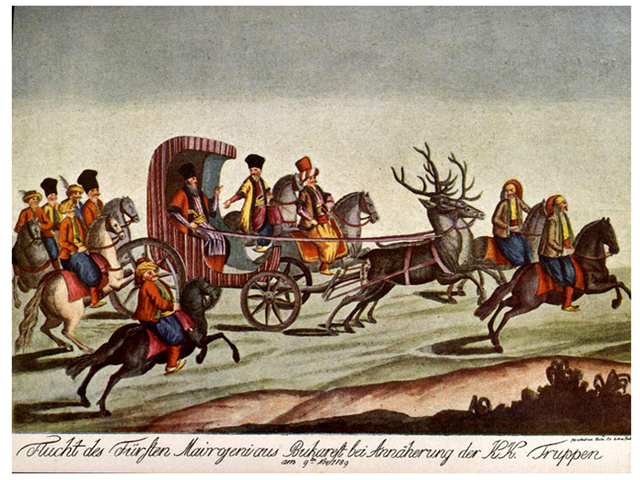
A peak moment of the Greek presence in Bucharest was the 18th century, during the so-called Phanariot Period. It was a time when princes from Greek families were sent here to rule. Thanks to some of these families, the cultural level of the province increased. Georgeta Penelea-Filiti:
“We must mention the large number of Greek people who came to Bucharest, started working here, got rich and even resorted to a so-called ‘marriage strategy’, which is still used nowadays. In order to better integrate themselves into the local community, Greek men started marrying Romanian women. Many Greek men decided to settle in Wallachia for good. In 1719, one of them said that Constantinople was a city that no longer interested him, as in Wallachia he had found everything he needed. Also in the 18th century, another Greek man confessed that if there was a paradise, it had to look a lot like Wallachia. The large number of Greeks in Bucharest made people consider it a Greek city.”
Among the Romanian personalities of Greek descent we can mention writers Ion Luca Caragiale and Panait Istrati, artists Hariclea Darclee and Jean Moscopol, politician I.G. Duca, industrialist Nicolae Malaxa and banker Zanni Chrissoveloni.