The Romanian Orthodox Church and the Holocaust
Relations between the Church and Jews have been mostly cold throughout history
Steliu Lambru, 05.11.2018, 14:38
In the 1930s and ’40s the relationship became one of rejection, when most Christian European churches had contradictory attitudes relating to the Jewish population, which was being sent into death camps and massacred. The Romanian Orthodox Church was no exception, going through the entire range of attitudes towards Romanian Jews.
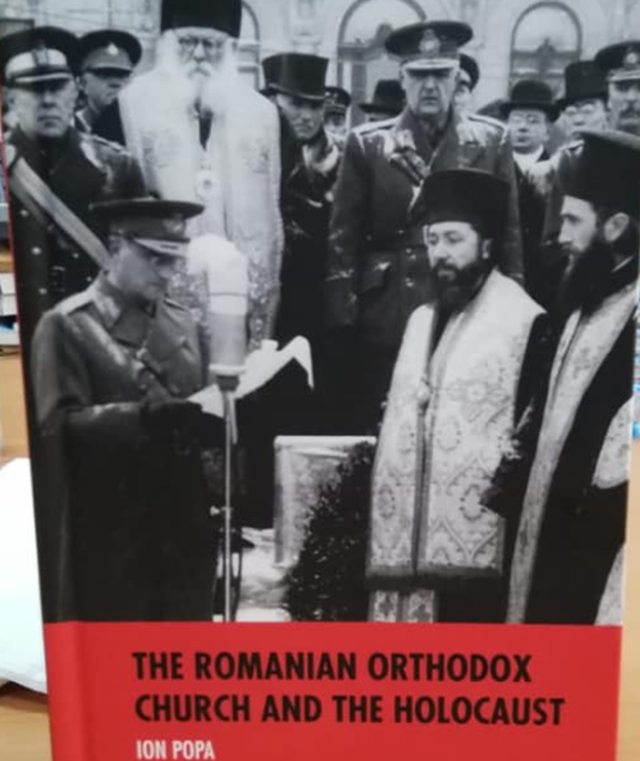
Ion Popa wrote a book called “The Romanian Orthodox Church and the Holocaust, where he reviews all the types of anti-Semitism and the attitudes taken by the Romanian Orthodox Church during the years of the Holocaust.
Ion Popa: “The first patriarch of the Romanian Orthodox Church, Miron Cristea, made in 1936-1937 some of the most virulent anti-Semitic statements, which secured the prime minister position for him in the first governments under King Carol II’s dictatorial regime. In 1937 he said that, ‘There are entire cities and lands where nothing is more Romanian than poverty, the starkest misery and the shadow of a thorn. One deplores the poor Romanian people, which the Jews are sucking of their very bone marrow. To defend ourselves is a national and patriotic duty, it is not anti-Semitic. To not react, to not act to get rid of this plague means to be cowardly, indolent, and to go to our grave with years to live and to the oblivion that looms above us. The Holy Synod of the Church had declared as early as 1937 its support for any policies to get rid of foreigners, which was 99% understood to mean Jews. In March 1938, the same Holy Synod decided to forbid any Jew who could not prove his or her Romanian citizenship to convert to Christianity, in a context which contested the Romanian citizenship of Jewish people.
The 1940s were a time when things went from worse to worst. During the governance of the Miron Cristea cabinet, hundreds of thousands of Jews lost their Romanian citizenship.
His successor followed this policy, as Ion Popa tells us: “After Nicodim Munteanu was elected patriarch, the Holy Synod voted in 1939 to forbid conversion to Jews who could not provide proof of citizenship, and introduced draconian measures related to the conversion of Jewish people. The signal was clear, the Church didn’t care a bit for Jews, and they wanted them hastily run out of the country. Even though patriarchs Miron Cristea and Nicodim Munteanu, were, for political reasons, against associating with the Iron Guard, other members of the high clergy, thousands upon thousands of Orthodox priests openly supported the Legion of the Archangel Michael. Metropolitans Nicolae Balan of Transylvania and Metropolitan Visarion Puiu of Bukovina were notorious for their ties to the Iron Guard. As for the clergy, we only need one example. In the general elections of 1937, 33 of the 103 candidates fielded by the Everything for the Motherland Party were Orthodox priests, almost one third. After the invasion of the Soviet Union in 1941, when the physical destruction of the Jewish population started, the Orthodox Church was mostly indifferent, or even active, in the destruction of the Jewish community, and in only a few cases instrumental in safeguarding it.
In the 1940s, the anti-Semitic attitude of the Orthodox Church was manifest in its theological arguments, spread through the press.
Ion Popa: “The Church’s publications became a vehicle for the circulation of virulent anti-Semitism. Church magazines in Bukovina, Bessarabia, and Transdnestr, territories where there were most of the killings, the death of Jews was met with glee. In various articles published between 1941 and 1943, Jews were depicted as being, quote, ‘cursed by Jesus, sons of Satan, straying from God.’ These articles urged people to, quote, ‘take up the sword and wipe out the Jews.’ These were articles in Church publications, by no means marginal. In April 1942, Patriarch Nicodim himself let loose a ferocious expression of anti-Semitism when he issued a sermon called ‘A Word for the Fast, for the Army and the Farmland’, in which he said, quote, ‘Jews are dastardly souls, mercenaries of Bolshevism, soldiers of Satan, a people that has called upon themselves and their sons a curse when they hanged on the cross the Son of God, the Savior of our souls.’ This was published in the official magazine of the Holy Synod, the most important Orthodox Church publication, right at the time when tens of thousands of Jews were being killed by the Transylvanian authorities.
The behavior of both the high and the low clergy, however, did result in the rescue of some of the oppressed: “Patriarch Nicodim himself, in 1942, sent to various state institutions letters from converted Jews which had been sent to him. Nicodim, however, did not insist on the rights of these people to be observed, and he obviously did not defend the rights of Jews who had not converted. Alexandru Șafran, head rabbi of the Jewish community, speaks in his memoirs several times about Nicodim, and is always critical of the patriarch’s passive attitude in contrast with the efforts made by Papal Nuncio Andrea Casulo, who provided help to the Jewish community during the Holocaust. In his memoirs, Șafran praises Metropolitan of Transylvania Nicolae Balan. Șafran says that Balan talked to Antonescu about revoking the deportation order for the approximately 230,000 Jews of the Old Kingdom to the Belzec in the summer of 1942.
The behavior of the Romanian Orthodox Church during the Holocaust was sinuous, from open and violent anti-Semitism to rescue and political calculations.