Women – The Enemy of the People
An exhibition that captures a different definition for the term `hero`.
Steliu Lambru, 29.12.2025, 14:00
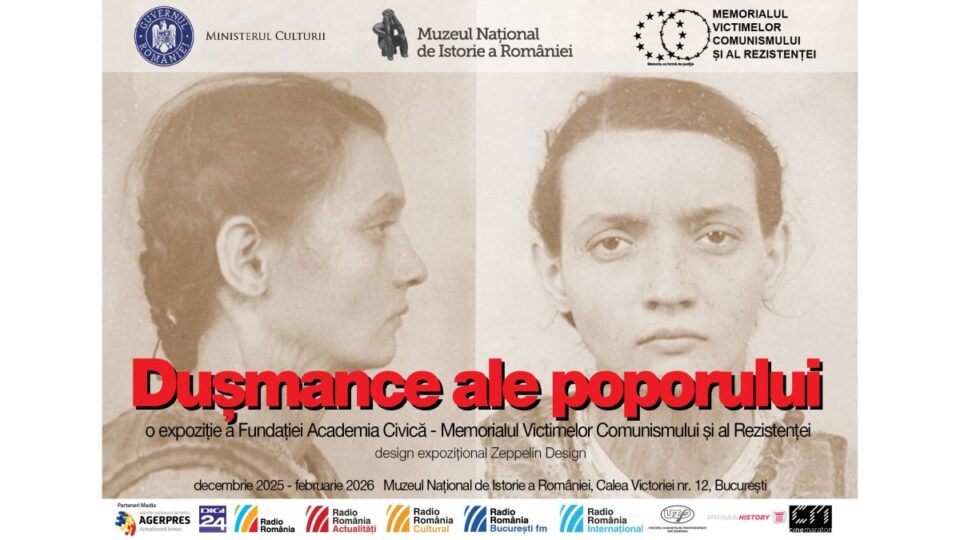
The expression “enemy of the people” entered Romanian public life with the establishment of the communist regime imposed by the Soviet army. Hundreds of thousands of Romanians were imprisoned on a wide range of charges, from the mere expression of opinions opposed to the regime, to armed resistance fighters who took to the mountains. Communist justice and the communist media were the main instruments through which so-called “enemies of the people” were targeted by public disgrace. The term was not just a journalistic figure of speech; it was a formal charge and the basis for criminal conviction. The list of “enemies of the people” is so long that it would take entire libraries to contain it.
But there were also “enemies of the people” who were women.
Women (often relatives of those labeled “enemies of the people”), much like men, endured forms of physical and psychological abuse that are almost impossible to imagine. They were thrown into prisons, deprived of food, warmth, rest, light and clothing. They were tortured to death. They gave birth to children in prison cells. The Memorial of the Victims of Communism and of the Resistance has compiled statistics on the women persecuted during the communist period. 5% of those imprisoned for political reasons in communist Romania were women—several thousand individuals. The reasons varied, from being deemed dangerous to the social order of the communist state to being jailed solely because they were relatives of male prisoners. Of these women, 1.25% did not survive detention.
In terms of social origin, 27% came from the bourgeoisie, 45% were peasants, 21% workers, and 1.5% wealthy landowners. In political terms, 89% were apolitical, 5% were democrats, and 6% socialists or communists. In terms of education, 28% had completed secondary school, 26% primary school, 15% basic elementary schooling, 13% higher education, 4% vocational training, and 9% were illiterate.
The destinies of these women were presented in the exhibition Women – The Enemy of the People at the National Museum of Romanian History, where the panels portray acts of genuine heroism. We are accustomed, from films and stories, to think of heroes and heroines as figures who distinguish themselves in battle, on the front line. But real life shows us that heroines are also those who face an unjust fate with dignity and honor. The poet Ana Blandiana said that, beyond the terrible times these brave women lived through and that put them to such cruel tests, they suffered for the noblest of human feelings.
“This is, in fact, an exhibition about love. This exhibition, which brings together women who were imprisoned under communism, does not speak about their ideology—an ideology which, I believe, cannot even be defined as such. The many and complex reasons that led them to prison were only to a small extent political. At the foundation of their strength, of their ability to remain faithful to themselves, was love. Because in most cases, these women ended up giving their lives, because they refused to betray their fathers, their brothers, their beloved ones, their husbands. This is that defining trait, that feminine strength. Moreover, the writer in me cannot help draw attention to the fact that in Romanian literature, especially from Transylvania, portraits of women possess immense power. Women in Transylvanian novels are stronger than men, and this strength is visible in an extraordinary way in our exhibition”.
Each of us has inner reserves of humanity we do not even suspect we possess. And the reserves of love of these severely tested women became the force that allowed them to resist and to fight for what is good and just, Ana Blandiana added.
“What is political, what belongs to contemporary history, in the destinies of these women, is the fact that they belonged (through their upbringing, through their essence and their strength) to a world that refused to degrade itself. Let us remember that at the end of the Roman Empire, humanity was saved by the Good News, the Gospel. The Good News was: love thy neighbor as you love yourself. And twenty centuries later, love, although constantly trampled underfoot, still stood, at least in theory, at the foundation of humanity’s moral architecture. In the 20th century Romania, where these women lived, love had been replaced by hatred: class hatred, and before that, racial hatred. But that hardly matters. What matters is that love no longer had a place in society, it had been replaced by hatred, and these women refused to accept that”.
The women of the communist prisons suffered for lofty ideals, for other people, for their principles, for everything that makes us human. Ana Blandiana continued:
“The love between men and women lies at the very foundation of our existence. I would like us to look at this exhibition beyond everything we know about communism, beyond all that was monstrous in that society, and to view it in a philosophical way. Because everything these women did (for whom prison was clearly even harder than it was for men), everything they did was something rooted in the very essence of humanity. And our exhibition is a tribute to the power of women to remain human”.
The “enemies of the people” are today in a better world, and for us they are human legends. They were, indeed, enemies, but enemies of evil and of everything that is inhuman. (VP)