CATANE, the feature film debut of Ioana Mischie
Inspired by real events and social phenomena, CATANE proposes an incursion into a borderline situation
Corina Sabău, 29.08.2026, 14:00
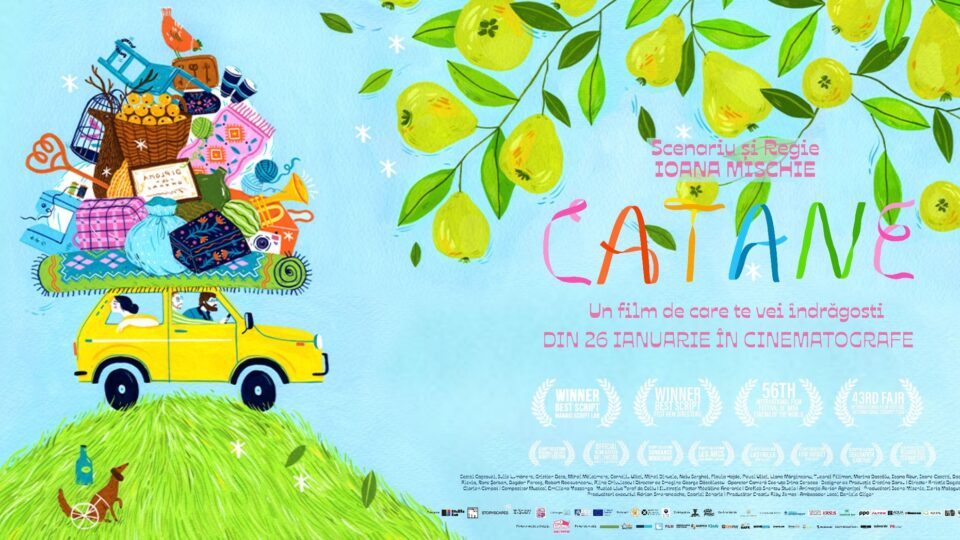
After a successful international run, with a world premiere hosted by IFFI Goa/International Film Festival of India, a Hollywood nomination for original music and numerous awards for the screenplay, the film CATANE, written and directed by Ioana Mischie, has been recently seen by the Romanian audience. Inspired by real events and social phenomena, CATANE proposes an incursion into a borderline situation: a village that has reached the end of its legal resources, which builds its own strategies to survive, fooling the authorities. In the leading roles we meet Costel Cașcaval, Iulia Lumânare and Cristian Bota, who play the roles of the inspectors who make up the investigation commission of the case in the village of Catane. The film was described by the international press as a “delight for the audience” (Film New Europe), “poetic, humorous and satirical” (Cineuropa) and “a dramatic comedy, which captures a reversal of the situation with black humor” (Variety). The film CATANE started from a bachelor’s degree script at the National University of Theatre and Cinematography “Ion Luca Caragiale” (UNATC).
The development and financing of the script took over a decade. Although it starts from real facts that outline a social phenomenon, Ioana Mischie chose to approach them in a comic key: “I really love the genre of black comedy, of social comedy – a genre rarely embraced, but which I consider of great artistic value, especially in Romania, where mischievous humor is our calling card. I think it also has a therapeutic role: we can talk about serious topics in a relaxed and gentle manner. Many have asked me why I didn’t turn it into a drama, because dramas benefit from the myth that they circulate more easily internationally, while comedy is more local. But I think we, the artists, are excited to propose new formats and cinematic approaches.”
CATANE is not about a single person, but about an entire community. In an era of loneliness and polarization, the film invites to seeing nuances and to an approach that raises questions about social justice and marginalization. Ioana Mischie: “I think it’s a necessary film, because in Romania we need to talk not only about individuals, but about communities, about systems and about larger groups. I feel this need more than ever, in an era of loneliness and social fragmentation. It’s a philosophical credo that follows me: I would like us to reach a point where we can give up prejudices and the reflex of judging each person and each action individually, because it is a toxic psychological process. For this story, I have researched extensively, I read hundreds of case studies. There are people who benefit from social assistance and fully deserve it, but there are also situations in which it is obtained unjustly. However, I looked for nuances, so that we would not judge the villagers in the film. They are not greedy persons who want to build villas with social assistance, but simple people, with small pensions, unable to pay huge taxes, in a place frozen in time. Universal questions arise from this reality about social justice and how we can live in a more equitable world, without marginalizing certain social categories.”
Cristian Bota told us about his experience working with director Ioana Mischie, a collaboration that began many years ago, on the short film “237 years”, selected at the Palm Springs International ShortFest. Familiarity with the film universe prepared him for this role, of Silviu Stavarache, a rookie social worker who arrives in a community with its own rules.
The actor spoke about the challenges of the character and the freedom offered by the director: “Things got really interesting when Ioana gave me the freedom to improvise. Not all collaborations give you this freedom, but it suits me. I also liked that the film has a clear and visible reversal of the situation, and such key moments help you understand the character better. When a character remains in an area of ambiguity or is not very well outlined in the script, the responsibility of building it falls on you, as an actor. But, in the end, if we don’t understand all the subtleties and motivations of a character, we can neither empathize with them nor convey emotion.”
Ioana Mischie is considered a trendsetter in the audiovisual field, her most recent cinematic universes exploring a new audiovisual genre called noetic fiction (which promotes futures stimulated by the evolution of human consciousness: Government of Children, Human Violins, Tangible Utopias). Among many other projects, she has made the first stereoscopic documentary in Romania, the first immersive multi-player franchise and the first film to integrate AI in a creative way. (LS)