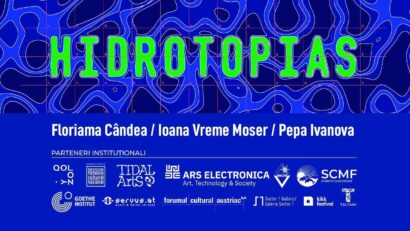
Modern Romanian Ceramics from the Dr. Nicolae Minovici Museum Collection
At the Bucharest Municipality Museum (MMB), headquartered at Suțu Palace, the exhibition ‘Modern Romanian Ceramics from the Dr. Nicolae Minovici Museum Collection’ showcases a selection of pieces produced in the early decades of the 20th century in four major Romanian pottery workshops.
Ion Puican, 02.05.2026, 14:00
The ceramic objects come from the collection of forensic physician Nicolae Minovici (1868–1941). The youngest member of the renowned Minovici family, he was a pioneer of modern medicine in Romania: founder of the Institute of Forensic Medicine, pathologist, anatomist, university professor, and even mayor of one of Bucharest’s administrative sectors.
The exhibition at the Bucharest Municipality Museum brings to the public a series of objects that illustrate the diversity of forms and decorative styles from a period in which Romanian ceramics began to blend traditional folk motifs with new urban aesthetic influences. It highlights part of Dr. Nicolae Minovici’s collection, which includes around 1,800 ceramic pieces from various regions of the country. Beyond their visual appeal, the exhibition traces how ceramics contributed to shaping a modern national style.
Mădălina Manolache, museographer at the ‘Prof. Dr. Nicolae Minovici’ Museum of Folk Art within the MMB, gave us details about the exhibition: “The exhibition ‘Modern Ceramics from the Collection of the Dr. Nicolae Minovici Museum’, hosted at Suțu Palace until June 7, features around 150 pieces of artistic ceramics. They come from four workshops and factories that operated in the first half of the 20th century on Romanian territory: the Royal Crown Domain Workshops in Periș, the Troița workshop in Bucharest, the workshop of artist Gheorghe Niculescu Mogoș in the former commune of Băneasa, and the Tompa brothers’ factory in Turda. Visitors will be able to admire a wide variety of decorative ceramic objects—plates, bowls, jugs, pots, vases, flower pots, and other ornamental vessels.”
Mădălina Manolache told us more about the ceramics displayed at Suțu Palace, particularly regarding the distinctive features of the workshops that produced the pieces on view: “In our case, modern ceramics draw directly from traditional pottery in both form and decoration, with ornamentation being the main distinguishing element. Each workshop or factory developed its own aesthetic program. Generally, we see numerous geometric and floral motifs, as well as zoomorphic and avimorphic elements, sometimes copied exactly from Romanian folk pottery or from neighboring ethnic traditions. At the Royal Domains workshops, for example, we encounter the rhombus motif, borrowed even from peasant bark textiles. As the workshop pursued a modernization of decoration, it gradually moved away from traditional ornamentation, adopting a fully geometric system that at times creates optical art effects. Potter Gheorghe Niculescu Mogoș also oscillated between traditional sources and innovative designs. In his workshop, as well as at Troița, he developed an original motif—the dance—a subtle reference not only to folk celebrations but also to the aspiration for territorial unity. There are also pieces with religious forms and decorations. One candlestick with a double medallion, for instance, depicts key biblical scenes: Adam and Eve near the forbidden tree and the expulsion from Paradise. The Tompa brothers’ factory in Turda likewise alternated between folk inspired decoration and a transformed ornamental vocabulary, using traditional motifs such as rhombuses and ram’s horns in new, densely composed, richly decorated arrangements.”
The exhibition also includes works created by visual artists who collaborated with the ceramics workshops. Madalina Manolache: “At Troița, artists also worked who attempted to create what we would today call product design. Remarkable, without a doubt, is the discovery of pieces made by Camil Ressu and Nora Steriadi. The exhibition presents a mug and two lobed jugs produced for Troița by Nora Steriadi, one of the most important decorative artists of the interwar period. We also highlight the plates decorated with birds—a stork and a hen with chicks—created by Camil Ressu for the same workshop. The contribution of artists to the field of decorative arts during the interwar period remains very little known and promoted.”
At the end of our discussion, museographer Mădălina Manolache added: “We believe that our exhibition captivates above all through its visual appeal: the harmonious shapes of the vessels, their carefully chosen colors, the engaging decoration, and especially the sheen of the enamel that coats them. Each workshop’s products have their own characteristics and style, waiting to be discovered.” (EE)