Eminescu Today
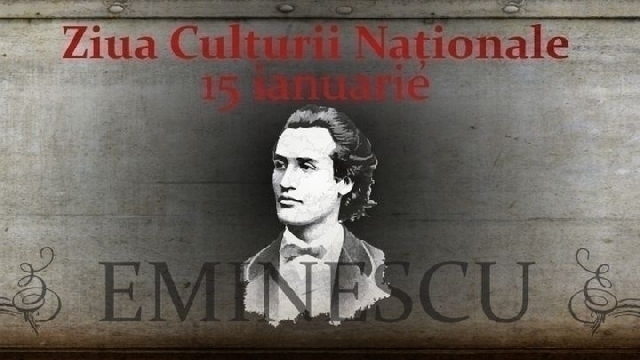
Every year on January 15 we celebrate National Culture Day, concurrently with the birthday celebration of Romanias national poet Mihai Eminescu
Corina Sabău, 27.01.2018, 16:23
Beyond the tribute-paying and celebratory events, we have tried to find out to what extent Romanians are still willing today to read his work and discover who Mihai Eminescu actually was, keeping in mind that school books still reduce his personality to a handful of stereotypes and that there has been hardly any notable progress in the critical approach to his works for half a century.
The critic Luminita Corneanu, who has also been teaching Romanian literature in high-school and college, says that it is essential for readers to understand the context in which Mihai Eminescu lived, if they are to understand his work. “The biographical approach, introducing Eminescu as a passionate man, as an outstanding journalist, in spite of his fierceness and excesses, as a man involved in a great love story with a woman named Veronica Micle, is the most effective method of bringing the young generations close to a body of work written one and a half centuries ago,” says Luminita Corneanu:
Luminita Corneanu: “Much as we admire Mihai Eminescu’s poetry, and I have great admiration for it, we must acknowledge that we are talking about poetry written with the poetic instruments of the 19th Century, which obviously reflect a type of worldview that was specific to that era. If we look, for instance, at the poem ‘The Lake’, which our kids study in the 8th grade, we have there a young man and a young woman trying to get together, in a forest, on the shores of a lake. So imagine the extent to which today’s young people, who meet over Facebook and get together in nightclubs, can actually relate to this poem. So Mihai Eminescu’s poetry is not easily accessible for kids, they often fail to understand what a particular poem is about.”
Before and after Eminescu, is how we could summarise Eminescu’s impact on the Romanian literature.
Luminita Corneanu: “Opening poetry up to ideas, to philosophy, integrating the Romanticism, bringing Romanian poetry in tune with Western poetry, with the European literary movements, we owe all of this to Mihai Eminescu. Moreover, Mihai Eminescu is the one who created the Romanian literary language, a truly poetic language. The Eminescu moment was decisive for the Romanian literature. As I have already said, if we study his life we will understand his works more easily, but I believe there are also poems that today’s young people, today’s public in general, can appreciate even without biographical data. And these are the poems that make up the ‘plutonic’ part of Eminescu’s work, as the critic Ion Negoitescu called it in a 1968 essay, talking about Eminescu’s posthumous poems, his dark poems, so to say.”
Before being the Romanians’ national poet, Mihai Eminescu was first of all an outstanding poet, says Carmen Muşat, editor-in-chief of the Cultural Observer journal. She believes that people should read Mihai Eminescu’s poems once again before paying homage to his work.
Carmen Musat: “I think that without Mihai Eminescu the Romanian literature would have looked different today, and the evolution, the transformation of the Romanian literature and language would have been delayed. Mihai Eminescu has the merit of having created a literary language and a work with very many nuances, open to interpretations. If we read his work attentively, we discover that Eminescu was not just a Romantic poet. Indeed, his prose is typically Romantic but his poetry goes beyond Romanticism, announcing many of the subsequent guidelines and developments in the Romanian literature. Eminescu’s poems include, besides melodiousness, rhythm, rhyme, and a typically Romantic imagination and rhetoric, the modernism of the late 19th Century and of the early 20th Century.”
Because Mihai Eminescu’s work was excessively used to create ideologies and myths, writer Simona Popescu did not feel the need to pay more attention to Eminescu’s poetry during school. It was only later that she discovered, on her own, the true meaning of Eminescu’s work:
Simona Popescu: “I re-discovered my own Eminescu, the humane Eminescu, the wonderful Eminescu in faculty, when I read and re-read his complete works. I even read all the versions of his poems included in the critical edition compiled by literary historian Dumitru Murăraşu. As a student I was able to come up with my personal approach of Eminescu’s poetry. I discovered a playful, ironical Eminescu, who also used parody and self-parody. At the time, I used to attend the Mihai Eminescu colloquiums in Iasi, in north-eastern Romania, and I remember having shocked the audience with my paper on a poem by Eminescu, which I had not heard of in school. Even today this poem is not paid the deserved attention, as it is considered a problematic poem. It’s called ‘Anthropomorphism’, it’s a kind of parody of ‘Luceafarul’ — The Evening Star which Eminescu wrote before ‘The Evening Star’. ‘Anthropomorphism’ also tells a love story, but between a cock and a hen, unlike ‘The Evening Star’ which tells the love story between a mortal woman and the Evening Star. It is a poem in which Eminescu makes a parody of his own themes and ideas that he used in his more serious, profound poems. This is an exercise that only a great poet can afford to make, given that we are speaking of a self-parody signed by Minunescu, a play upon words from Eminescu. I was very happy to discover that Minunescu, which made me love Eminescu even more.”