Activity assessment by the interim prime minister
Ilie Bolojan, who has headed the Romanian government for the past 16 months or so, has provided an overview of his term in office.
Corina Cristea, 20.10.2026, 13:50
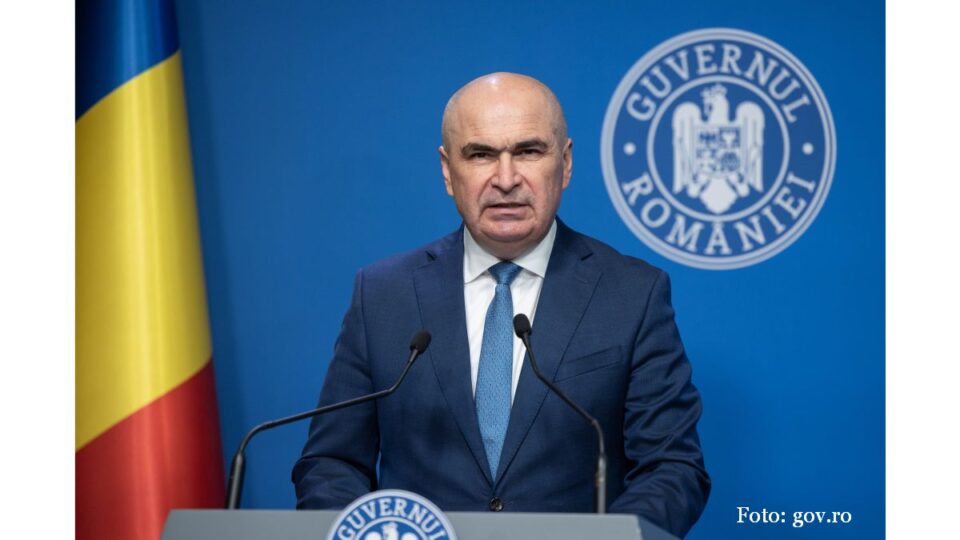
One day before Luca Niculescu was set to seek a vote of investiture for a new government in Romania’s Parliament, the interim Prime Minister Ilie Bolojan, who was removed on May 5th via a motion of no confidence, took stock of his tenure at the helm of the executive. It was a term of nearly 16 months, one he describes as being heavily marked by internal and external crises and various challenges. He notes that he took over a country with its back against the wall, yet he leaves the incoming administration a Romania on the path to recovery, a legacy defined by “a style of governance free from lies and populism, and rooted in respect for the people.” “In June 2025, the situation was so difficult that no one was lining up to become Prime Minister,” says Ilie Bolojan. “We faced a 9.3% deficit, an unhealthy economic growth model, driven solely by consumption and debt, a stalled National Recovery and Resilience Plan (NRRP) with an imminent risk of losing European funds, a society left fragmented following the cancellation of elections, and a genuine risk of sovereign default. There was no real choice; there was only one path forward: to begin the recovery, even at the cost of inevitable sacrifices.”
Ilie Bolojan acknowledged that he was compelled to begin his term by raising the VAT in order to urgently generate revenue for the state budget; he thanked the Romanian people for bearing the brunt of the burden during this period and emphasized that their efforts had been worthwhile. The budget deficit was reduced both last year and this year, and Romania avoided a credit rating downgrade. Furthermore, Ilie Bolojan pointed out that investments have increased and the reform of magistrates’ pensions has been carried out, an achievement that previous governments had failed to reach. At the same time, he admitted that consumption has declined and economic growth has been lost; however, he argued that these had been unsustainable, as they were fueled by borrowed funds. The outgoing Prime Minister also stated that the next government will face a number of challenges, including the issue of outstanding payments. This concerns more than five billion lei (nearly one billion euros) owed to magistrates who won these claims in court, as well as outstanding amounts stemming from energy compensation schemes.
Regarding the healthcare sector, Ilie Bolojan stated that the new government must ensure that issues related to salaries and poor hospital management do not translate into higher costs for the healthcare services provided to patients. Another future challenge, Bolojan pointed out, is improving the management of state-owned enterprises. He emphasized the need to revise performance indicators and conclude new management contracts, ensuring that these companies, such as CFR and Metrorex, are run in the best interest of the citizens. Furthermore, Bolojan highlighted the need for the incoming government to better manage investments, specifically by eliminating over-contracting and identifying priority projects that require rapid implementation. (LS)