Romania and Bulgaria: nearly 20 years in the EU
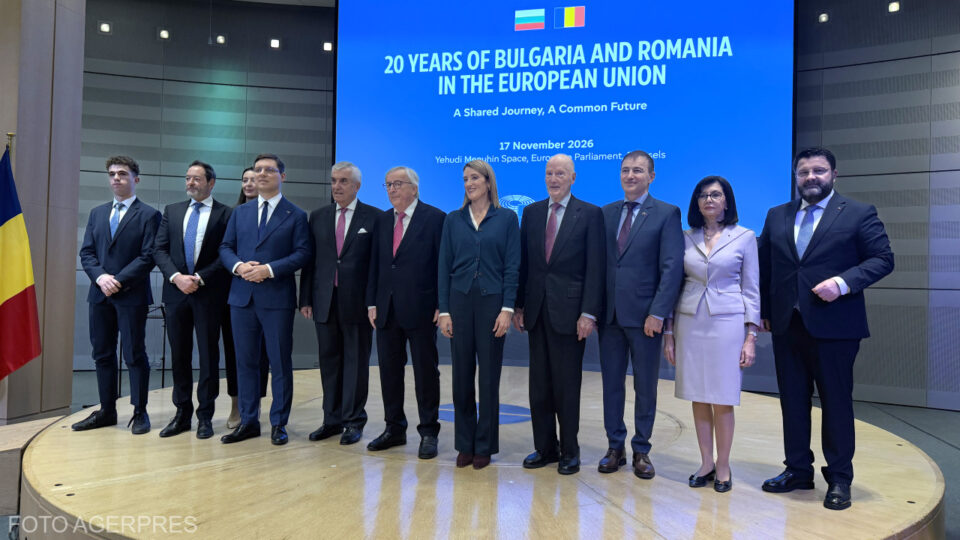
The accession of Romania and neighboring Bulgaria to the European bloc, which took place on January 1, 2007, was marked by an event held at the European Parliament headquarters in Brussels.
Florentin Căpitănescu, 18.11.2026, 13:50
Romania and Bulgaria marked two decades since their accession to the European Union ahead of schedule in Brussels, through a ceremony held at the European Parliament headquarters. The event brought together past and present political leaders, including European Parliament President Roberta Metsola, former European Commission President Jean-Claude Juncker, and former Romanian Prime Minister Călin Popescu-Tăriceanu.
On this occasion, Roberta Metsola congratulated Romania and Bulgaria on the benefits they have brought to the European Union, as well as on the progress both countries have made since their integration. “For me, Romania is at the heart of Europe, and the European Union is far better because of it,” the President of the European Parliament stated in her speech. In turn, Romanian MEP Victor Negrescu, Vice-President of the European Legislature, declared that “for many generations, Europe was a dream, yet Romania’s accession to the European Union proved that this dream can become a reality.”
Following their accession to the bloc on January 1, 2007, both nations bridged a significant portion of the vast economic gap separating them from the rest of the Union. According to an analysis by the European Parliamentary Research Service, Romania has reached 78% of the EU average in terms of GDP per capita, measured in purchasing power parity (PPP). In 2007, at the time of integration, that figure stood at just 44%.
The benefits are also clearly reflected in the fact that Romania has received roughly three times more funding than it has contributed to the EU budget. According to the same report, between 2007 and 2025, Romania received approximately €100 billion from the European budget, while its contribution to the bloc’s budget over the same period was around €35 billion. Integration has also spurred the expansion of trade: over two-thirds of Romania’s exports go to other EU member states, and more than 80% of its foreign direct investment originates from within the Union.
The Treaty of Accession to the European Union, signed in April 2005 in Luxembourg, served as the legal framework establishing the terms for Romania and Bulgaria’s EU integration. The document encompassed the provisions agreed upon across 31 negotiation chapters, covering areas ranging from the single internal market and agriculture to justice and home affairs. Romania committed to adopting the community acquis in full, which required aligning national legislation across all sectors with European standards. Furthermore, Romania’s accession was accompanied by a series of reforms, particularly within the judicial system and the fight against corruption. (VP)