RRI Live!

Listen to Radio Romania International Live

The Sugalete Compound in Bistrita

As they settled in southern and northeastern Transylvania in mid 12th century, German settlers soon started building fortified settlements thus laying the foundations of urban life in Romania.

The Sugalete Compound in Bistrita

, 11.06.2016, 12:20

The German population was concentrated in central Romania, in the depression area inside the Carpathian Arch, where we can find today the seven Saxon historical centres of Sibiu, Brasov, Rupea, Bistrita, Sighisoara, Medias and Sebes. Located in northern Romania, more precisely in the depression region in the northeast of the Transylvanian highlands, Bistrita was one of the most important medieval trade centers. First documented in 1241, the town was granted urban autonomy in 1355. The settlement could thus consolidate its reputation as a trade and crafts center run by a so-called ‘patriciate’ made up of all guild leaders.


Corneliu Gaiu, a researcher with the Bistrita Museum Compound, tells us how the town developed: “After 1330, when Bistrita was granted the right to elect its own leader and therefore have urban autonomy, the town received a series of facilities and privileges that consolidated its development. One such example is the development of crafts, and the first guilds in Transylvania were established in Bistrita in mid 14th century. The number of guilds increased in the following decades. Against the backdrop of the growing power of the town’s patriciate, the first wall constructions were erected in Bistrita in 15th century. Around the mid-15th century, most of the buildings located along the sides of the town square were given a new look to create the impression of more space, just as the town patriciate wanted.”


Some of those buildings can still be seen today and are grouped in the Sugalete compound, located in the town’s central square. The compound is one of the most important samples of urban medieval architecture preserved in Transylvania. Built between the middle of the 15th century and around the year 1660, these buildings belonged to some of Bistrita’s most prominent families such as the Peterman family, whose head was the leader of the armourers’ guild, the Kretschmer and the Eiben families.


Speaking again is historian Corneliu Gaiu, this time about the architecture of these houses:

“To create more living space and to provide better separation from the commercial market area where they sold their cereals, the owners had a series of open porches on the ground floor which provide an extension of the house on first floor. All these buildings thus create a coherent compound, even if they were not built at the same time and did not belong to the same owner. The model for such buildings can be found in Padua and Prague where similar constructions appear at about the same time. In Transylvania, these are clear examples of Gothic architecture. Some of these buildings have inscriptions with the construction date, such as the parish house and the Peterman house, both inscribed with the year 1480, when construction had already been finished. The other buildings in the compound date from the same period, although some of them saw Renaissance transformations and additions and others were restored during the Baroque period.”


The Romanian population called this group of buildings “Sugalete”, which is in fact a contraction of “Sub Galete”, meaning “Under the Buckets”. The vault of the porches reminded the customers who came to Bistrita to buy cereals of the shape of bucket turned upside down. Another explanation could be related to the fact that the bucket was the measurement unit for cereals in the Middle Ages. Regardless of the origin of the name, the Sugalete compound has become the trademark of Bistrita, reminding visitors of the vibrant trading life the town used to have.
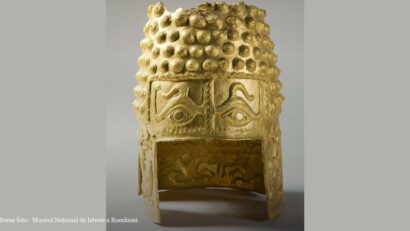

Coțofenești gold helmet (Photo: Muzeul Național de Istorie a României)
RRI Encyclopaedia Sunday, 25 October 2026

The Coțofenești Helmet

The Coțofenești helmet is one of the most valuable gold artifacts ever discovered on the territory of Romania, belonging to the Thraco-Getic civilizat…

The Coțofenești Helmet
Sergiu Celibidache (1912-1996)
RRI Encyclopaedia Sunday, 18 October 2026

The Institute of Forensic Medicine, or Bucharest’s lost heritage

  On the left bank of the Dâmbovița, after the river leaves the central area around Unirii Square, stood until 1985 the building of the Institute…

The Institute of Forensic Medicine, or Bucharest’s lost heritage
RRI Encyclopedia
RRI Encyclopaedia Sunday, 11 October 2026

Alburnus Maior, Roșia Montană

Alburnus Maior is the ancient Roman name for the town of Roșia Montană, located in central Romania, in the historical region of Transylvania, in the A…

Alburnus Maior, Roșia Montană
RRI Encyclopedia
RRI Encyclopaedia Saturday, 03 October 2026

Forensic Medicine in Romania

Forensic medicine is the branch of medicine that makes it easier to establish the truth and ensures that the law is applied fairly. The institutional …

Forensic Medicine in Romania
RRI Encyclopaedia Sunday, 27 September 2026

The “Anastasie Fătu” Botanical Garden in Iași

The “Anastasie Fătu” Botanical Garden in Iași is celebrating its 170th anniversary — 170 years devoted to science and culture in the service of nature…

The “Anastasie Fătu” Botanical Garden in Iași
RRI Encyclopaedia Sunday, 20 September 2026

The Sip Canal

The most spectacular section of the Danube, along its 2,850-kilometer course from the Black Forest Mountains in Germany to its mouth on the Black Sea …

The Sip Canal
RRI Encyclopaedia Sunday, 13 September 2026

Historian Gheorghe Brătianu

Among the leading figures in 20th-century Romanian historiography, Gheorghe I. Brătianu holds an important place. Gathered around the ‘Revista Istoric…

Historian Gheorghe Brătianu
RRI Encyclopaedia Sunday, 30 August 2026

Princely and Royal Thrones

  A symbol of royal authority, thrones held a central place in the representations of power in the Romanian space. Before 1945, they were a natur…

Princely and Royal Thrones

Partners

Muzeul Național al Țăranului Român Muzeul Național al Țăranului Român
Liga Studentilor Romani din Strainatate - LSRS Liga Studentilor Romani din Strainatate - LSRS
Modernism | The Leading Romanian Art Magazine Online Modernism | The Leading Romanian Art Magazine Online
Institului European din România Institului European din România
Institutul Francez din România – Bucureşti Institutul Francez din România – Bucureşti
Muzeul Național de Artă al României Muzeul Național de Artă al României
Le petit Journal Le petit Journal
Radio Prague International Radio Prague International
Muzeul Național de Istorie a României Muzeul Național de Istorie a României
ARCUB ARCUB
Radio Canada International Radio Canada International
Muzeul Național al Satului „Dimitrie Gusti” Muzeul Național al Satului „Dimitrie Gusti”
SWI swissinfo.ch SWI swissinfo.ch
UBB Radio ONLINE UBB Radio ONLINE
Strona główna - English Section - polskieradio.pl Strona główna - English Section - polskieradio.pl
creart - Centrul de Creație Artă și Tradiție al Municipiului Bucuresti creart - Centrul de Creație Artă și Tradiție al Municipiului Bucuresti
italradio italradio
Institutul Confucius Institutul Confucius
BUCPRESS - știri din Cernăuți BUCPRESS - știri din Cernăuți

Affiliates

Euranet Plus Euranet Plus
AIB | the trade association for international broadcasters AIB | the trade association for international broadcasters
Digital Radio Mondiale Digital Radio Mondiale
News and current affairs from Germany and around the world News and current affairs from Germany and around the world
Comunità radiotelevisiva italofona Comunità radiotelevisiva italofona

Providers

RADIOCOM RADIOCOM
Zeno Media - The Everything Audio Company Zeno Media - The Everything Audio Company