Union of Romanians
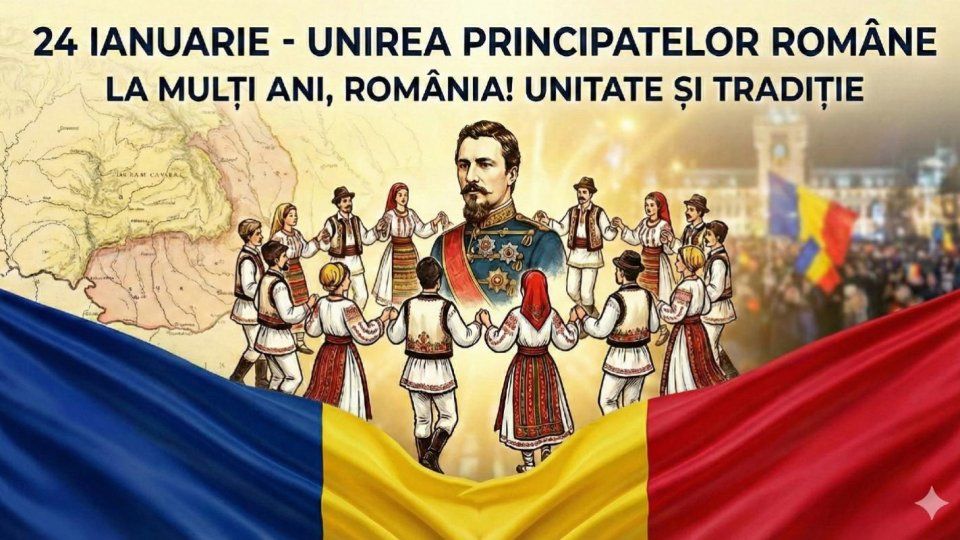
The union of the Principalities of Moldavia and Wallachia on January 24, 1859, was one of the three great moments of Romanian history in the 19th century.
Steliu Lambru, 16.02.2026, 14:00
The union of the Principalities of Moldavia and Wallachia on January 24, 1859, was one of the three great moments of Romanian history in the 19th century. It is the founding act of Romania, along with the other two equally powerful moments: gaining state independence in 1877 and proclaiming the kingdom in 1881. But beyond the actual, formal union, it meant a series of intense efforts made by the elites and the people for the Romanian state to get coherence.
The historian Ioan-Aurel Pop is the president of the Romanian Academy and his opinion is that although the unification of Romanians was an act achieved late, compared to the nations of Western Europe, it is no less worthy of consideration: “We think that we did it a bit late, we Romanians, compared to other peoples. About the peoples of Western Europe, about some of them, it is said that they managed to become nations in the 15th and 16th centuries and to form national states. Here, in Central and Southeastern Europe, we did it much later, with more difficulty. Romanians are the last to come in this line, if we want to put ourselves among the peoples with a history of their own. They are also geographically located somewhat eccentrically from the central area of the continent. When the Romanians of Transylvania and Bukovina were in the Romano-German Empire, then in the Habsburg Empire, from 1806, and then in the Austro-Hungarian Empire from 1867, they were seen as a people without history. This is what was taught in school actually.”
The emancipation of the Romanians occurred when the idea of a national state and that of knowing one’s own past became decisive in the way the 19th-century people imagined the new world: “We were considered a people without statehood and consequently a people without a history. The construction of national states in our area occurred around the 19th century, in all the surrounding peoples. The first ones to start were the Greeks, helped enormously by the West. When Greece was liberated, at the beginning of the 19th century, around the time when we were in a state of chaos, Tudor Vladimirescu was on the Cotroceni Hill, expected to enter Bucharest. And he entered, he ruled for two months and introduced the first modern reforms. In Greece, the struggle was in full swing and, in the end, the Great Powers helped Greece to obtain independence. A famous English poet of the time, Lord Byron, died in Missolonghi at the age of 20 or so, defending Greece with romantic ideals. But not because he necessarily loved the Greeks of that time, but only because he admired the democracy of the ancient Greeks.”
The Romanians were not the only ones who made their own union. It was an idea of the time that others also embraced: “Our turn also came, also in the 19th century, alongside these peoples, who were considered peoples on the periphery. There were peoples located in the center and peoples on the periphery. We, those from the outskirts of the European West, and especially the Orthodox peoples, were considered a people on the periphery. This people made a plan. How many times did we hear someone say that the Great Powers did the unification for us? Or some eccentrics who had nothing to do? Or foreign adventurers? We should think a little about ourselves, what our people did. Were they all passive? Let’s remember that those marginal boyars of Wallachia and Moldavia, from the period around 1770-1780, when the Transylvanians were making memoirs to the Court of Vienna for the rights of the Romanian nation in Transylvania, they were making memoirs for a Kingdom of Dacia.”
The unification of Romanians therefore had its own dynamics before becoming a reality in 1859. Ioan-Aurel Pop is back at the microphone with details: “Around 1840, people were writing patriotic poems. It was this idea that we call Daco-Romanianism because we have testimonies from the time, when people were discussing whether the new country that would be created would be called Romania or Dacia. Others say that our elite worked before 1848. The Romanian leaders created the Romanian nation with a national state because certain conditions were prepared. First of all, and this is something that some do not believe, was the linguistic factor. The Romanian language was fundamental. Mihail Kogălniceanu, in 1843, when he opened the national history course at the Mihăiliană Academy in Iași, said the following: ‘I call homeland the entire expanse of land where Romanian is spoken. Vasile Alecsandri wrote Hora Unirii (The Union Round Dance) and published it in 1857. Andrei Mureșanu, in Transylvania, wrote the poem Un răsunet. Deșteaptă-te, Române! (An echo. Awaken thee, Romanian!) also in those years. The poem was published in 1848, but he wrote it before. Anton Pann was born in what is now Bulgaria and he is the author of the music for the national anthem.”
The unification of the Romanians in 1859 was an idea, a value, a meaning of existence that the people of at that time had. And today it is an element of identity, a heritage and a legacy. (LS)