A New Life for Romanian Traditional Costume
Romanian traditional costumes are back in fashion. No matter how simple or elaborate, the Romanian peasant shirt in particular is making a big comeback.
Virginia Linul was born in a family in Bistrita Nasaud that carried the tradition of making peasant garb, and now has a home that is a veritable museum, where she gathered 50 to 60 women to help her in her work. She admits that she regained confidence in her skills after Romania took part in the 1999 Smithsonian Folklife Festival in Washington, with traditional dress, cuisine, and folklore. Virginia Linul told us that what she does actually carries a great deal of responsibility:
“I started off by making traditional costumes from our area, from Bistrita Nasaud, then I started making costumes based on patterns from other areas of the country, with similar techniques, but different patterns. This was a very serious undertaking, with a lot of research, both in museums and in villages. I dont make just anything, for appearances sake, I dont make imitations, I realize I have a great deal of responsibility, because they are meant for the generations to come, because I know that if we dress our children up in bad imitations, they will grow up thinking that is the genuine article. We as parents have a responsibility towards future generations to dress them in authentic traditional costumes, manually sewn, so that children grow up with the notion of what authentic means.”
Virginia Linul told us that Romania has 450 ethnographic areas, which is why it is important to preserve their authenticity. She also told us about how traditional costumes made a comeback:
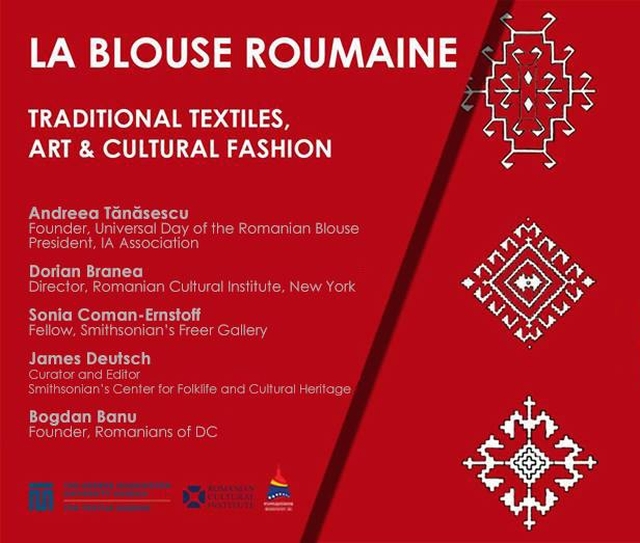
“In 2011, a French designer with the French Embassy came to Romania as a cultural director, Pilippe Guiller. He fell in love with Romania and its beauty. He knew how to see the artistic side of everything, and he wanted to showcase it. He put together a collection called 100%.ro. Thanks to this foreign designer who came to work with me, 60% of the collection was made here, but he also worked with craftsmen and women from Maramures, Bukovina, Brasov, and Oltenia, he worked with artists from across the country. Thanks to the promotion activity, television stations picked this up, promoting the clothing, which started being worn by stars, especially on Romanias national day. Soon after that, Andreea Tanasescu created on Facebook a page called La Blouse Roumaine, the Romanian peasant shirt, creating events all over the place.”
Another remarkable presence on-line promoting traditional garb is the association Sewn Signs, which in June this year was present on Google Arts and Culture with the exhibition Dressing Fairy Tales, exploring the craft of weaving and sewing traditional shirts, showcasing the embroidery and the fabrics, explaining the tales that are encoded in the patterns, with each color and symbol. It meant traveling the path between art and tradition, according to Ioana Cordureanu, the founder of the Sewn Signs association:
“I hope that as we go along we will get father away from cheap fabrics, and will start doing what our grandmothers did, making costumes out of linen, hemp, silk, and wool, because these materials are healthier for us and for the planet. These are precious and noble materials, as our shirts deserve. Traditional shirts have to have crimped collars, straight shirts, some women wear them with traditional skirts, not always, but some of them want to go full on traditional.”
Ioana Cordureanu also told us that the ladies in the Sewn Signs community are making the shirts because they simply love making them:
“They mostly work out of their love for the craft, embroidery is an art and a form of relaxation. They make them for themselves, because they love wearing them, they also make them for their family, for their loved ones, for friends, and the most generous of them make them for our exhibitions, which have now moved into the virtual space.”
Any woman who wants to join the craft has to take only a few steps, as Ioana Cordureanu told us:
“If you do a Google search using the keywords sewn signs you can find our blog, you can find the workgroup sewn signs in action on Facebook, that is all you have to do to join this sewing group, to study a bit about what was discussed, what they want to do, and they will get the help they need. Symbols are universal, they are a visual language, understood by all. In the Romanian tradition you have a veritable grammar, you assemble letters into words and sentences, which makes us unique. You can differentiate a Romanian peasant shirt from those of all our neighbors, we can be as specific as being able to tell which village it was made in, or at least the region. There area ladies from the Netherlands, Bulgaria, and Japan, who are interested in sewing Romanian traditional shirts, embracing the values that our shirts carry, which are universal, valid for the past, present, and future.”
As for some good news, this year, for Romanias national day, in Paris, several ladies in Ioana Cordureanus group wore traditional shirts with blue skirts, because visitors to the exhibition were taking pictures of them next to the famous painting by Henri Matisse called La Blouse Roumaine, the Romanian traditional shirt, which was made in 1940.
Ana-Maria Cononovici, 17.12.2019, 14:41
Romanian traditional costumes are back in fashion. No matter how simple or elaborate, the Romanian peasant shirt in particular is making a big comeback.
Virginia Linul was born in a family in Bistrita Nasaud that carried the tradition of making peasant garb, and now has a home that is a veritable museum, where she gathered 50 to 60 women to help her in her work. She admits that she regained confidence in her skills after Romania took part in the 1999 Smithsonian Folklife Festival in Washington, with traditional dress, cuisine, and folklore. Virginia Linul told us that what she does actually carries a great deal of responsibility:
“I started off by making traditional costumes from our area, from Bistrita Nasaud, then I started making costumes based on patterns from other areas of the country, with similar techniques, but different patterns. This was a very serious undertaking, with a lot of research, both in museums and in villages. I dont make just anything, for appearances sake, I dont make imitations, I realize I have a great deal of responsibility, because they are meant for the generations to come, because I know that if we dress our children up in bad imitations, they will grow up thinking that is the genuine article. We as parents have a responsibility towards future generations to dress them in authentic traditional costumes, manually sewn, so that children grow up with the notion of what authentic means.”
Virginia Linul told us that Romania has 450 ethnographic areas, which is why it is important to preserve their authenticity. She also told us about how traditional costumes made a comeback:
“In 2011, a French designer with the French Embassy came to Romania as a cultural director, Pilippe Guiller. He fell in love with Romania and its beauty. He knew how to see the artistic side of everything, and he wanted to showcase it. He put together a collection called 100%.ro. Thanks to this foreign designer who came to work with me, 60% of the collection was made here, but he also worked with craftsmen and women from Maramures, Bukovina, Brasov, and Oltenia, he worked with artists from across the country. Thanks to the promotion activity, television stations picked this up, promoting the clothing, which started being worn by stars, especially on Romanias national day. Soon after that, Andreea Tanasescu created on Facebook a page called La Blouse Roumaine, the Romanian peasant shirt, creating events all over the place.”
Another remarkable presence on-line promoting traditional garb is the association Sewn Signs, which in June this year was present on Google Arts and Culture with the exhibition Dressing Fairy Tales, exploring the craft of weaving and sewing traditional shirts, showcasing the embroidery and the fabrics, explaining the tales that are encoded in the patterns, with each color and symbol. It meant traveling the path between art and tradition, according to Ioana Cordureanu, the founder of the Sewn Signs association:
“I hope that as we go along we will get father away from cheap fabrics, and will start doing what our grandmothers did, making costumes out of linen, hemp, silk, and wool, because these materials are healthier for us and for the planet. These are precious and noble materials, as our shirts deserve. Traditional shirts have to have crimped collars, straight shirts, some women wear them with traditional skirts, not always, but some of them want to go full on traditional.”
Ioana Cordureanu also told us that the ladies in the Sewn Signs community are making the shirts because they simply love making them:
“They mostly work out of their love for the craft, embroidery is an art and a form of relaxation. They make them for themselves, because they love wearing them, they also make them for their family, for their loved ones, for friends, and the most generous of them make them for our exhibitions, which have now moved into the virtual space.”
Any woman who wants to join the craft has to take only a few steps, as Ioana Cordureanu told us:
“If you do a Google search using the keywords sewn signs you can find our blog, you can find the workgroup sewn signs in action on Facebook, that is all you have to do to join this sewing group, to study a bit about what was discussed, what they want to do, and they will get the help they need. Symbols are universal, they are a visual language, understood by all. In the Romanian tradition you have a veritable grammar, you assemble letters into words and sentences, which makes us unique. You can differentiate a Romanian peasant shirt from those of all our neighbors, we can be as specific as being able to tell which village it was made in, or at least the region. There area ladies from the Netherlands, Bulgaria, and Japan, who are interested in sewing Romanian traditional shirts, embracing the values that our shirts carry, which are universal, valid for the past, present, and future.”
As for some good news, this year, for Romanias national day, in Paris, several ladies in Ioana Cordureanus group wore traditional shirts with blue skirts, because visitors to the exhibition were taking pictures of them next to the famous painting by Henri Matisse called La Blouse Roumaine, the Romanian traditional shirt, which was made in 1940.