The Ethnography Museum in Ciocanesti
Today we are going to a commune whose brands are the painted egg and the house with traditional motifs
Călin Coțoiu and Ana-Maria Cononovici, 16.04.2026, 19:13
It is the village of Ciocăneşti. We are in a place that in 2004 was named a museum commune, and in 2014 it was named the “cultural village of Romania”, after which all the locals had the obligation to decorate the exterior walls of their houses with traditional patterns.
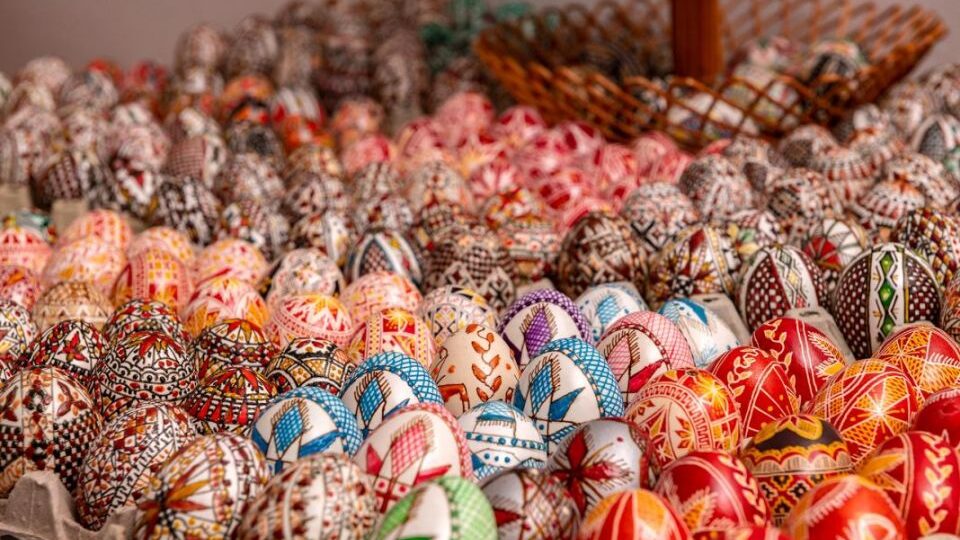
The story that brought fame to the village of Ciocăneşti throughout the world began in 1950, in the house of Leontina Ţăran, who began to renovate her house, but not just any way, but using the patterns found on the painted eggs here. The result pleased the neighbors and in the shortest possible time all the houses in the village began to be decorated with patterns found on Easter eggs. Over time, Leontina Ţăran’s house was converted into a museum, which preserves old traditional garb from the Bistriţa Valley, as well as traditional objects. All of the over 600 houses here have walls painted with traditional, geometric motifs, which can be found on traditional clothing, but also on eggs, a traditional Ciocăneşti egg being painted on black, with a white pattern.
The commune also has a Museum of Painted Eggs, which brings together over 1800 painted eggs between 40 and100 years old, as well as over 2,800 eggs awarded by the National Painted Egg Festival that takes place here annually, during Easter. Opposite there is a village museum, the Ethnographic Museum.
Marilena Niculiţă, director of the National Museum of Painted Eggs in Ciocăneşti, took us through the Village Museum:
“At the Village Museum, tourists have the opportunity to see the organized workshops, because the museum is organized by workshops, by the main occupations of the locals. With a blacksmith workshop, a traditional sheepfold, a room for rafting, a room for mining, a woodworking room, a peasant room, fabrics, folk costumes, folk masks, but also the most beautiful patterns on the houses. Because, in Ciocăneşti, the architecture of the houses is special. On the Holy Easter holidays, the locals decorate their houses as beautifully as possible for the holidays, and 99% of the houses are decorated with traditional motifs, they are geometric motifs, which we find not only on houses in Ciocăneşti, but also on folk costumes, on fabrics, on seams, but also on painted eggs.”
Walking through the museum rooms, the visitor travels back in time, discovering peasant shirts and peasant trousers, rafts on turbulent rivers, black and white portraits, hand-sewn carpets, looms, kneading vats, and dowry chests.
One of the biggest festivals organized in Ciocăneşti is the National Trout Festival, which takes place on August 15, and tourists can find details on the website www.ciocanestibucovina.eu .
The custom of rafting is another tradition preserved in Ciocăneşti, where raft rides on the Bistriţa River are also organized. A visit to one of the sheepfolds on the nearby mountain, Suhard, or a visit to a manganese mine add to the tourist attractions of the area.