Between Combat Experience and the NATO Mission in Romania
Military cooperation on NATO’s eastern flank is built day by day
Agenția Media a Armatei, 23.09.2026, 13:43
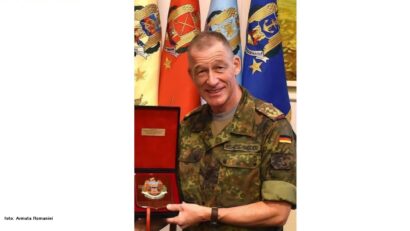
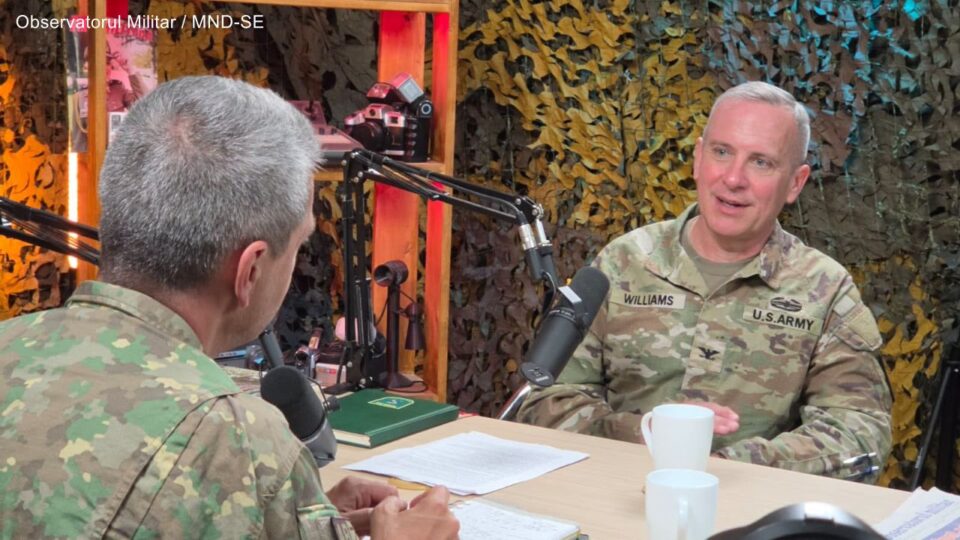
Military cooperation on NATO’s eastern flank is built day by day, in training areas, in command posts, and during exercises and missions where personnel from different armies must operate as a single team. At the heart of this reality is, among others, Colonel Dennis Williams, Deputy Chief of Staff for Operations with the NATO Headquarters Multinational Division Southeast. A career that started as an enlisted soldier and spanned operational theaters such as Somalia, Iraq, and Afghanistan, has brought him today at a multinational command centre in Romania. His experience speaks to leadership, responsibility, and the elements that make the difference between a mere group of soldiers and a team capable of successfully executing a mission: My role as Deputy Chief of Staff, he says, is to ensure we have a deterrence plan in place and to coordinate our combat efforts. We achieve this through exercises, as well as bilateral and multinational agreements; my job is to ensure we can join forces and fight together to achieve a common objective, and, if necessary, to defend NATO against any form of aggression, Col. Williams adds.
A common goal is what brings together military personnel from various nations, each with their own procedures, experiences, and perspectives. For Colonel Williams, working in such an environment is nothing new. Yet, the mission in Romania offers him a unique vantage point: that of an American officer witnessing first-hand our country’s role in the North Atlantic Alliance’s security architecture. And here, he says, cooperation with Romanian forces is essential: We have numerous contacts with the host nation, he adds, and we could not fulfill our mission here without Romania’s contribution. I work with the Romanian Land Forces, with joint forces, and with AIRCOM. We are deeply integrated into the national defence plan. Romania is an exceptional host nation, Col. Williams also pointed out, we constantly work together with Romanian forces to participate in their exercises, and all of this serves to build a natural rapport among soldiers, enabling us to carry out our mission should the need arise.
It is a relationship built through training, collaboration, and trust. Yet for Colonel Dennis Williams, this lesson did not begin in Romania; it stems from his earlier years as a officer participating in missions within conflict zones. In Somalia in 1993, he was part of the teams tasked with recovering downed aircraft during operations following the Battle of Mogadishu. That was his first experience working alongside partners in a multinational coalition, an experience that would shape his entire career.
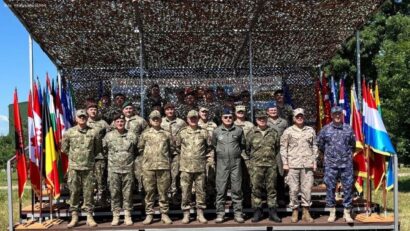
NATO’s Eastern Flank means, above all, presence, readiness, and the ability to respond together. For Colonel Dennis Williams, the challenge is not for all these armies to think alike, but to arrive at a common solution when the Alliance’s security demands it: We have 14 nations, which means 14 different solutions. None is necessarily better than the other. We must work together to find the solution that works best for our mission, he explains.
And this is one of the key goals for the Eastern Flank: not merely the existence of military forces, but their ability to coordinate, to understand one another, and to act as a single structure. For Colonel Williams, the experience on NATO’s Eastern Flank is also a new professional stage, one where lessons learned in theaters of operation meet the reality of an alliance that must be prepared to act in unison. (AMP)