Drones and surveillance in the Black Sea
One of the most consequential transformations driven by the Russian-Ukrainian war has been the conversion of the Black Sea into a theater of maritime and aerial confrontation.
Corina Cristea, 06.11.2026, 14:00
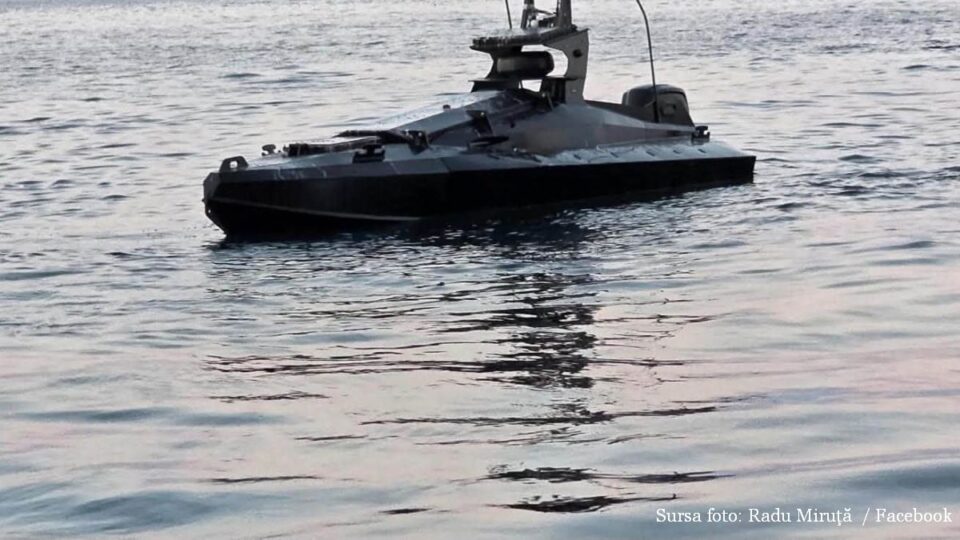
The proliferation of aerial and naval drones, long-range missiles, sea mines, and targeted attacks on commercial vessels has fundamentally rewritten the rules of surveillance and defense in the region. To partially offset its conventional naval inferiority, Ukraine has increasingly turned to uncrewed surface vessels, while Russia has intensified its deployment of aerial drones and missiles against Ukrainian infrastructure, including its Black Sea and Danube ports.
The inevitable fallout? The spillover of military risk far beyond the immediate zone of hostilities. Stray drones and shrapnel drifting across the borders of neighboring states, including Romania, underscore just how porous and fragile the boundary between the active warzone and the security architecture of NATO allies has become. In response, the North Atlantic Alliance has reinforced its posture in the Black Sea (dispatching specialized assets to bolster surveillance, reconnaissance, and investigative capabilities, according to an Alliance spokesperson) while concurrently upgrading counter-drone defenses.
Yet, experts argue more is required. Retired General Dorin Toma, former commander of NATO’s Multinational Division Southeast, warns against an imbalance on the southeastern flank, calling for a dedicated NATO Black Sea operation modeled after the Baltic approach, even as member states deploy various tracking systems to assist Romania:
“From my perspective, it is simply not enough. When we look across the entire eastern front, from the Arctic and the Baltic down to the Black Sea, a glaring imbalance emerges. While NATO plans and executes dedicated operations in the Arctic and the Baltic Sea specifically mandated to safeguard territorial waters and monitor economic infrastructure within allied exclusive economic zones, security in the Black Sea has been relegated to an ad-hoc trilateral initiative launched back in 2023 by Turkey, Bulgaria, and Romania, originally limited to mine countermeasures. Although an attempt was made at the NATO summit to extend this mandate to critical underwater infrastructure, further details remain scarce. Regardless of how many systems you deploy or how advanced they are, without seamless integration, a clearly defined mission mandate, a unified command-and-control hierarchy, and the complete synchronization of NATO and national architectures, the outcomes will fall short of expectations.”
A particularly alarming dimension of this escalation involves commercial navigation. As a vital artery for exports of grain, oil, petroleum products, and other essential raw materials, the Black Sea has seen maritime shipping risks surge dramatically. A disturbing series of incidents throughout October demonstrated that even neutral vessels operating outside military zones and flying the flags of non-combatant nations are increasingly in the crosshairs.
Corneliu Bjola, Professor of Diplomatic Studies at the University of Oxford:
“Russia’s overriding priority right now is to economically and militarily strangle Ukraine. The strategy is transparent and has been unfolding for months. The fact that these drones are breaching our airspace is part of a deliberate effort to deter cargo vessels, whether hailing from the Global South or elsewhere, from reaching Odesa and moving goods. This explains the steady escalation and the wave of successive attacks we’ve witnessed over the summer. Nothing here is accidental; it is a calculated strategy designed to choke off Ukraine’s grain export corridors with high efficiency. Diminishing Ukraine’s shipping capacity also shifts the financial burden onto Europe, which must step in with economic assistance to offset these staggering losses.”
Moreover, Professor Bjola notes, every stray drone incident is systematically leveraged within a broader disinformation campaign aimed at paralyzing political decision-making. These flashpoints are exploited to erode public trust in state authorities, NATO, and the strategic partnership with the United States. Moscow’s objective is twofold: to drive wedges between Western allies, soften resolve in supporting Ukraine, and paint the North Atlantic Alliance’s regional presence as a destabilizing force. Simultaneously, these frequent border incidents exert calculated strategic pressure on frontline NATO states like Romania and Bulgaria, testing the Alliance’s reflexes and resolve. Ultimately, NATO must prove capable of shielding allied territory and deterring escalation without handing Moscow a pretext for direct confrontation.
For Romania, the answer cannot be purely military, nor can it rely exclusively on requests for allied reinforcement. What is urgently needed is a cohesive, long-term strategy anchored in persistent surveillance, modernized defense capabilities, and robust regional cooperation. (VP)