Romanian Prisoners in the USSR after WWII
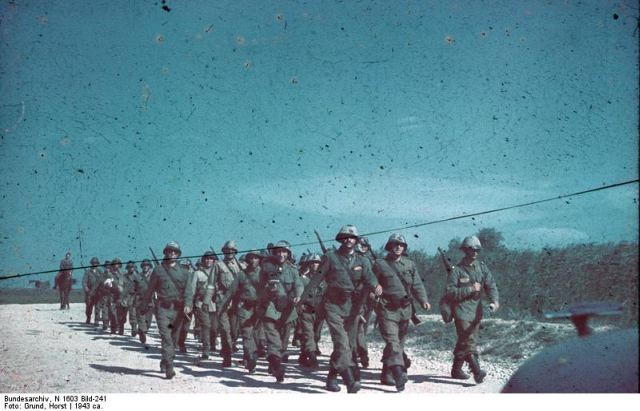
After August 23, 1944, the Soviets disarmed and took as many as 100 thousand Romanian prisoners.
Steliu Lambru, 25.08.2014, 01:04
The number of Romanian prisoners in the Soviet Union after WWII cannot be established exactly. Until August 23rd 1944, when Romania joined the United Nations coalition, almost 165 thousand Romanian soldiers were reported missing, most of them being prisoners. After August 23rd the Soviets disarmed and took as many as 100 thousand Romanian prisoners. According to Soviet official sources, which should be taken with a grain of salt, though, back in 1946 there were 50 thousand Romanian prisoners in the USSR.
The stories of these people, most of whom got lost in the huge Soviet machinery, will probably never be known. Although the Soviet archives are open for consultation, the huge amount of documents makes the task of historians quite difficult. Romanian historians are trying to find out as much as possible. One of them, Vitalie Văratec, is the author of the book “Romanian Prisoners of War in the Soviet Union. Documents 1941-1956”. He told us about the difficulties he encountered when consulting the archives in Moscow.
Vitalie Văratec: “Today we are not able to establish the exact number of Romanian prisoners. The documents of that period use such phrases as ‘people reported missing’. No one knows what happened to these people, how they disappeared, maybe they fell into a river or died when pushing through a barricade. One of the colleagues who worked with me on the book tried to make a list of people who died in the battle in Ţiganca village, and concluded that no one can establish for certain how many people died, how many were made prisoner and how many disappeared. They are listed as ‘missing people’ because no one knows what happened to them. And I’m talking about the soldiers who fought on the Prut River, not to mention those who fought on the Don River bend sector, on the Dnieper or in Stalingrad”.
The status of the Romanian and other prisoners was interpreted according to the Soviet reading of the international law regarding the people captured in battles and conflicts:
Vitalie Văratec: “The POWs in the Soviet Union had a different status, generally in line with the one established under the 1929 Geneva Convention. But there were also many differences, given that the Soviet Union promoted at political, official level the principle of class conflict and officers were subject to a different treatment. The Soviet Union also had different views on using prisoners of war as labour force. Although the Geneva Convention established that prisoners could not be used in the military industry or in whatever was related to the army’s interests, the Soviet Union disregarded it. Actually, the same happened in Nazi Germany.”
The toughest conditions in labour camps had to do with the food. According to Vitalie Varatec, despite the tremendous amount of ideological pressure, Soviet physicians stated that the way prisoners were treated was below any acceptable standard.
Vitalie Văratec: “A great number of prisoners died of starvation. Russian historians gave a lot of attention to the issue. A researcher based in Volgograd, Dr Sidorov, even published a comprehensive volume focusing on the progress of the food ration given to prisoners during the war. He revealed that the decisions taken in the second half of 1942 claimed the lives of thousands of people. The struggling economy left the Soviet state with no choice but purchase huge amounts of grains from the USA, so they could not provide the minimum ration for the prisoners. And as the number of POWs had grown dramatically after the Stalingrad and the Don River Bend battles, in the first months of 1943, an official medical examination was even requested. Despite that regime, which relied on fear of the proletarian anger, there were Soviet physicians who said that the official food rations could not provide for a normal life. According to their calculations, the number of calories prisoners received only ensured their survival if they made no effort whatsoever. And they were certainly not enough for people taken to work.”
The prisoners in Soviet camps were leading a horrible life. But in spite of the gloomy prospects, people continued to hope:
Vitalie Văratec: “I’ve come across statistical data on the number of dead, sick or ailing prisoners. There are also interesting data indicating the number of escapes. Apart from the names of the prisoners who managed to escape, there are also data about those who got caught. Some 3.2% of those who escaped got caught. Most of those who managed to escape were Romanians. I wondered why this was the case. An Italian researcher is trying to find an answer to this issue and speaks of a so-called Romanian mafia along the prisoners of war in the USSR. It is true that a first big group of over 30,000 prisoners, was made up of Romanians who had fought in Stalingrad. I’ve also found testimonies by civilians. An old woman said that in the morning, when she passed by the camp, on her way to school, she stopped near the barbed wire and looked at the prisoners who were standing in line. The Romanians were making the sign of the cross, and the Germans were pointing fingers at them and giggling. Then, I realized that the Romanians adjusted better than others to those harsh conditions, maybe thanks to the Orthodox spirit. Based on this principle, they found more understanding.”
The generation of the Romanian prisoners experienced one of the most violent changes imposed on the Romanian society by the communist regime, against the backdrop of a humanitarian crisis cased by war. The suffering of Romanian prisoners and the losses that Romania suffered in the USSR, have never been compensated.